
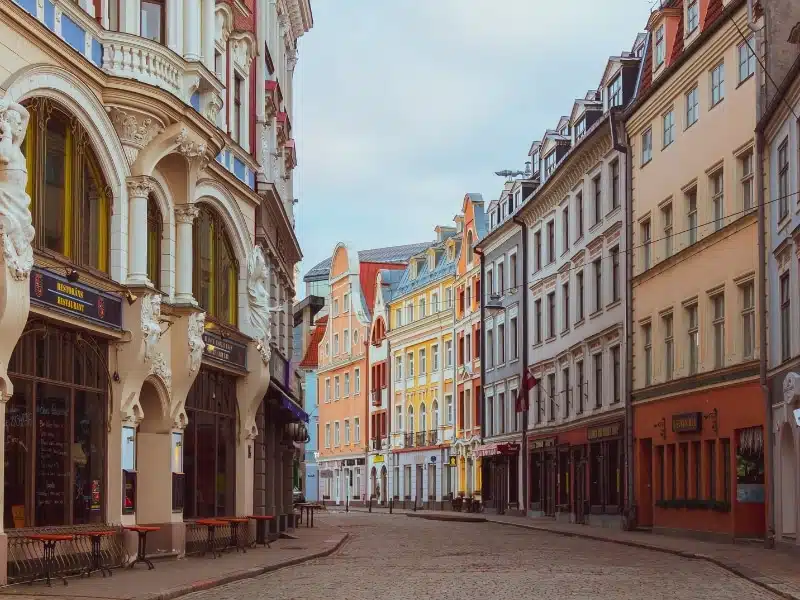
Riga, the capital of Latvia, was founded in 1201 and grew rich as a Hanseatic port on the Daugava. It has two faces: a medieval Old Town of guild halls, merchants' houses and church spires, and a newer centre lined with some of the most elaborate Art Nouveau facades in Europe. Here are the facts and stories that make the city special.
10 spannende Fakten über Riga
- Von einem Bischof gegründet: Bischof Albert von Buxhoeveden gründete Riga 1201 als Stützpunkt für die Kreuzzüge im östlichen Baltikum.
- Anspruch auf den ersten Weihnachtsbaum: Riga zufolge stellte hier 1510 die Bruderschaft der Schwarzhäupter, eine Gilde unverheirateter Kaufleute, den ersten geschmückten Weihnachtsbaum auf. Eine Gedenkplatte auf dem Rathausplatz markiert die Stelle, auch wenn Tallinn Ähnliches für sich beansprucht.
- Ein Gildenhaus, ganz neu errichtet: Das Schwarzhäupterhaus am Rathausplatz geht auf das Jahr 1334 zurück. 1941 wurde es zerbombt, und 1948 ließen die sowjetischen Behörden die Ruine abtragen. Das Gebäude, das du heute siehst, ist eine Rekonstruktion, die 1999 eröffnet wurde.
- Three brothers in a row: the Three Brothers on Mazā Pils iela are three adjoining houses, the oldest from the 15th century. Side by side they show how Riga's homes changed over the centuries, and today they house the Latvian Museum of Architecture.
- Cats with their tails turned: two black cats with arched backs sit on the turrets of the Cat House, built in 1909 on Līvu Square. Legend says the owner, refused entry to the Great Guild, turned the cats' tails towards the guild hall across the street.
- Ein Markt in Zeppelinhallen: Der Zentralmarkt von Riga wurde 1930 in fünf Pavillons eröffnet, deren Stahlgerüste von deutschen Zeppelinhallen aus dem Ersten Weltkrieg in Vaiņode im Westen Lettlands stammen.
- Roosters on the spires: the main church spires of the Old Town are topped with weathercocks. The spire of St Peter's Church burned in 1941, was rebuilt in steel after the war and now has a lift up to a viewing platform.
- A monument that outlasted the Soviet era: the Freedom Monument was unveiled on 18 November 1935, Latvia's Independence Day. Paid for by public donations, it is 42 metres tall and topped by a copper figure of Liberty, nicknamed Milda, holding up three gold stars.
- Eine Uhr mit Schokoladennamen: Die Laima-Uhr am Rand der Altstadt wurde 1924 fertiggestellt und trägt seit 1936 den Namen des Süßwarenherstellers Laima.
- A song festival since 1873: Latvia's first Song Festival was held in Riga in 1873. The Baltic song and dance celebrations are on UNESCO's intangible heritage list, and the festival still brings tens of thousands of singers and dancers to the city.
The legend of 'Is Riga finished?'
Riga's best-known legend comes from the river. Once every hundred years, it says, a spirit rises from the Daugava at night and asks the first person it meets: 'Is Riga finished yet?' If the answer is ever yes, the whole city will sink into the water. So the answer must always be no, and Riga must never stop building.
Jugendstil und Museumsviertel
Around 1900 Riga was booming, and roughly a third of the buildings in today's centre went up in the Art Nouveau style. The most theatrical facades, with carved faces and masks, are on Alberta iela, several of them by Mikhail Eisenstein, father of the film director Sergei Eisenstein. Nearby stands the Latvian National Museum of Art, built in 1903–1905 as the first purpose-built museum in the Baltics.
Was man in Riga essen sollte
- Graue Erbsen mit Speck: pelēkie zirņi ar speķi, ein deftiges Gericht aus Erbsen, gebraten mit Speck und Zwiebeln, oft mit einem Glas Kefir serviert.
- Roggenbrot: Das dunkle, dichte und leicht süße Rupjmaize gibt es zu fast jeder Mahlzeit, und es taucht sogar in Desserts auf, geschichtet mit Sahne und Beeren.
- Pīrāgi: kleine gebackene Brötchen mit einer Füllung aus gehacktem Speck und Zwiebeln, erhältlich in Bäckereien und auf dem Zentralmarkt.
- Sklandrausis: ein kleiner offener Kuchen aus Roggenteig, gefüllt mit Kartoffelpüree und süßen Karotten und mit Zimt gewürzt.
- Rigaer Schwarzer Balsam: ein dunkler Kräuterlikör, dessen Rezept auf das Jahr 1752 und den Rigaer Apotheker Abraham Kunze zurückgeht.
Gut zu wissen vor dem Besuch
- Auf dem Zentralmarkt ist morgens am meisten los und die Auswahl am größten.
- Jūrmala's long sandy beach is a short train ride from Riga, an easy half-day trip in summer.
- For a view over the Old Town's roofs and the Daugava, take the lift up the tower of St Peter's Church.
- Midsummer, Jāņi, on 23 and 24 June, is Latvia's biggest holiday. Many people leave the city, and some shops and restaurants close.
Riga mit World City Trail entdecken
Unsere Schnitzeljagd in Riga macht aus diesen Sehenswürdigkeiten ein Spiel auf deinem Handy. Die Route verbindet 10 Stationen und dauert etwa drei Stunden, davon rund 40 Minuten zu Fuß, unter anderem mit dem Lettischen Nationalen Kunstmuseum, dem Freiheitsdenkmal und der Laima-Uhr.
An jeder Station löst du ein Rätsel und hörst eine kurze Geschichte, in deinem eigenen Tempo. Du kannst starten, wann du willst.
Die Schnitzeljagd in Riga spielen →
Fakten geprüft im Oktober 2026.