
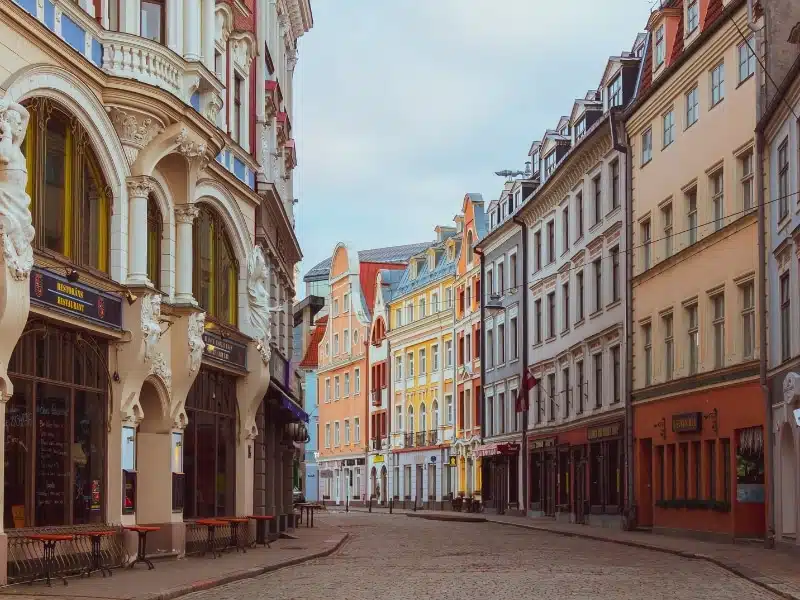
Riga, the capital of Latvia, was founded in 1201 and grew rich as a Hanseatic port on the Daugava. It has two faces: a medieval Old Town of guild halls, merchants' houses and church spires, and a newer centre lined with some of the most elaborate Art Nouveau facades in Europe. Here are the facts and stories that make the city special.
10 anecdotes sur Riga
- Fondée par un évêque : l’évêque Albert de Buxhoeveden a fondé Riga en 1201 comme base pour les croisades dans l’est de la Baltique.
- Le premier sapin de Noël ? Riga affirme que le premier sapin de Noël décoré y fut dressé en 1510 par la confrérie des Têtes noires, une guilde de marchands célibataires. Une plaque sur la place de l’Hôtel de ville marque l’endroit, même si Tallinn revendique le même honneur.
- Une maison de guilde rebâtie de zéro : la Maison des Têtes noires, sur la place de l’Hôtel de ville, remonte à 1334. Elle a été réduite en ruines par les bombardements en 1941, et les autorités soviétiques en ont fait déblayer les restes en 1948. Le bâtiment que vous voyez aujourd’hui est une reconstruction inaugurée en 1999.
- Three brothers in a row: the Three Brothers on Mazā Pils iela are three adjoining houses, the oldest from the 15th century. Side by side they show how Riga's homes changed over the centuries, and today they house the Latvian Museum of Architecture.
- Cats with their tails turned: two black cats with arched backs sit on the turrets of the Cat House, built in 1909 on Līvu Square. Legend says the owner, refused entry to the Great Guild, turned the cats' tails towards the guild hall across the street.
- Un marché dans des hangars à zeppelins : le marché central de Riga a ouvert en 1930 dans cinq pavillons dont les structures en acier proviennent de hangars à zeppelins allemands de la Première Guerre mondiale, à Vaiņode, dans l’ouest de la Lettonie.
- Roosters on the spires: the main church spires of the Old Town are topped with weathercocks. The spire of St Peter's Church burned in 1941, was rebuilt in steel after the war and now has a lift up to a viewing platform.
- A monument that outlasted the Soviet era: the Freedom Monument was unveiled on 18 November 1935, Latvia's Independence Day. Paid for by public donations, it is 42 metres tall and topped by a copper figure of Liberty, nicknamed Milda, holding up three gold stars.
- Une horloge au nom de chocolat : l’horloge Laima, en bordure de la vieille ville, a été achevée en 1924 et porte depuis 1936 le nom du confiseur Laima.
- A song festival since 1873: Latvia's first Song Festival was held in Riga in 1873. The Baltic song and dance celebrations are on UNESCO's intangible heritage list, and the festival still brings tens of thousands of singers and dancers to the city.
The legend of 'Is Riga finished?'
Riga's best-known legend comes from the river. Once every hundred years, it says, a spirit rises from the Daugava at night and asks the first person it meets: 'Is Riga finished yet?' If the answer is ever yes, the whole city will sink into the water. So the answer must always be no, and Riga must never stop building.
L’Art nouveau et le quartier des musées
Around 1900 Riga was booming, and roughly a third of the buildings in today's centre went up in the Art Nouveau style. The most theatrical facades, with carved faces and masks, are on Alberta iela, several of them by Mikhail Eisenstein, father of the film director Sergei Eisenstein. Nearby stands the Latvian National Museum of Art, built in 1903–1905 as the first purpose-built museum in the Baltics.
Que manger à Riga
- Pois gris au lard : pelēkie zirņi ar speķi, un plat copieux de pois poêlés avec du lard et de l’oignon, souvent servi avec un verre de kéfir.
- Pain de seigle : le rupjmaize, sombre, dense et légèrement sucré, accompagne presque chaque repas et se retrouve même dans des desserts, en couches avec de la crème et des baies.
- Pīrāgi : de petits pains cuits au four, farcis de lard haché et d’oignon, vendus dans les boulangeries et au marché central.
- Sklandrausis : une petite tarte ouverte à pâte de seigle, garnie de purée de pommes de terre et de carottes sucrées, parfumée à la cannelle.
- Baume noir de Riga : une liqueur sombre aux herbes dont la recette remonte à 1752 et au pharmacien de Riga Abraham Kunze.
Bon à savoir avant de partir
- Le marché central est le plus animé et le mieux achalandé le matin.
- Jūrmala's long sandy beach is a short train ride from Riga, an easy half-day trip in summer.
- For a view over the Old Town's roofs and the Daugava, take the lift up the tower of St Peter's Church.
- Midsummer, Jāņi, on 23 and 24 June, is Latvia's biggest holiday. Many people leave the city, and some shops and restaurants close.
Découvrir Riga avec World City Trail
Notre chasse au trésor à Riga transforme ces lieux en un jeu sur votre téléphone. Le parcours relie 10 étapes et dure environ trois heures, dont une quarantaine de minutes de marche, avec notamment le Musée national letton des beaux-arts, le monument de la Liberté et l’horloge Laima.
À chaque étape, vous résolvez une énigme et écoutez une courte histoire, à votre rythme. Vous pouvez commencer quand vous voulez.
Jouer à la chasse au trésor de Riga →
Faits vérifiés en octobre 2026.