What is the Milan outdoor escape game?
The Milan outdoor escape game is an escape room with the roof removed: the puzzles sit out at the city's landmarks, you solve them on your phone, and what you need is attention rather than knowledge. Allow about 2 hours, of which 53 minutes are spent walking 4.3 km between 10 stops, and open the game on any day you like.
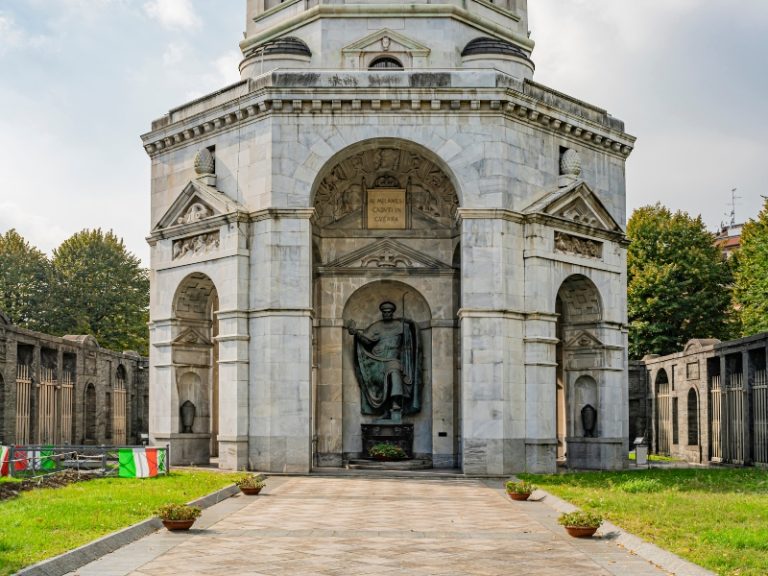
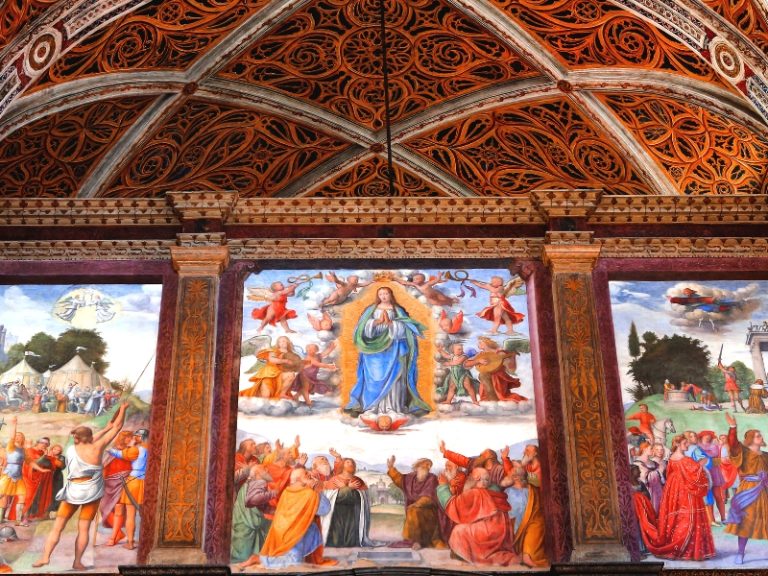
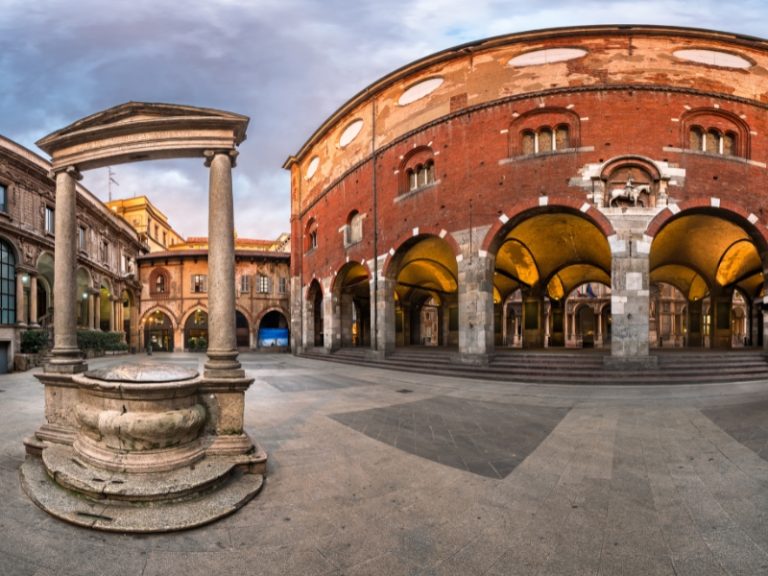
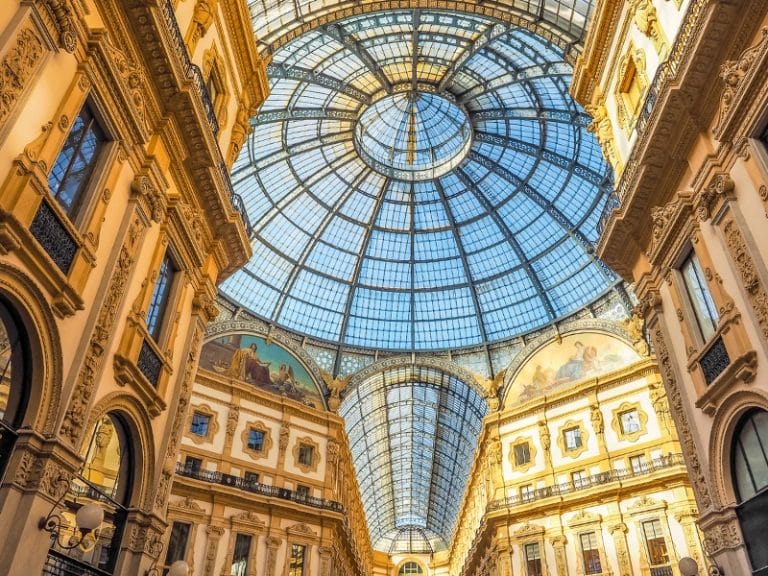
The puzzles are planted at Castello Sforzesco, Santa Maria delle Grazie, the neo-medieval Castello Cova, the Basilica of Sant'Ambrogio with the Temple of Victory beside it, the frescoed San Maurizio, medieval Piazza dei Mercanti, the Duomo, the Galleria Vittorio Emanuele II and Teatro alla Scala. None of them belongs to a storyline, so each is its own small problem, and three levels of hints are available. Milan keeps its centre flat and close-knit, so the walk from one puzzle to the next is short.
- Durationabout 2 hours
- Walkingabout 53 min · 4.3 km
- Stops10
- LanguagesEnglish, German, French, Italian, Spanish, Dutch, Polish
What you do on the escape game
Solve
One puzzle per landmark, worked out by looking around and reasoning. There is nothing to read up on first.
Look closer
The clues hide in marble carvings, floor mosaics, bell towers and the writing over the arches.
Walk
Google Maps joins the stops: 53 minutes of walking in all, across roughly 4.3 km.
Take your time
No clock is running down. Call up a hint when a puzzle resists, break for an aperitivo and finish later or another day.
See the route and attractions →
How it works
- Book online Choose the number of players. Your booking reference arrives by email straight away.
- Get the app Download the World City Trail app from the App Store or Google Play and enter your booking reference.
- Play when you like Start whenever you are ready, walk at your own pace and pause any time. No guide, no fixed schedule.
Who it suits
Friends on a day out
A puzzle at each stop gives the group something to disagree about between the castle and the opera house.
Couples
One challenge shared between two people, solved at exactly the speed you feel like.
Team building
Teams of up to 5 play on their own phones, so an office outing needs little organising.
Good to know
- Bring a charged smartphone with mobile data; a power bank helps.
- Best started in daylight, so you can see the details the puzzles ask about.
- No entry tickets needed: everything happens outside the buildings. Going inside is optional and paid separately.
- Family friendly; children must be accompanied by an adult.
- Not suitable for wheelchair users and difficult with strollers.
- Teams of up to 5 work best; bigger groups split into several teams, one ticket per player.
- Every purchase helps support stray cats and dogs in Greece.
Puzzle route: from Castello Sforzesco to Teatro alla Scala
10 stops · about 53 min walking · start: Sforza Castle (Castello Sforzesco) · finish: Teatro alla Scala
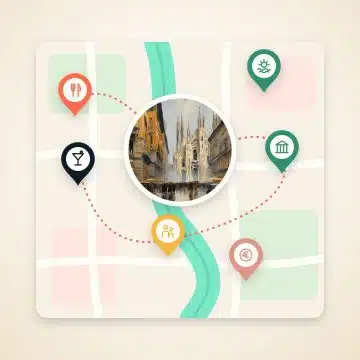
Castello Sforzesco holds the opening puzzle, and Santa Maria delle Grazie and the neo-medieval Castello Cova come soon after. Sant'Ambrogio is next, together with the Temple of Victory standing right beside it, and then the frescoed church of San Maurizio al Monastero Maggiore. Piazza dei Mercanti brings you into medieval Milan, after which the Duomo, the Galleria Vittorio Emanuele II and a final puzzle at Teatro alla Scala close the route. Daylight is the better choice, because every answer is read off the building in front of you and rain slows the walking. Google Maps handles the navigation, the stop order can be changed in the app, and no puzzle needs an entry ticket.
Open the route map ↗
1Sforza Castle (Castello Sforzesco)Start
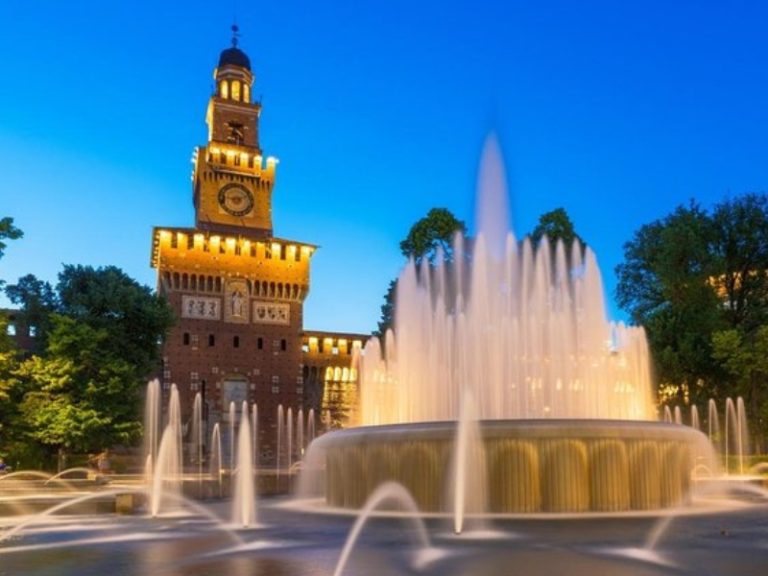
Galeazzo II Visconti built the first castle here in the 14th century, and from 1450 Francesco Sforza turned it into his ducal residence. The tall Filarete Tower above the entrance was rebuilt by Luca Beltrami in 1900–1905, and the castle museums hold Michelangelo's last sculpture, the Rondanini Pietà.
2Santa Maria delle Grazie
Guiniforte Solari began this Dominican church in 1463, and its Renaissance apse and dome are attributed to Donato Bramante. In the refectory of the convent next door Leonardo da Vinci painted The Last Supper in 1495–1498, and church and convent have been a UNESCO World Heritage Site since 1980.
3Castello Cova
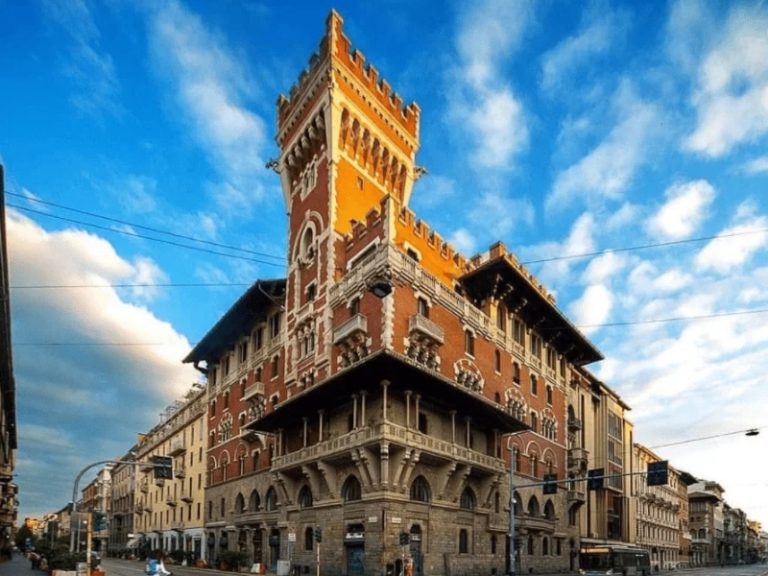
Castello Cova is a private residence on Via Carducci, built in the early 20th century in a neo-medieval style. With its brick walls, battlements and tower it looks like a small medieval castle, although it was built as a home and never served as a fortress.
4Basilica of Sant'Ambrogio
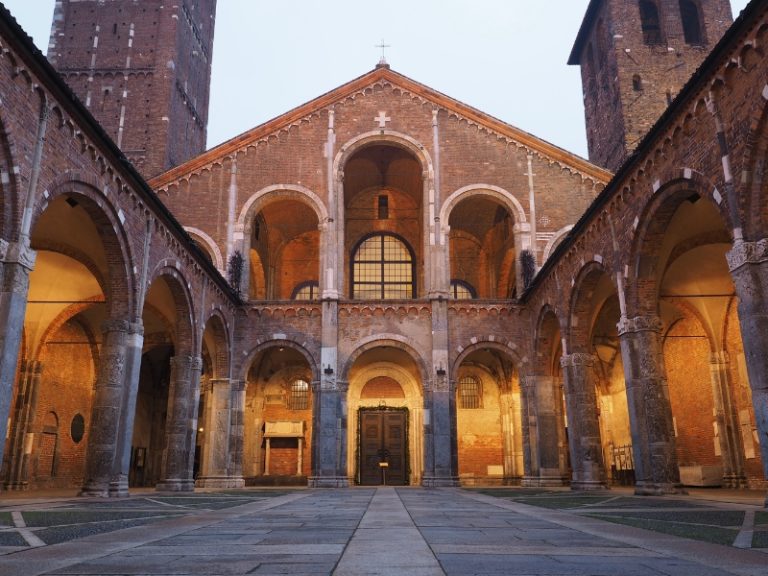
Saint Ambrose, bishop of Milan, founded this basilica in 379–386, and the present Romanesque church dates mostly from the late 11th and 12th centuries. Its two bell towers belonged to the monks and the canons, and according to legend the two holes in the marble column beside the church were made by the Devil's horns.
5Temple of Victory
The Temple of Victory, also known as the Sacrario dei Caduti Milanesi, is Milan's memorial to the soldiers from the city who died in the First World War. The octagonal marble building was completed in the late 1920s and stands right next to the Basilica of Sant'Ambrogio.
6San Maurizio al Monastero Maggiore
This church was begun in 1503 for the most important Benedictine convent in Milan. A wall divides it into a hall for the public and a hall for the nuns, and its walls are covered in 16th-century frescoes, many by Bernardino Luini, which is why it is often called the Sistine Chapel of Milan.
7Piazza dei Mercanti
This square was the centre of medieval Milan. The Palazzo della Ragione, built in 1233, housed the city government, and on its arcade you can spot a relief of the half-woolly sow, linked by legend to the origin of the name Mediolanum, while opposite stands the Loggia degli Osii of 1316.
8Milan Cathedral (Duomo)
The cathedral was begun in 1386 under Gian Galeazzo Visconti, and its façade was only completed in Napoleon's time, in the early 19th century. Built of pale pink Candoglia marble, it is one of the largest Gothic cathedrals in the world, with thousands of statues and the gilded Madonnina on its highest spire.
9Galleria Vittorio Emanuele II
Designed by Giuseppe Mengoni and built from 1865 to 1877, this glass-roofed arcade links Piazza del Duomo with Piazza della Scala, and its two wings meet under a large glass dome. Tradition says that spinning three times on your heel on the bull in the floor mosaic brings good luck.
10Teatro alla ScalaFinish
Milan's opera house opened on 3 August 1778 with Antonio Salieri's Europa riconosciuta, in a neoclassical building by Giuseppe Piermarini. It takes its name from the church of Santa Maria della Scala, which once stood on the site, and in the square in front stands Pietro Magni's monument to Leonardo da Vinci from 1872.
Read the full story →
Only logged in customers who have purchased this product may leave a review.






Britt– United States –
Collected on GetYourGuide
We loved that it was self guided and we could start and stop the tour as we pleased
Spain –
Collected on GetYourGuide
Ha sido una forma original y divertida de descubrir la ciudad. No resolvimos alguno de los enigmas porque las instrucciones no nos quedaron claras pero, en general nos ha gustado y volver?amos a hacer algo as? en otra ciudad seguro 🙂
Elena– Spain –
Collected on GetYourGuide
Se pasa un rato muy intrigante y ameno Lo hicimos en cuatro horas y muy divertido
Italy –
Collected on GetYourGuide
Molto carina