
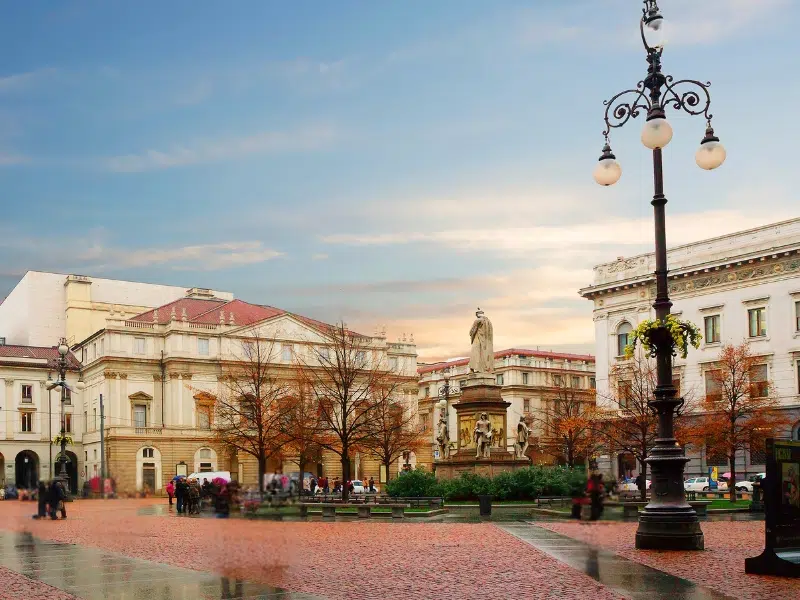
Piazza della Scala is the square between the Galleria Vittorio Emanuele II and Milan's opera house, La Scala. It only appeared in 1858, when the houses crowding the theatre were pulled down, and at its centre stands a marble Leonardo da Vinci surrounded by four of his pupils, a group the Milanese nicknamed un litro in quattro, a litre between four.
Piazza della Scala at a glance
- Where: in central Milan, at the north end of the Galleria Vittorio Emanuele II, a few minutes' walk from Piazza del Duomo.
- Created: 1858, when the houses in front of La Scala were demolished; the Leonardo monument was unveiled in 1872.
- What it is today: a square framed by La Scala, Palazzo Marino (Milan's city hall) and the Gallerie d'Italia art museum.
- Time needed: 15–20 minutes for the square; an hour or more if you visit the La Scala museum or the Gallerie d'Italia.
A square opened up for the opera
On 25 February 1776 a fire destroyed Milan's court theatre, the Teatro Regio Ducale. Its replacement was built on the site of the church of Santa Maria alla Scala, founded in the 14th century by Regina della Scala, wife of Bernabò Visconti, and the new theatre took the church's name. Designed by Giuseppe Piermarini, it opened on 3 August 1778 with Antonio Salieri's L'Europa riconosciuta. For eighty years it faced nothing more than a street lined with modest houses.
In 1858 those houses were demolished to open up a square in front of the theatre, first called Piazza del Teatro. Palazzo Marino, begun in 1557 for the Genoese banker Tommaso Marino to designs by Galeazzo Alessi, had always faced the other way, towards Piazza San Fedele. Between 1888 and 1892 the architect Luca Beltrami gave it a new façade onto the square, and in 1872 Pietro Magni's monument to Leonardo was unveiled in the middle. La Scala was badly damaged by bombing in 1943 and reopened on 11 May 1946 with a concert conducted by Arturo Toscanini; a renovation by Mario Botta followed in 2002–2004.
What to look for
- Leonardo and his pupils: the Carrara marble figure of Leonardo stands on a pink Baveno granite plinth about 7 metres high, with four pupils at the corners: Giovanni Antonio Boltraffio, Marco d'Oggiono, Cesare da Sesto and Salaì, here called Andrea Salaino.
- The reliefs on the plinth: four marble panels show Leonardo as painter, sculptor, architect and engineer.
- La Scala's façade: Piermarini's restrained neoclassical front with a ground-floor portico. From outside it looks surprisingly plain for one of the world's most famous opera houses.
- Palazzo Marino: the city hall on the opposite side of the square, with Beltrami's 19th-century façade in the style of Alessi's original building.
- The Gallerie d'Italia: three palaces on the square, including the former headquarters of the Banca Commerciale Italiana, now an art museum.
A litre between four
Milanese humour soon found a name for Magni's monument. Seen from a distance, the tall Leonardo surrounded by four shorter pupils looks like a wine bottle with four glasses around it, so the group became un litro in quattro, a litre between four. The phrase is credited to the writer Giuseppe Rovani. The square has its own big night too: every 7 December, the feast of St Ambrose, Milan's patron saint, La Scala opens its season, and the square fills with photographers, onlookers and security barriers.
Tips for your visit
- Arrive the classic way: walk from Piazza del Duomo through the Galleria and step out with La Scala straight in front of you.
- The Museo Teatrale alla Scala, inside the theatre building, shows costumes, instruments and portraits, and when there is no rehearsal you can often look into the auditorium from a box.
- Performances sell out early, especially around the December opening, so book well ahead if you want to see an opera.
Nearby
- Galleria Vittorio Emanuele II: the glass-roofed shopping arcade that links the square with Piazza del Duomo; look for the mosaic bull on the floor, where tradition says you spin on your heel for luck.
- Duomo di Milano: the Gothic cathedral, a few minutes' walk through the Galleria, with rooftop terraces among the spires.
- Piazza San Fedele: the small square behind Palazzo Marino, with the 16th-century Jesuit church of San Fedele and a statue of Alessandro Manzoni.
- Casa del Manzoni: the house where the author of The Betrothed lived, a short walk away, now a museum.
See Milan with World City Trail
Our Milan scavenger hunt turns the city centre into a game you play on your phone. The route links 10 stops and takes around 3 hours, with about 53 minutes of walking. It includes the Duomo, the Galleria Vittorio Emanuele II and Sforzesco Castle.
If you prefer a different format, there is also a self-guided walking tour and an outdoor escape game in Milan.
Play the Milan scavenger hunt →
Take the self-guided walking tour of Milan →
Play the outdoor escape game in Milan →
Facts checked in October 2026.