What is the Oxford self-guided walking tour?
The Oxford self-guided walking tour is a self-guided audio walk in the World City Trail app: your phone shows you the way and, at each stop, tells the story of the place you are standing in front of. Allow about 3 hours, of which 42 minutes are on foot, for a 3 km route with 10 stops. Between Norman walls and riverside meadows, the time goes on colleges, libraries and the writers who lived among them.
At the castle the narration tells how Empress Matilda is said to have escaped across the frozen river in 1142, dressed in white against the snow. On Broad Street you hear about the blackboard in the History of Science Museum that Albert Einstein used in a lecture in 1931, and about the stone heads lined up in front of Wren's Sheldonian Theatre. The Bodleian brings the Tower of the Five Orders, with its column types stacked one above another, and at Christ Church you learn why Great Tom rings 101 times every evening and that Lewis Carroll taught mathematics there.
- Durationabout 3 hours
- Walkingabout 42 min · 3 km
- Stops10
- LanguagesEnglish, German, French, Italian, Spanish, Dutch
How the audio walk works
A story at every stop
Each stop has its own narrated chapter with history, local legends and curious facts, and the full text is there if you would rather read.
Directions on your phone
Between stops, Google Maps shows the way; the walking adds up to about 42 minutes over 3 km.
Your own timetable
Nobody waits for you and nothing starts without you. Drop into a café or a museum and resume later or the next day.
Food and shops nearby
The app recommends cafés, restaurants and shops close to the route, and lets you pick a different first stop or reorder the walk.
See the route and attractions →
How it works
- Book online Choose the number of people. Your booking reference arrives by email straight away.
- Get the app Download the World City Trail app from the App Store or Google Play and enter your booking reference.
- Walk when you like Start whenever you are ready, walk at your own pace and pause any time. No guide, no fixed schedule.
Who will get the most out of it
New to Oxford
In a few hours you see the main landmarks of the centre and learn why each one matters.
Not keen on group tours
Nobody holds up a flag and nobody checks the time: linger where something catches your eye and move on when you have seen enough.
Short on time
About 3 hours covers the centre, and the afternoon or evening stays yours.
Good to know
- Bring a charged smartphone with mobile data; a power bank helps.
- No entry tickets needed: everything happens outside the buildings. Going inside is optional and paid separately.
- Family friendly; children must be accompanied by an adult.
- Not suitable for wheelchair users and difficult with strollers.
- Groups of up to 5 work best; larger groups split up, one ticket per person.
- Every purchase helps support stray cats and dogs in Greece.
Castle to meadow: the route stop by stop
10 stops · about 42 min walking · start: Oxford Castle and Prison · finish: Christ Church Meadow
Oxford Castle and Prison, where a castle went up in 1071, is where you set off, and the Covered Market of 1774 is the next stop. The walk then heads north to the Ashmolean on Beaumont Street and back to Broad Street for the History of Science Museum and the Sheldonian Theatre of the University of Oxford. Next come the Bodleian Library and the round Radcliffe Camera, then the Story Museum on Pembroke Street, Christ Church and, to close, the open fields of Christ Church Meadow. You can pick another first stop in the app, and no stop requires an entry ticket.
Open the route map ↗
1Oxford Castle and PrisonStart
Robert D'Oyly built a castle here in 1071 for William the Conqueror, and its mound and St George's Tower still stand. In 1142 Empress Matilda is said to have escaped the besieged castle across the frozen river, dressed in white against the snow. The site was used as a prison until 1996.
2Covered Market
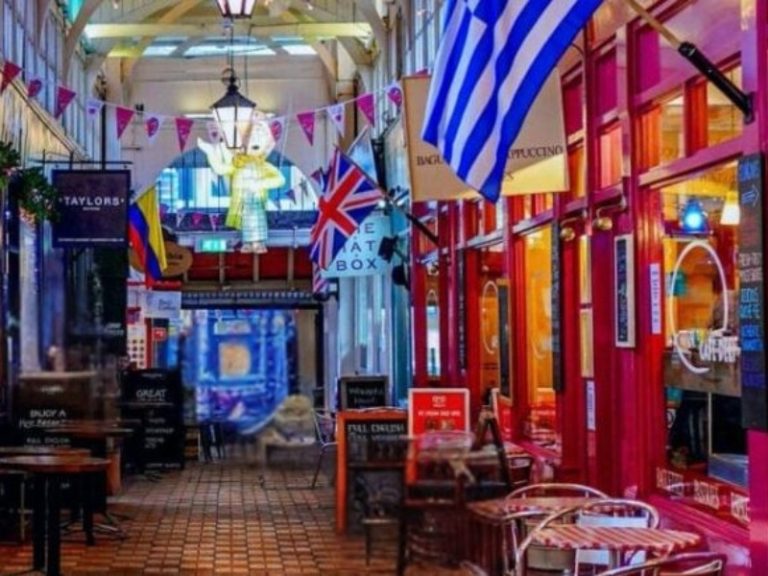
The Covered Market opened in 1774, when the city moved untidy street stalls off the main streets into one building between High Street and Market Street. Its long, roofed avenues are still lined with small independent traders, from butchers and bakers to cafés.
3Ashmolean Museum
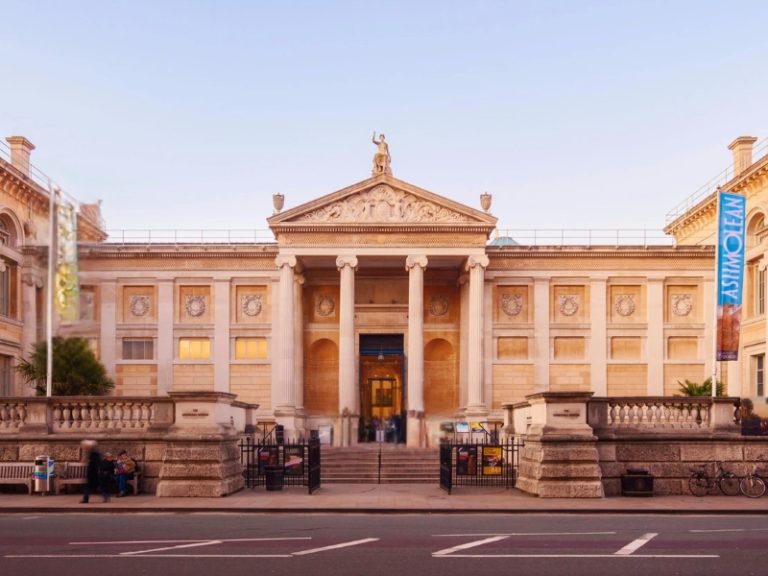
Founded in 1683 around the collection that Elias Ashmole gave to the university, the Ashmolean is often called Britain's first public museum. Its present neoclassical building on Beaumont Street, designed by Charles Robert Cockerell, opened in 1845. The collections range from ancient Egyptian objects to European paintings.
4History of Science Museum
This building on Broad Street was completed in 1683 for the original Ashmolean Museum and is considered the oldest surviving purpose-built museum building in the world. Today it displays scientific instruments such as astrolabes and early clocks, as well as a blackboard used by Albert Einstein in a lecture in 1931.
5University of Oxford
Teaching took place in Oxford by 1096, which makes it the oldest university in the English-speaking world. On Broad Street stands the Sheldonian Theatre, designed by Christopher Wren and completed in 1669, where degree ceremonies are held. Look for the large carved stone heads on the pillars in front of it.
Read the full story →
6Bodleian Library
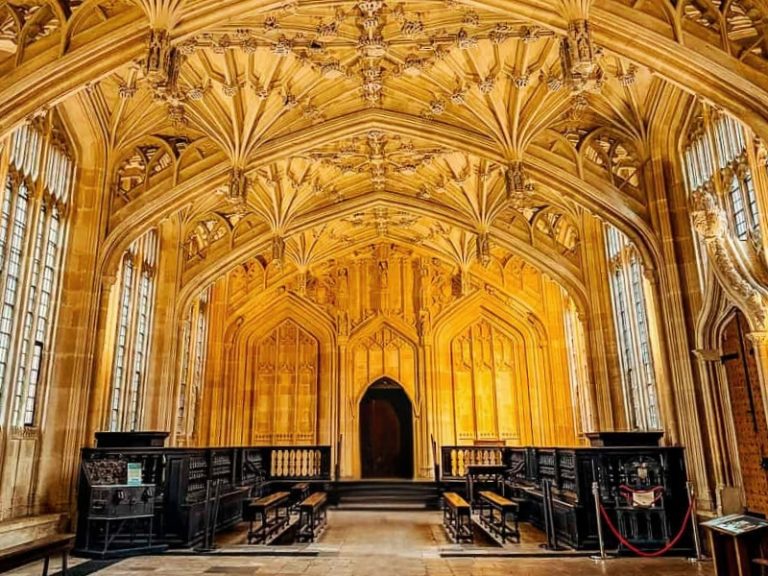
Sir Thomas Bodley refounded the university library, which reopened in 1602 and still bears his name. The Old Schools Quadrangle is entered beneath the Tower of the Five Orders, which shows the five classical types of column stacked one above the other. Since an agreement of 1610, the library has collected books published in England.
7Radcliffe Camera
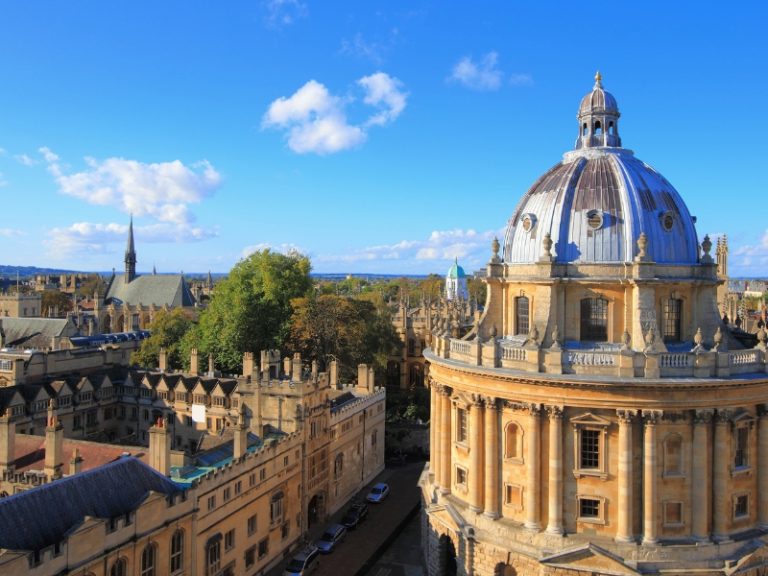
Paid for by a bequest from the royal physician John Radcliffe, this round, domed library was designed by James Gibbs and completed in 1749. It stands in the middle of Radcliffe Square, surrounded by colleges and the University Church, and today serves as a reading room of the Bodleian Library.
Read the full story →
8The Story Museum
The Story Museum on Pembroke Street is devoted to stories and storytelling for children and families. It suits Oxford well, a city linked with authors such as Lewis Carroll, Tolkien and Philip Pullman, whose books were written or set here.
9Christ Church
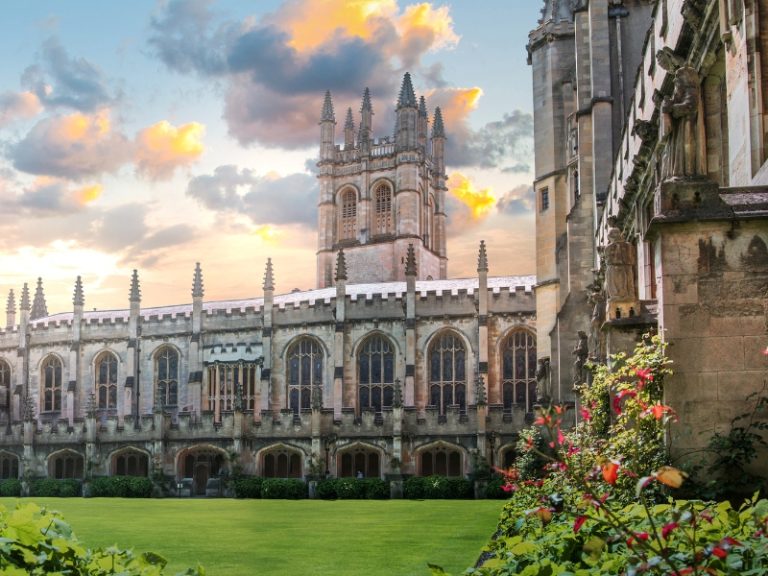
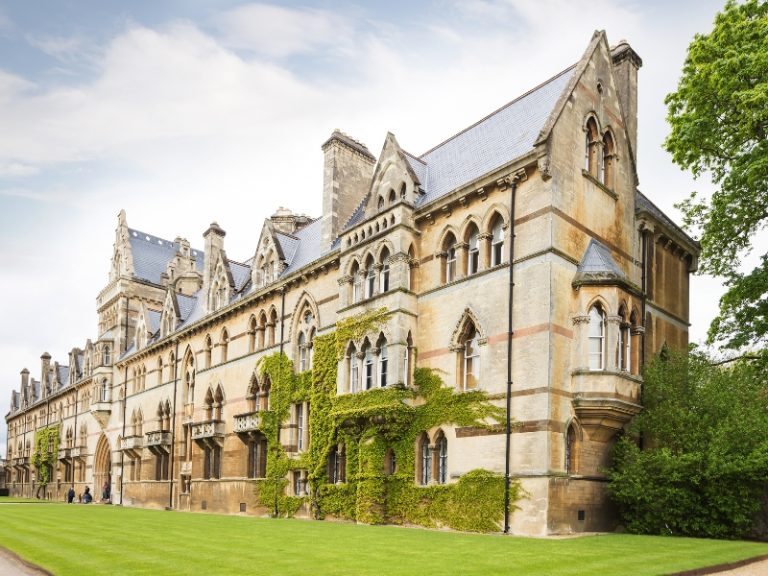
Cardinal Wolsey founded this college in 1525, and Henry VIII refounded it in 1546 as Christ Church, with its chapel serving as Oxford's cathedral. Christopher Wren designed Tom Tower above the main gate, and its bell, Great Tom, rings 101 times every evening. Lewis Carroll taught mathematics here.
Read the full story →
10Christ Church MeadowFinish
This wide stretch of open meadow belongs to Christ Church and lies between the Thames and the river Cherwell. Its paths offer views back to the towers of Christ Church and Merton College, and cattle often graze in the fields, a rural scene a few minutes from the city centre.
Only logged in customers who have purchased this product may leave a review.







Reviews
There are no reviews yet.