
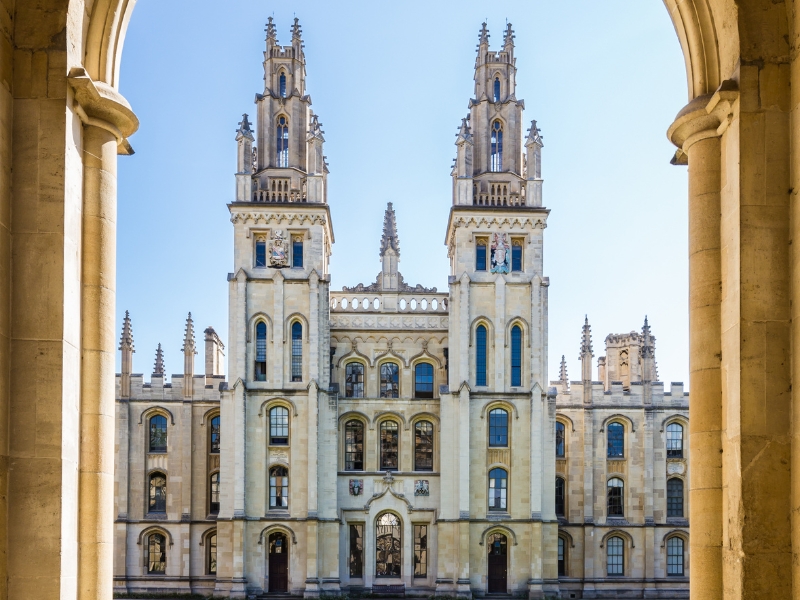
The University of Oxford has no single campus. Its colleges, libraries, museums and departments are spread across the centre of the city, so walking through Oxford means walking through the university. There is evidence of teaching here as early as 1096, which makes it the oldest university in the English-speaking world, and many of the buildings you pass on an ordinary street are still used every day by students and scholars.
The University of Oxford at a glance
- Where: throughout central Oxford, with its historic core around Radcliffe Square, Broad Street and the High Street.
- Founded: no exact date is known; teaching took place in Oxford by 1096, and the university grew quickly from 1167.
- What it is today: a collegiate university of more than 40 colleges and halls, each a self-governing community, plus the university's own departments, libraries and museums.
- Time needed: half a day to see the main buildings from outside; a full day if you add a college visit and a museum.
From scattered halls to self-governing colleges
Nobody knows exactly when the university began. It grew in the 12th century, and especially after 1167, when King Henry II banned English students from going to the University of Paris and many scholars settled in Oxford instead. The head of the university was called chancellor from at least 1214, and a royal charter followed in 1248. Relations with the town were often violent: after clashes in 1209, a group of scholars left Oxford for Cambridge, where they went on to form the University of Cambridge.
At first, students lodged in halls and religious houses. Then private founders began to set up colleges as self-contained communities: William of Durham endowed University College in 1249, Balliol College carries the name of its founder John Balliol, and the rules Walter de Merton wrote for Merton College became the model for colleges at Oxford and Cambridge. During the English Civil War the university backed the king, while the town supported Parliament. In the 1650s a group of scientists meeting at Wadham College, including Christopher Wren and Robert Boyle, formed the nucleus of what became the Royal Society.
What to look for
- The Radcliffe Camera on Radcliffe Square: the round, domed library designed by James Gibbs and built in 1737–1749, used as a reading room of the Bodleian Library since 1861.
- The Bodleian Library, reopened by Sir Thomas Bodley in 1602, and inside it the 15th-century Divinity School, with a stone vaulted ceiling designed by William Orchard in the 1480s.
- The Sheldonian Theatre on Broad Street, designed by Christopher Wren and built in 1664–1669 for the university's ceremonies, including graduations.
- The Bridge of Sighs, a covered bridge completed in 1914 to a design by Sir Thomas Jackson, linking the two parts of Hertford College across New College Lane.
- Tom Tower at Christ Church, the gate tower Christopher Wren designed in 1681–1682, which houses the great bell, Great Tom.
Oxford time and other odd traditions
Every night at five past nine, Great Tom in Tom Tower is struck 101 times. In old Oxford time, which ran five minutes behind Greenwich, that was nine o'clock, and the bell was once the signal for all the colleges to lock their gates. The number stands for Christ Church's 100 original scholars, plus one more added in 1663. Oxford's statutes kept other medieval habits for a long time too: until a review in 1827, students had to swear an oath of enmity against Henry Symeonis, a townsman found guilty of murdering a student in the 13th century.
Tips for your visit
- Colleges are working communities: many open to visitors only at certain times, some charge for entry, and some close around exams, so check each college's own website before you go.
- For the best view over Radcliffe Square and the domes and spires around it, climb the tower of the University Church of St Mary the Virgin on the High Street.
- Keep off the lawns in the college quadrangles unless a sign says otherwise, and keep your voice down in libraries and chapels.
- Be on St Aldate's just after 9 p.m. to hear Great Tom ring out its 101 strokes.
Nearby
- Ashmolean Museum: on Beaumont Street, the world's oldest university museum, with collections of art and archaeology.
- University Church of St Mary the Virgin: on the High Street, with the tower view over Radcliffe Square.
- Covered Market: a short walk from Carfax, a market hall with food stalls, cafés and independent shops.
- Oxford Castle & Prison: on the western edge of the centre, a Norman castle that was later used as a prison until 1996.
See Oxford with World City Trail
Our Oxford scavenger hunt turns the city centre into a game you play on your phone. The route links 10 stops and takes around 3 hours, with about 42 minutes of walking. It includes Oxford Castle & Prison and the Covered Market. You can play in English, German, French, Italian, Spanish or Dutch.
If you prefer a different format, there is also a self-guided walking tour and an outdoor escape game in Oxford.
Play the Oxford scavenger hunt →
Take the self-guided walking tour of Oxford →
Play the outdoor escape game in Oxford →
Facts checked in October 2026.