What is the Paris self-guided walking tour?
The Paris self-guided walking tour runs along the Seine at a pace you set, with audio narration on your phone standing in for the guide. Allow about 3 hours: 77 minutes of that is walking, the route measures 6.2 km, and at 16 stops you stand still and listen. There is no departure time and no group to keep up with.
Above the Trocadéro gardens the narration stops at the Palais de Chaillot, where the United Nations adopted the Universal Declaration of Human Rights on 10 December 1948. At the Pont de l'Alma you meet the Zouave whose shoulders the flood of 1910 reached. Later come Monet's eight Water Lilies panels in the Orangerie, some 91 metres of them, and the 260 striped columns Daniel Buren set in the courtyard of the Palais-Royal in 1986.
- Durationabout 3 hours
- Walkingabout 77 min · 6.2 km
- Stops16
- LanguagesEnglish, German, French, Italian, Spanish, Dutch
What you do on the walking tour
Listen
At every stop the narration gives the history of the place, the legends around it and the details you would otherwise walk past. The same text is on screen for anyone who would rather read.
Follow the river
Google Maps points the way from one stop to the next: 77 minutes on foot and 6.2 km in all, at a pace you set yourself.
Break off
Sit down on a bench in the Tuileries or give an hour to a museum, then take the walk up again, the same day or another one.
Eat and browse
Tips for food and shops near the route come with the stops. The opening stop and the order are yours to change in the app.
See the route and attractions →
How it works
- Book online Choose the number of people. Your booking reference arrives by email straight away.
- Get the app Download the World City Trail app from the App Store or Google Play and enter your booking reference.
- Walk when you like Start whenever you are ready, walk at your own pace and pause any time. No guide, no fixed schedule.
Who the walking tour is for
A first visit to Paris
One walk puts the bridges, palaces and squares of the centre in order and explains what you are standing in front of.
Anyone who avoids groups
No raised umbrella and no roll call: you stay as long as something holds you and move on when you decide to.
A day on foot
3 hours links the Eiffel Tower to the Île de la Cité, which leaves the afternoon for a museum or a long lunch.
Good to know
- Bring a charged smartphone with mobile data; a power bank helps.
- No entry tickets needed: everything happens outside the buildings. Going inside is optional and paid separately.
- Family friendly; children must be accompanied by an adult.
- Not suitable for wheelchair users and difficult with strollers.
- Groups of up to 5 work best; larger groups split up, one ticket per person.
- Every purchase helps support stray cats and dogs in Greece.
The walk stop by stop: the Eiffel Tower, the Grand Palais, the Louvre, Notre-Dame
16 stops · about 77 min walking · start: Eiffel Tower · finish: Notre-Dame Cathedral
The first stop is the Eiffel Tower. The route crosses to the Trocadéro, comes back over the Pont de l'Alma and follows the right bank by way of the Pont Alexandre III to the Petit Palais and the Grand Palais. From Place de la Concorde it takes in the Musée de l'Orangerie, the Tuileries Garden, the Palais-Royal and the Louvre Museum, then the left bank for the Church of Saint-Germain-des-Prés. The Pont Neuf leads onto the Île de la Cité for the Conciergerie and the Sainte-Chapelle, and Notre-Dame Cathedral ends the walk. Another opening stop or another order is set in the app, and no stop needs an entry ticket.
Open the route map ↗
1Eiffel TowerStart
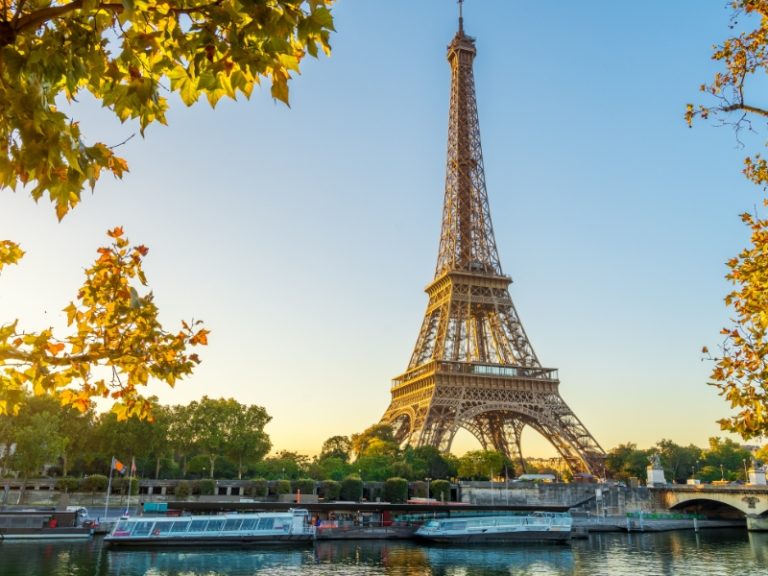
Gustave Eiffel's company built the tower in 1887–1889 as the entrance to the 1889 World's Fair, held for the centenary of the French Revolution. Now 330 metres tall including its antennas, it was the tallest structure in the world until the Chrysler Building in New York overtook it.
2Trocadéro
The square was laid out in 1869 and named after the Battle of Trocadéro, fought in Spain in 1823. Above its gardens rises the Palais de Chaillot, built for the 1937 International Exposition by Louis-Hippolyte Boileau, Jacques Carlu and Léon Azéma on the site of an earlier palace of 1878. Between the two curved wings an esplanade opens the view across the Seine to the Eiffel Tower, and the United Nations adopted the Universal Declaration of Human Rights in the palace on 10 December 1948.
3Pont de l'Alma
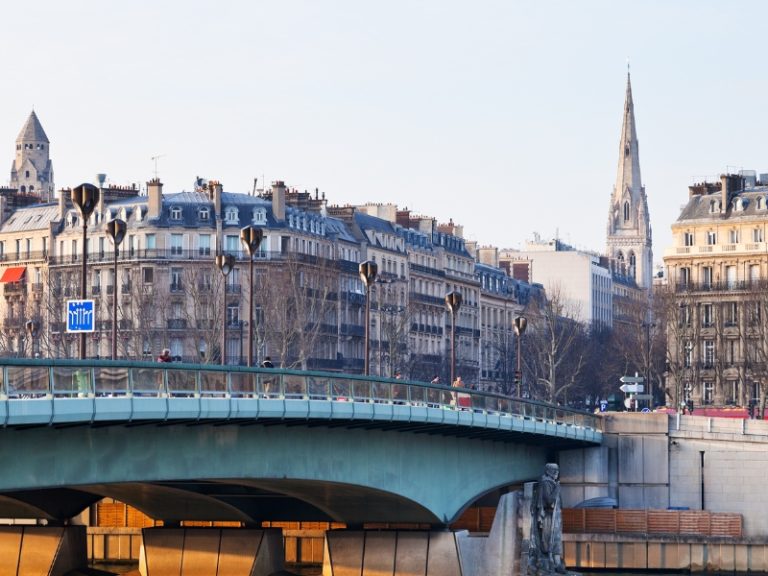
Named after the 1854 Battle of the Alma in the Crimean War, the bridge was opened by Napoleon III in 1856 and rebuilt in 1970–1974. Parisians traditionally judge the level of the Seine by the Zouave soldier statue on its pier: in the great flood of 1910 the water reached his shoulders.
Read the full story →
4Pont Alexandre III
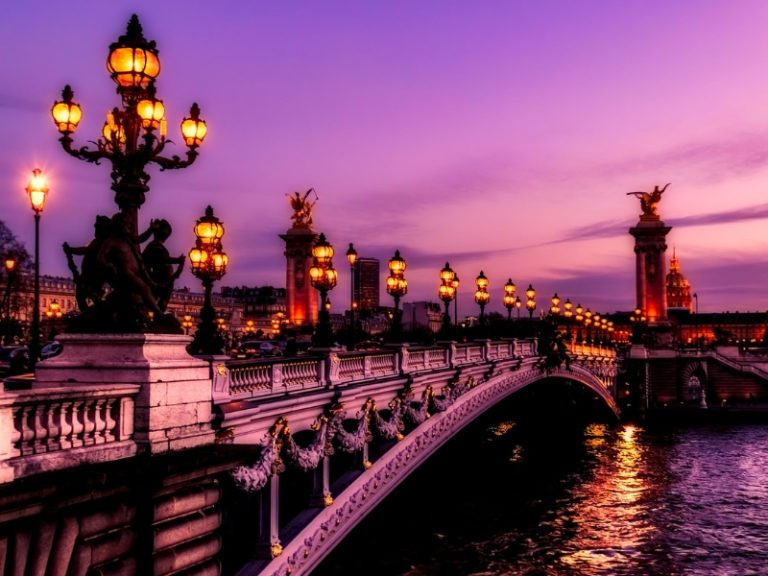
Tsar Nicholas II laid the first stone of this bridge in 1896, and it is named after his father Alexander III as a symbol of the Franco-Russian alliance. Opened for the 1900 World's Fair, it crosses the Seine in a single steel arch, and gilded bronze Fames stand on its four 17-metre pillars.
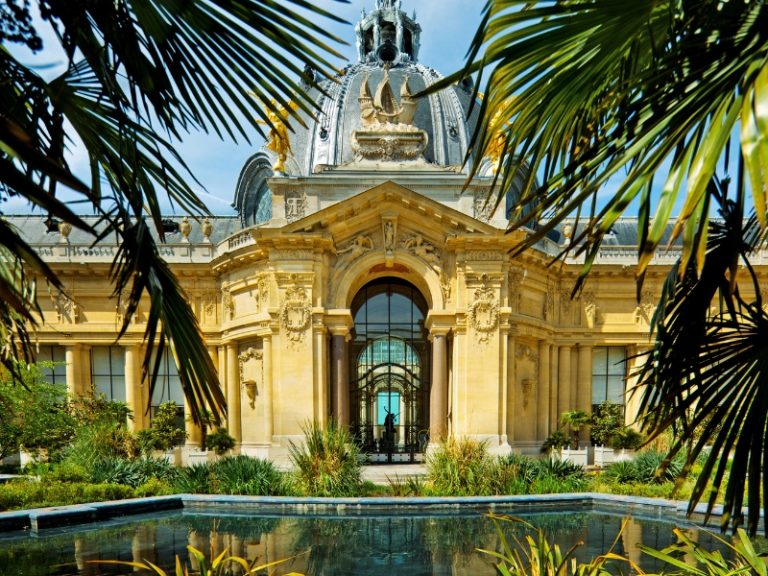
5Petit Palais
Charles Girault designed the Petit Palais for the 1900 World's Fair, with a domed entrance and a semicircular garden courtyard lined with columns. Today it houses the City of Paris Museum of Fine Arts.
6Grand Palais
Henri Deglane, Albert Louvet, Albert Thomas and Charles Girault built the Grand Palais between 1897 and 1900 for the Exposition Universelle, and it opened on 1 May 1900. Its nave of glass and steel is about 200 metres long and rises 45 metres under the central dome, below a glazed roof of roughly 14,000 square metres. Two copper quadrigas by Georges Récipon stand at the corners of the main façade, and the hall held the fencing and taekwondo events of the 2024 Olympic Games.
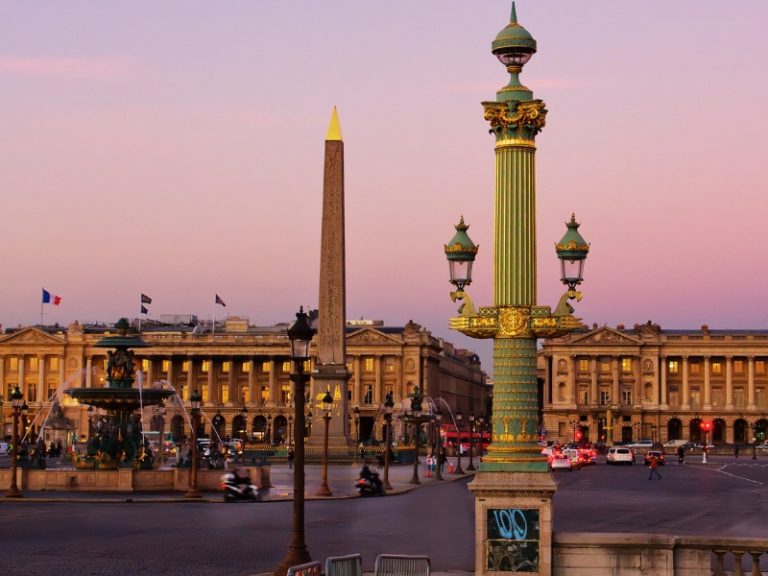
7Place de la Concorde
Laid out by Ange-Jacques Gabriel from 1755 as Place Louis XV, this is the largest square in Paris. During the Revolution Louis XVI and Marie Antoinette were guillotined here in 1793, and in the centre stands the Luxor Obelisk, more than 3,000 years old, erected in 1836.
8Musée de l'Orangerie
Firmin Bourgeois built the Orangerie in 1852 under Napoleon III as a winter shelter for the orange trees of the Tuileries. Monet gave his Water Lilies to the French state in 1922, and the eight panels, some 91 metres in all, line two oval rooms. The museum opened on 17 May 1927, months after his death, and the lower floor holds the Walter-Guillaume collection of Renoir, Cézanne and Picasso.
9Tuileries Garden
Catherine de' Medici laid out the garden in 1564 beside her new Tuileries Palace, on the site of the tile works that gave it its name. André Le Nôtre redesigned it from 1664 in the formal French style, and in 1667 it was the first royal garden in France to open to the public. The palace burned during the Paris Commune of 1871, and the 25-hectare garden now holds sculptures by Maillol and Rodin.
10Palais-Royal
Jacques Lemercier built the palace for Cardinal Richelieu between 1633 and 1639 as the Palais-Cardinal; it passed to Louis XIII on Richelieu's death in 1642 and took its royal name. The Duke of Orléans had Victor Louis ring the garden with arcades of shops and cafés between 1781 and 1784. The Council of State sits here today, and Daniel Buren's Les Deux Plateaux of 1986 fills the main courtyard with 260 striped marble columns.
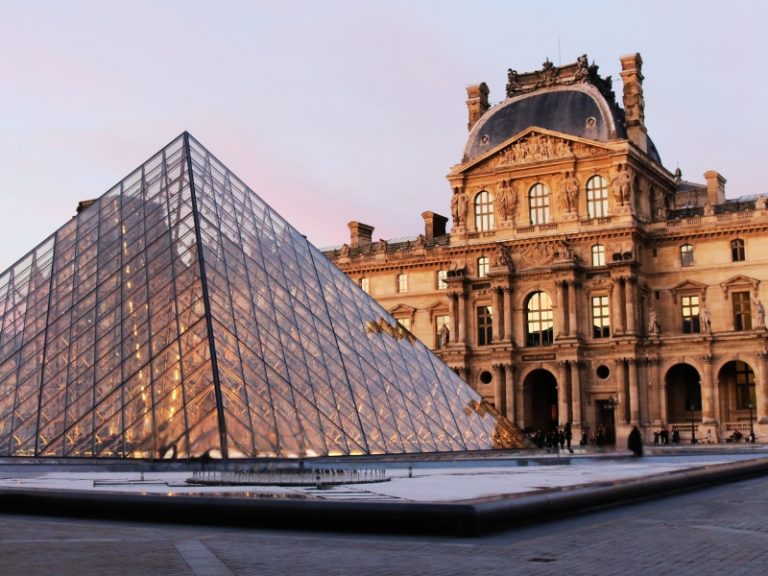
11Louvre Museum
The Louvre began as a fortress built by Philip II Augustus from 1190, became a royal palace and opened as a public museum in 1793. Its glass pyramid by the architect Ieoh Ming Pei opened in 1989, and the collections include Leonardo da Vinci's Mona Lisa.
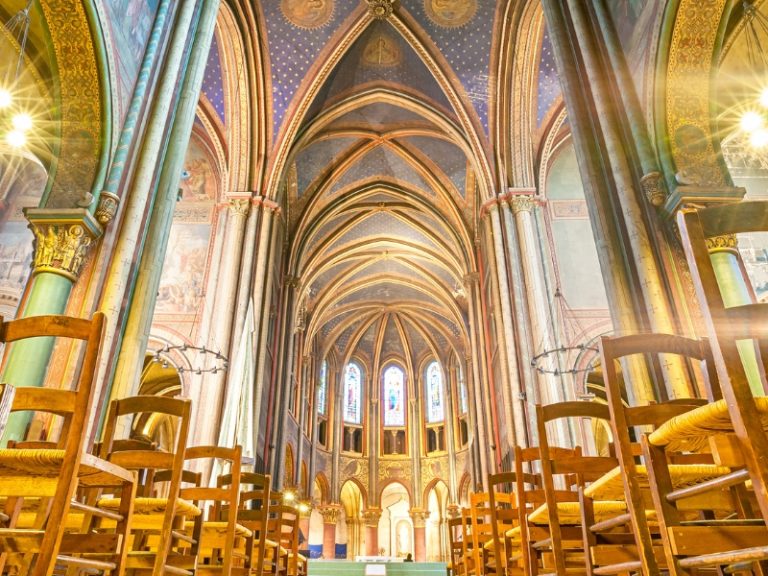
12Church of Saint-Germain-des-Prés
Considered the oldest church in Paris, it belonged to an abbey founded in 558 by the Merovingian king Childebert I. Its bell tower, begun around 990, is one of the oldest in France, and the philosopher René Descartes is buried in a side chapel.
13Pont Neuf
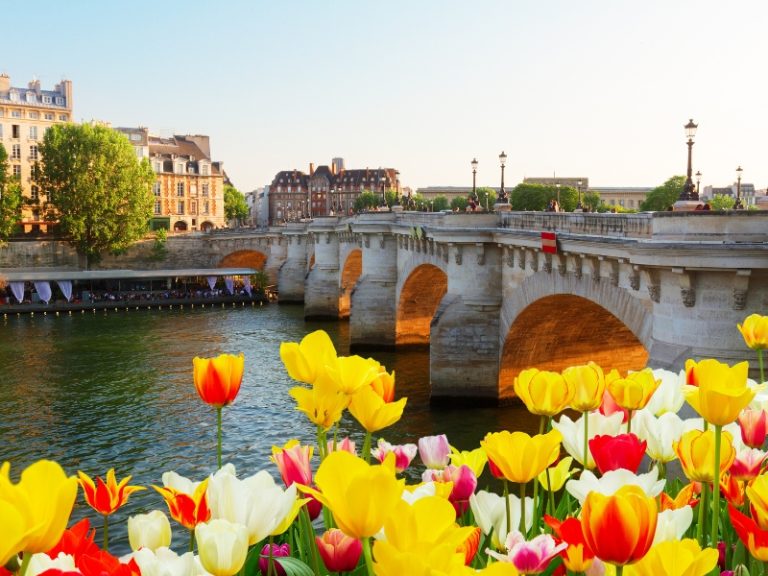
Despite its name, the New Bridge is the oldest standing bridge across the Seine in Paris, begun in 1578 and completed in 1607. It was the first Paris bridge built without houses and with pavements for pedestrians, 381 carved stone masks decorate its sides, and the equestrian statue of Henri IV stands halfway across.
14Conciergerie
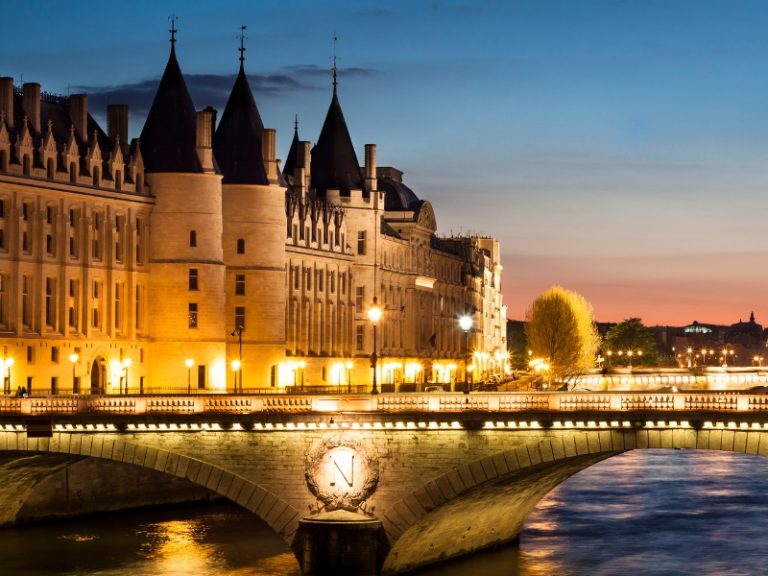
The Conciergerie is part of the Palais de la Cité, the residence of the French kings in the Middle Ages, and during the Revolution it became a prison where Marie Antoinette was held before her execution in 1793. The clock on its corner tower dates back to the 14th century and is considered the oldest public clock in Paris.
15Sainte-Chapelle
Louis IX had the chapel built between 1238 and 1248 to hold relics of the Passion, among them the Crown of Thorns, which he bought from Baldwin II of Constantinople for 135,000 livres. Its fifteen upper windows stand about 15 metres high and carry some 670 square metres of thirteenth-century stained glass. The nine-metre rose window at the west end was added in the late fifteenth century, and the cedar spire rises 33 metres.
16Notre-Dame CathedralFinish
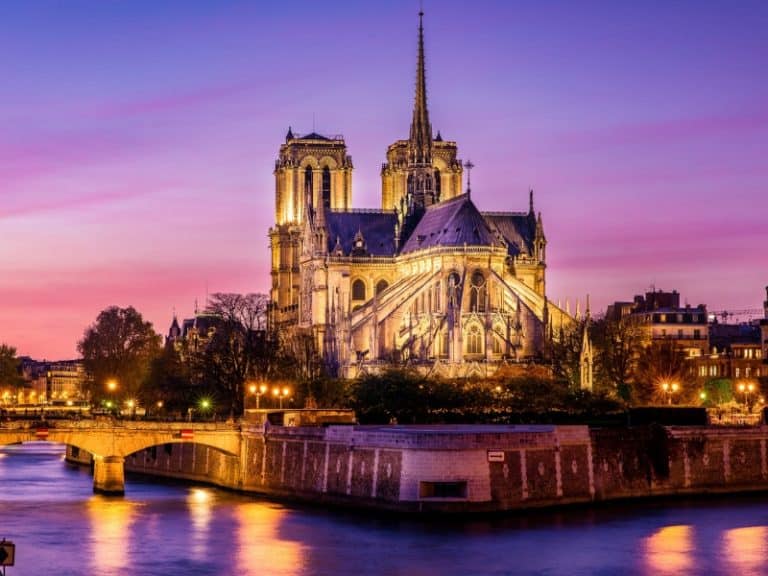
Construction of the Gothic cathedral began in 1163 under Bishop Maurice de Sully. After the fire of April 2019 destroyed its roof and spire, it was restored, with the spire rebuilt to Viollet-le-Duc's 19th-century design, and it reopened in December 2024.
Only logged in customers who have purchased this product may leave a review.



Reviews
There are no reviews yet.