What is the Pisa outdoor escape game?
The Pisa outdoor escape game is an escape room taken out onto the streets: you play on your phone, and at each of the 10 stops a puzzle waits that you solve by studying the surroundings and thinking it through. Set aside about 2 hours, of which 35 minutes are spent walking across 2.8 km.
Puzzles sit beside Keith Haring's Tuttomondo mural, the Gothic church of Santa Maria della Spina on the Arno, Vasari's Palazzo della Carovana, the Galileo statue and the monuments of the Piazza dei Miracoli. Pisa suits this format because its centre is flat and compact, so the walk from one puzzle to the next stays easy. Stuck? Three tiers of help at most wait behind every puzzle.
- Durationabout 2 hours
- Walkingabout 35 min · 2.8 km
- Stops10
- LanguagesEnglish, German, French, Italian, Spanish, Dutch
What you do on the escape game
Solve
At each stop, work out the puzzle from what you see around you. No prior knowledge is required, only observation and logic.
Look closer
The clues are in the details of façades, sculptures and squares, so keep your eyes on the monument in front of you.
Walk
Google Maps leads you from puzzle to puzzle: about 35 minutes of walking across 2.8 km in total.
Take your time
No countdown runs. Use a hint when you need one, take a coffee break, and resume later or on another day.
See the route and attractions →
How it works
- Book online Choose the number of players. Your booking reference arrives by email straight away.
- Get the app Download the World City Trail app from the App Store or Google Play and enter your booking reference.
- Play when you like Start whenever you are ready, walk at your own pace and pause any time. No guide, no fixed schedule.
Who it suits
Friends on a day out
Each puzzle gives the group something to debate before the next stop, and nobody needs to know Pisa beforehand.
Couples
A shared challenge that keeps you talking as you stroll, without a clock hanging over the afternoon.
Team building
Teams of up to 5 play on their own phones, which makes the game an easy choice for colleagues.
Good to know
- Bring a charged smartphone with mobile data; a power bank helps.
- Best started in daylight, so you can see the details the puzzles ask about.
- No entry tickets needed: everything happens outside the buildings. Going inside is optional and paid separately.
- Family friendly; children must be accompanied by an adult.
- Not suitable for wheelchair users and difficult with strollers.
- Teams of up to 5 work best; bigger groups split into several teams, one ticket per player.
- Every purchase helps support stray cats and dogs in Greece.
Puzzle route: from the Tuttomondo mural to the Baptistery of St John
10 stops · about 35 min walking · start: Tuttomondo (Keith Haring) · finish: Baptistery of St John
The route falls into two halves. The first begins at the Tuttomondo mural by the station. It drops to the Arno, where Santa Maria della Spina and the Palazzo Blu carry puzzles on the Lungarno Gambacorti. The second crosses the Ponte di Mezzo, reaches the Galileo statue and Piazza dei Cavalieri with Palazzo della Carovana, and ends among the Leaning Tower, the cathedral and the Baptistery of St John. Stops can be reordered in the app, Google Maps covers the legs, and no entry tickets are needed.
Open the route map ↗
1Tuttomondo (Keith Haring)Start
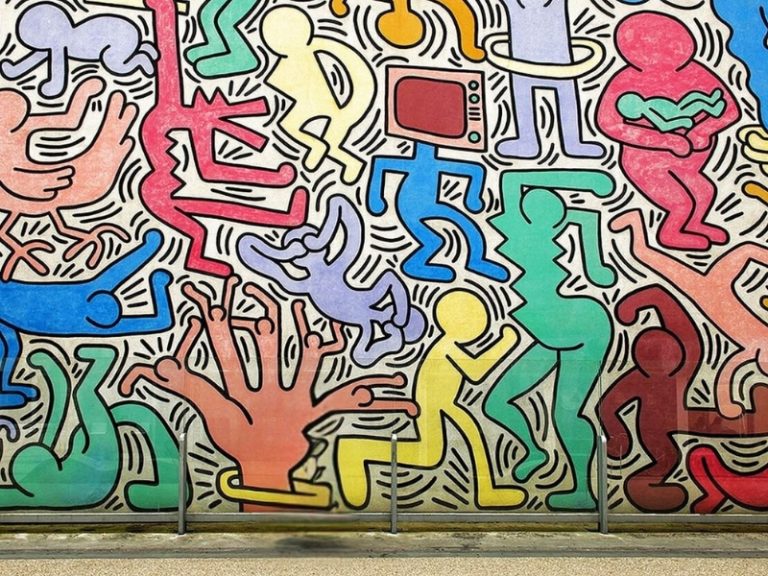
The American artist Keith Haring painted this mural in 1989 on the rear wall of the convent of Sant'Antonio Abate, near Pisa Centrale station. Its title means all the world, and 30 interlocking figures celebrate peace and harmony. It was one of his last public works, as Haring died in 1990.
2Santa Maria della Spina
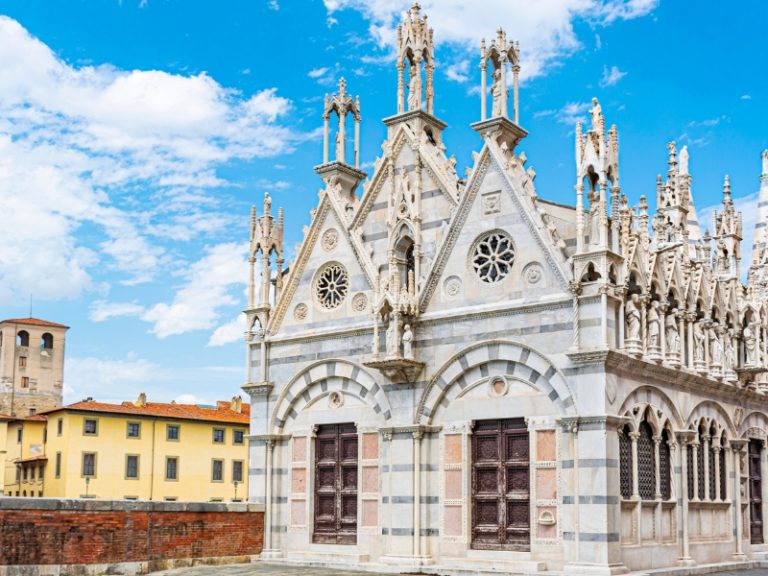
This small Gothic church on the Arno embankment takes its name from a thorn said to come from Christ's crown of thorns, kept here from 1333. Enlarged in the 14th century, it is covered with pinnacles, statues and tabernacles. In 1871 it was taken apart and rebuilt at a higher level to protect it from the river's floods.
3Palazzo Blu
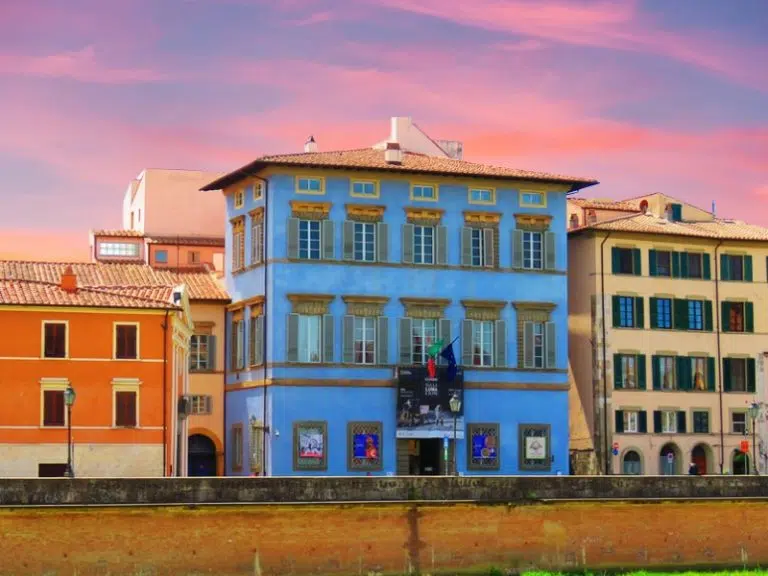
Palazzo Blu stands out on the Lungarno Gambacorti thanks to the blue façade that gives it its name. The building has medieval origins and was later turned into a noble residence. It opened as an exhibition centre in 2008 and hosts art exhibitions and a permanent collection.
4Piazza Garibaldi
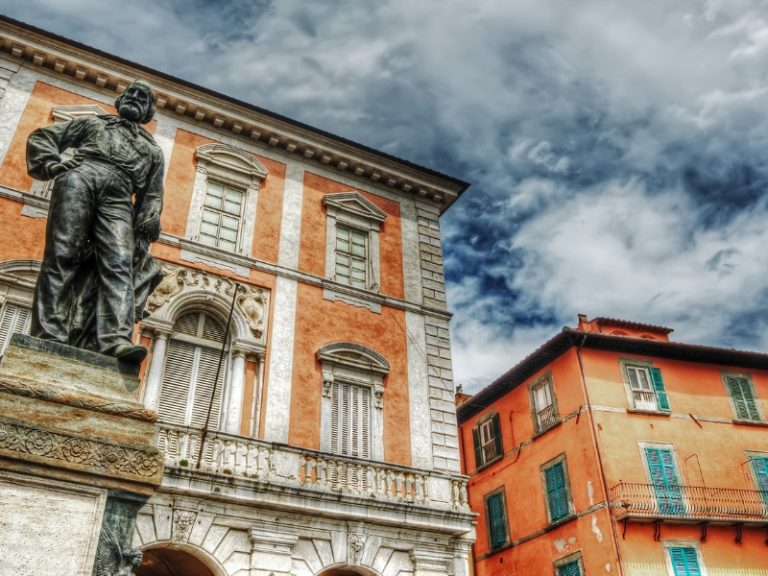
Piazza Garibaldi lies at the northern end of the Ponte di Mezzo, the central bridge over the Arno. A statue of Giuseppe Garibaldi, the general of Italian unification, stands in the square. The arcaded Borgo Stretto, Pisa's elegant shopping street, starts right here.
5Galileo Galilei Statue
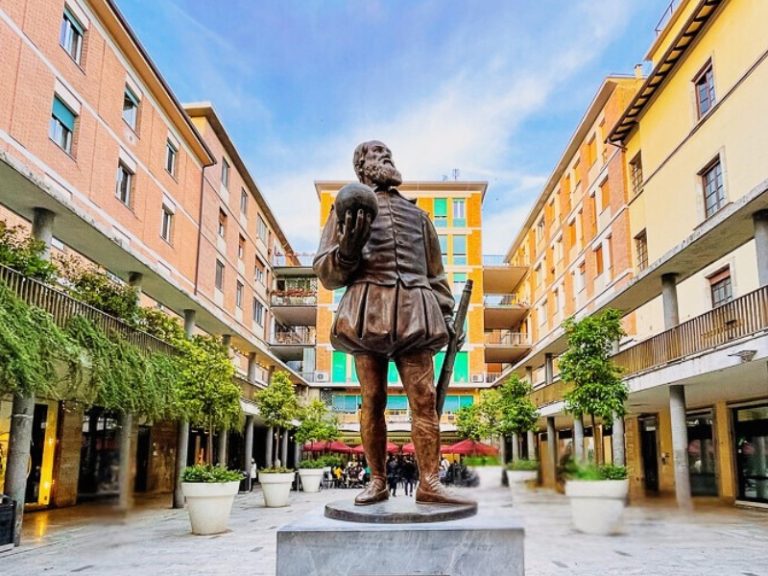
Galileo Galilei was born in Pisa in 1564 and studied and later taught mathematics at the city's university. This statue honours the scientist who, according to a famous story, dropped balls of different weights from the Leaning Tower to show that they fall at the same speed. In 1610 he discovered four moons of Jupiter with his telescope.
Read the full story →
6Piazza dei Cavalieri
This square was the political centre of medieval Pisa. In the 16th century Cosimo I de' Medici made it the seat of the Order of the Knights of St Stephen, founded in 1561, and Giorgio Vasari redesigned its buildings. In the Palazzo dell'Orologio is the old tower where Count Ugolino starved to death, a story told by Dante in the Inferno.
Read the full story →
7Palazzo della Carovana
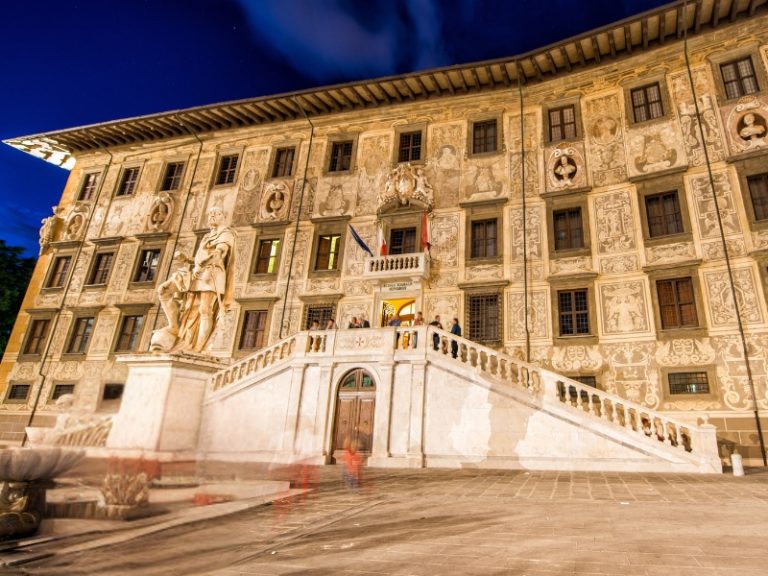
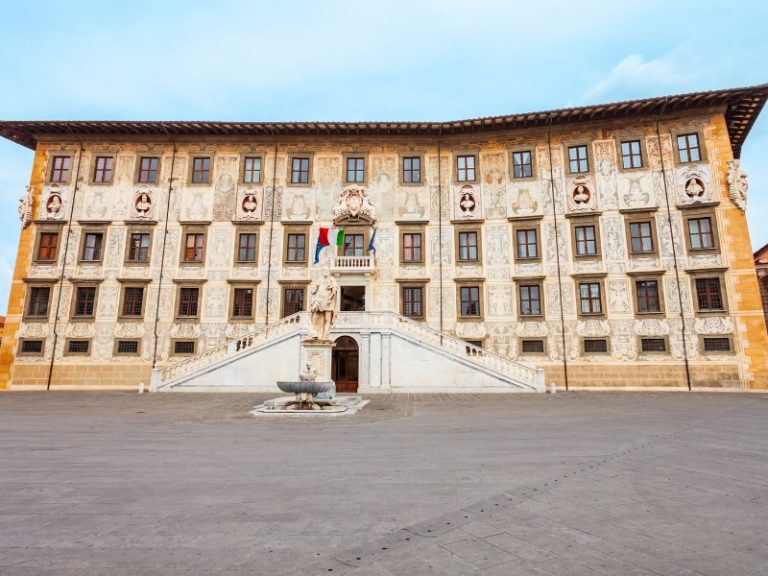
Giorgio Vasari remodelled this palace between 1562 and 1564 as the headquarters of the Knights of St Stephen. Its façade is covered in sgraffito decoration with allegorical figures and zodiac signs, and busts of Medici grand dukes. Today it is home to the Scuola Normale Superiore, a university founded in 1810 under Napoleon.
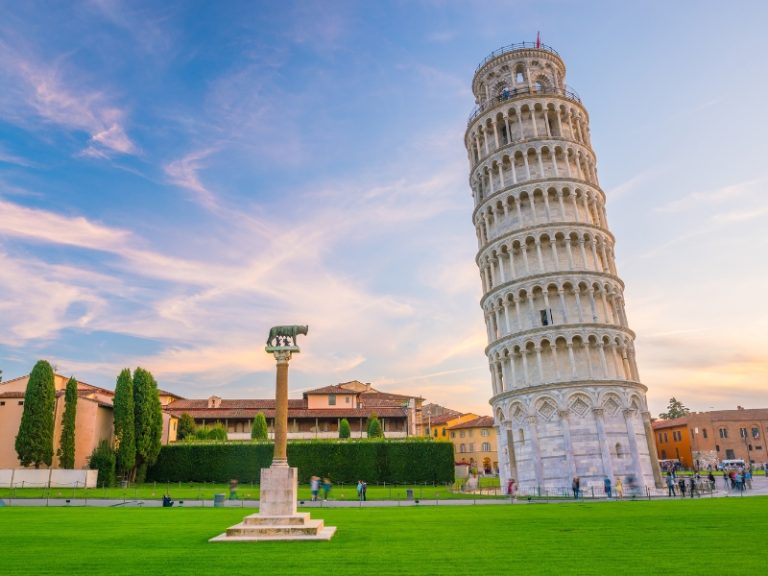
8Leaning Tower of Pisa
The cathedral's bell tower was begun in 1173 and started to lean during construction because of the soft ground beneath it. Building took about two centuries, and the builders tried to correct the tilt by making the upper floors slightly curved. Engineering work between 1990 and 2001 reduced the lean and stabilised the tower, which is about 56 metres tall.
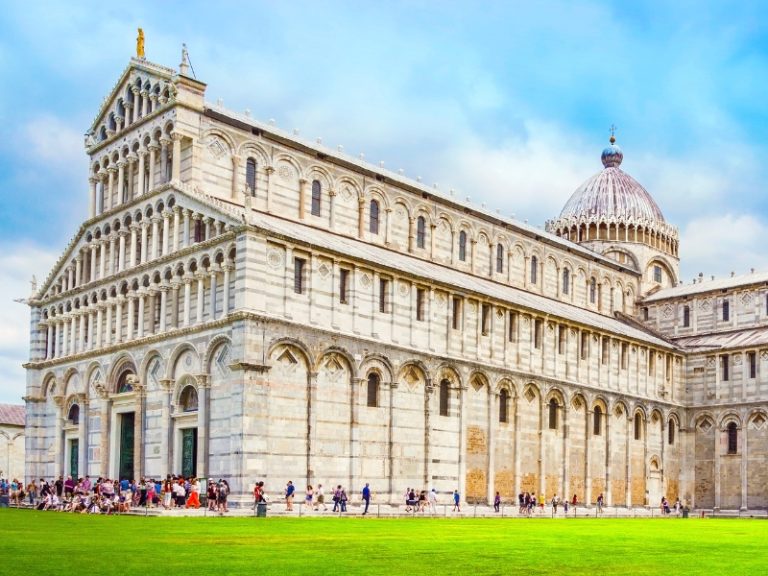
9Pisa Cathedral
Pisa Cathedral was begun in 1063, funded by spoils from a Pisan naval victory over the Saracens near Palermo. Its white and grey marble façade with rows of small arches set the model for the Pisan Romanesque style. Inside is Giovanni Pisano's carved pulpit, and legend says a swinging lamp here inspired Galileo's study of the pendulum.
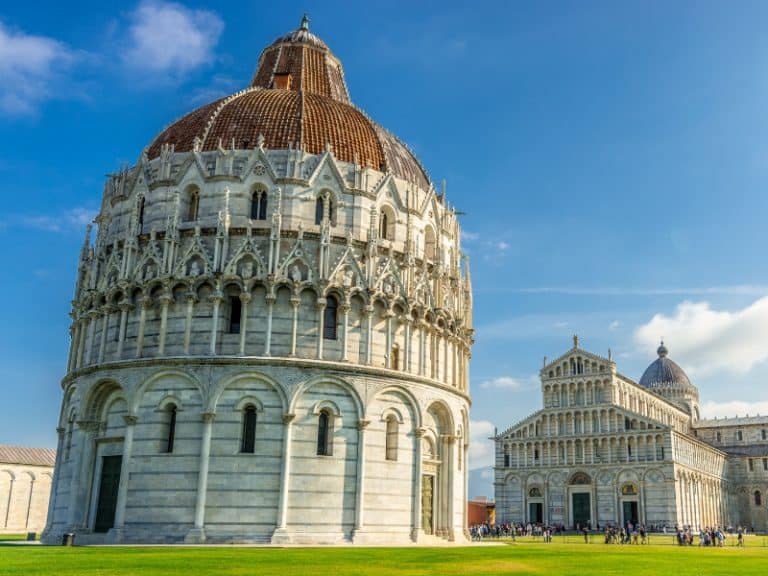
10Baptistery of St JohnFinish
The Baptistery of St John, begun in 1152 by the architect Diotisalvi, is the largest baptistery in Italy. Its round body combines Romanesque arches below with Gothic decoration above, added in the following centuries. Inside stands Nicola Pisano's pulpit of 1260, and the dome is famous for its echo.
Only logged in customers who have purchased this product may leave a review.



Reviews
There are no reviews yet.