
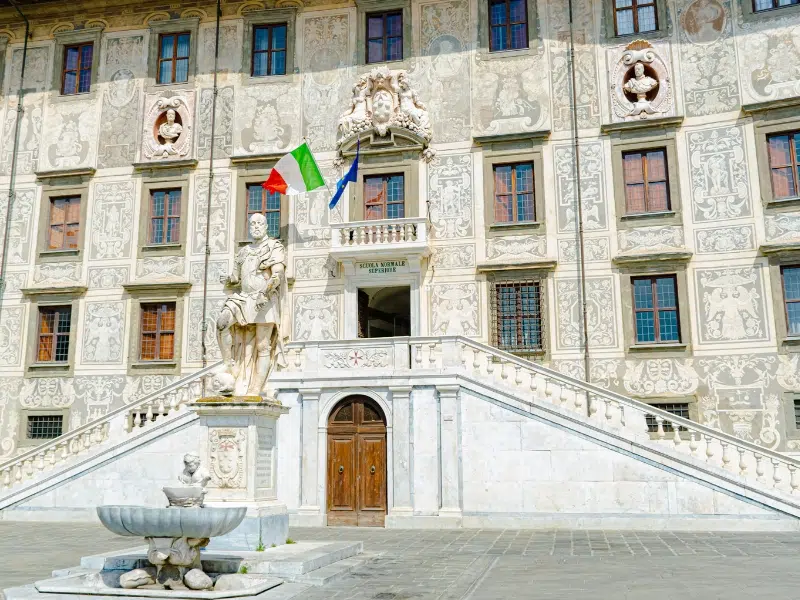
Piazza dei Cavalieri (Knights' Square) is the large square in the north of Pisa's old town, about ten minutes' walk from the Leaning Tower. It was the political centre of the medieval Republic of Pisa, and in the 1560s Cosimo I de' Medici had Giorgio Vasari remake it as the headquarters of a new order of knights. Today most of its palaces belong to the Scuola Normale Superiore, one of Italy's most selective universities.
Piazza dei Cavalieri at a glance
- Where: in the northern part of Pisa's historic centre, between Borgo Stretto and Piazza dei Miracoli.
- Built: a medieval square, rebuilt from 1562 into the early 17th century.
- By: Giorgio Vasari, who designed the overall plan, the Palazzo della Carovana and the church of Santo Stefano; Cosimo's son Giovanni de' Medici and others completed the work.
- What it is today: a university square. The Palazzo della Carovana is the main seat of the Scuola Normale, and the Palazzo dell'Orologio houses its library.
- Time needed: 20–30 minutes to walk round the square and look at the façades.
From the Republic's square to the knights' headquarters
In the Middle Ages this was the civic centre of the Republic of Pisa, the area of the 'Sette Vie' (seven streets), where the Palazzo degli Anziani, seat of the city's elders, stood. It was also the scene of the darkest episode in Pisan history: in 1289 Count Ugolino della Gherardesca, accused of betraying the city, starved to death here in a tower together with his sons and grandsons. Florence conquered Pisa in 1406, and the square lost its role.
In 1561 Cosimo I de' Medici founded the Order of the Knights of St Stephen to fight Ottoman fleets and pirates in the Mediterranean, and in 1562 he made this square its seat. Vasari turned the old Palazzo degli Anziani into the Palazzo della Carovana (1562–1567), where young knights did their training, and designed the church of Santo Stefano (1563–1572). Both men died in 1574, and work went on for decades: the church's marble façade was finished in 1596 and the Palazzo dell'Orologio in 1608. In 1810 Napoleon founded the Scuola Normale, modelled on the École normale supérieure in Paris, and in 1846 it moved into the Palazzo della Carovana.
What to look for
- The sgraffito façade of the Palazzo della Carovana: grey-and-white decoration scratched into the plaster in four bands, with allegorical figures and coats of arms. It has been redone several times over the centuries.
- The busts above the Carovana's windows: the Medici grand dukes, by Ridolfo Sirigatti, Pietro Tacca, Giovan Battista Foggini and others. Only the last grand duke, Gian Gastone, is missing.
- The statue of Cosimo I in front of the Carovana: commissioned in 1596 from Pietro Francavilla, it shows Cosimo in the robes of Grand Master with a dolphin at his feet, a sign of his power at sea. The fountain below has a shell-shaped basin flanked by two grotesque monsters.
- The Palazzo dell'Orologio: two buildings joined by an arch with a clock, added in 1696. The right wing contains the remains of the Torre della Muda, the 'Tower of Hunger' where Ugolino died.
- Santo Stefano dei Cavalieri: the church with the white Carrara marble façade and the Order's large Medici coat of arms. Inside hang flags captured from Turkish and pirate ships between the 16th and 18th centuries.
Ugolino and Dante's Tower of Hunger
Dante put Count Ugolino in the frozen lowest circle of Hell, among the traitors, gnawing the skull of Archbishop Ruggieri, who had locked him up. In Canto 33 of the Inferno Ugolino tells how his children starved beside him in the tower, ending with the line 'Poscia, più che 'l dolor, poté 'l digiuno' ('then fasting did what grief could not'). Whether that means he died of hunger or ate his children has been argued over for centuries, and Dante leaves it open. Since 2016 part of the Palazzo dell'Orologio has had a small exhibition space about the tower and Ugolino.
Tips for your visit
- For the classic photo, stand near the Palazzo dell'Orologio and look across at the Carovana: you get the façade, the staircase and Cosimo's statue in one frame.
- Most of the palaces are working university buildings, so for most visitors this is a square to enjoy from outside. Keep your voice down near the library entrance.
- The church of Santo Stefano has had long closures in recent years; check before you go if you want to see the flags inside.
Nearby
- Piazza dei Miracoli: the Leaning Tower, the Cathedral and the Baptistery, about ten minutes' walk to the west.
- Borgo Stretto: Pisa's arcaded shopping street, a few minutes' walk away, good for a coffee under the porticoes.
- Piazza delle Vettovaglie: the old market square just off Borgo Stretto, with a fruit and vegetable market in the morning and busy bars in the evening.
- Palazzo Blu: a blue-painted palace on the Arno that hosts art exhibitions, south of the square towards the river.
See Pisa with World City Trail
Our Pisa scavenger hunt turns the old town into a game you play on your phone. The route links 10 stops and takes around 2 hours, with about 34 minutes of walking. Along the way it includes Keith Haring's Tuttomondo mural and the little Gothic church of Santa Maria della Spina on the Arno.
If you prefer a different format, there is also a self-guided walking tour and an outdoor escape game in Pisa.
Play the Pisa scavenger hunt →
Take the self-guided walking tour of Pisa →
Play the outdoor escape game in Pisa →
Facts checked in October 2026.