
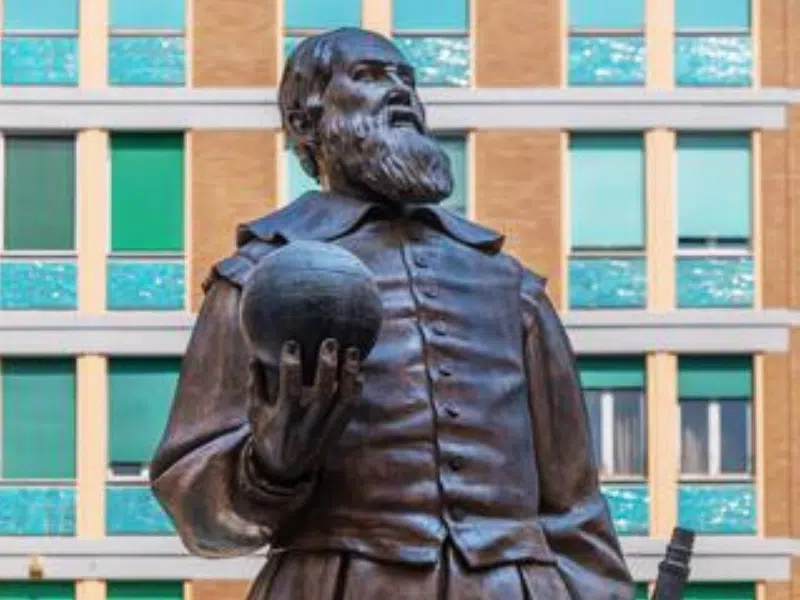
Pisa's bronze statue of Galileo Galilei stands in Largo Ciro Menotti, a small square off Borgo Stretto, a short walk from the house where he was born in 1564. Unveiled in 2020, it shows the scientist not as the old man tried by the Inquisition but as a confident observer, telescope in one hand, globe in the other, eyes turned to the sky.
The Galileo statue at a glance
- Where: Largo Ciro Menotti, off Borgo Stretto in central Pisa, near Galileo's birthplace
- Created: 2020, unveiled on 29 February
- By: Gabriele Vicari and Armando Barbon, who donated it to the city; cast in bronze by a foundry in Pietrasanta
- What it is today: a free open-air monument and a popular photo stop
- Time needed: 10 minutes, or an hour if you follow Galileo's trail through the old town
From a Pisan childhood to a statue at last
Galileo was born in Pisa on 15 February 1564 and baptised in the city's baptistery. He came back at 16 to study medicine at the university, switched to mathematics, and taught there from 1589 to 1592 before moving to Padua. It was in Pisa that he began questioning Aristotle's ideas about falling bodies and the swinging of pendulums, work that led to his later discoveries with the telescope and to his trial in Rome in 1633.
Pisa honoured him early indoors: a marble statue by Paolo Emilio Demi has stood in the Aula Magna of the Palazzo della Sapienza, the old university building, since 1839. A large figure in the street came much later. The bronze by Vicari and Barbon was placed in Largo Ciro Menotti in February 2020, during the city's celebrations for his birthday. At the unveiling the city said it might later move to the Cittadella Galileiana near the Arno, so check its exact spot before you set out.
What to look for
- The telescope in Galileo's left hand: a reminder that from 1609 he turned an improved telescope on the Moon, Jupiter's moons and the phases of Venus.
- The globe in his right hand, which he seems to weigh as he thinks.
- His raised gaze: the artists wanted to show him observing, the core of his scientific method.
- The 17th-century dress, with a buttoned doublet, wide collar and cloak, all cast in fine detail.
- The size: the bronze figure is about 2.6 metres tall and stands on two blocks of grey Carrara marble, together weighing around six tonnes.
The swinging lamp and the falling balls
Two famous stories tie Galileo to Pisa. One says that as a student in 1581 he watched a lamp swinging in the cathedral and timed it against his pulse, noticing that each swing took the same time; the bronze lamp now hanging in the nave, often called Galileo's lamp, was in fact installed a few years later. The other, that he dropped balls of different weights from the Leaning Tower, is a legend: his pupil Vincenzo Viviani told it decades later and no record from the time confirms it.
Tips for your visit
- Come in the morning or late afternoon, when Borgo Stretto is calmer and the light falls softly on the bronze.
- For a photo with the sky behind the telescope, stand slightly below and to one side of the statue.
- Make it a Galileo walk: start at Piazza dei Miracoli, where he was baptised, then the statue, his birthplace and the Palazzo della Sapienza.
- The square is part of a busy shopping area, so keep to one side when groups stop for pictures.
Nearby
- Galileo's birthplace: the house of the Ammannati family, his mother's relatives, in Via Giusti, marked with a plaque; a few minutes' walk.
- Borgo Stretto: Pisa's arcaded main shopping street, with the Romanesque-Gothic church of San Michele in Borgo.
- Palazzo della Sapienza: the historic university building where Galileo taught and where Demi's 1839 statue stands.
- Piazza dei Cavalieri: the grand square of the Knights of St Stephen, with Vasari's sgraffito-covered Palazzo della Carovana.
See Pisa with World City Trail
Our Pisa scavenger hunt turns the old town into a game you play on your phone. The route links 10 stops and takes around two hours, with about 34 minutes of walking. It includes places such as Keith Haring's Tuttomondo mural and the small Gothic church of Santa Maria della Spina on the Arno.
If you prefer a different format, Pisa also has a self-guided walking tour and an outdoor escape game.
Play the Pisa scavenger hunt →
Take the self-guided walking tour of Pisa →
Play the outdoor escape game in Pisa →
Facts checked in October 2026.