What is the St. Gallen self-guided walking tour?
The St. Gallen self-guided walking tour is a walk through a compact old town at your own pace, with audio narration on your phone where a guide would otherwise be. Allow about 3 hours, and note how little of it is walking: 26 minutes over a route of 2.1 km, with 10 stops where you stand still and listen. Everything lies close together, so the time goes on the stories rather than the distance.
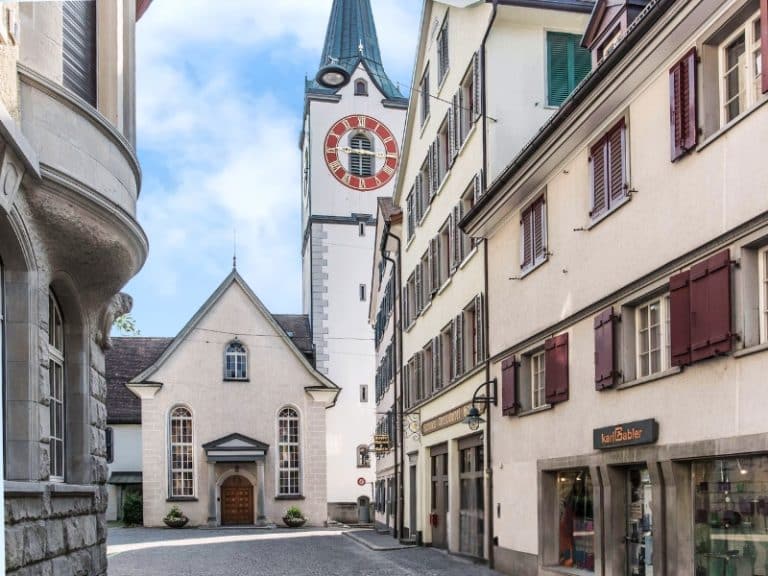
At the St. Gallus Fountain the narration tells how an Irish monk settled by the Steinach in 612 and gave the city its name, and why, according to legend, a bear that brought him firewood was paid in bread and still stands in the coat of arms. Beside St. Mangen you hear about Wiborada, walled into a cell there until a Hungarian raid killed her in 926, and at St. Laurenzen how Joachim Vadian carried the Reformation through the 1520s while the abbey next door stayed Catholic.
- Durationabout 3 hours
- Walkingabout 26 min · 2.1 km
- Stops10
- LanguagesEnglish, German, French, Italian, Spanish
What you do on the walking tour
Listen
At every stop the audio gives you the history of the place, the stories attached to it and the details you would otherwise walk past. The same text sits on screen if you would rather read.
Stroll
The stops stand within a few streets of each other: 26 minutes on foot in all, 2.1 km from the station to St. Mangen, with Google Maps pointing the way.
Break off
Stop for coffee on the Marktplatz or an hour in a museum, then pick the walk up again, the same day or another one.
Eat and browse
Tips for food and shops near the route come with the walk. The opening stop and the order of the stops are yours to change in the app.
See the route and attractions →
How it works
- Book online Choose the number of people. Your booking reference arrives by email straight away.
- Get the app Download the World City Trail app from the App Store or Google Play and enter your booking reference.
- Walk when you like Start whenever you are ready, walk at your own pace and pause any time. No guide, no fixed schedule.
Who the walking tour is for
A first visit
One walk explains the abbey, the merchant houses and the embroidery money that paid for them, and what you are standing in front of.
Walkers who dislike groups
No umbrella to follow and no meeting point: you stay where something holds you and move on when you feel like it.
A stop on a longer trip
Short distances make this easy to fit between trains, and the station is the first stop on the route.
Good to know
- Bring a charged smartphone with mobile data; a power bank helps.
- No entry tickets needed: everything happens outside the buildings. Going inside is optional and paid separately.
- Family friendly; children must be accompanied by an adult.
- Not suitable for wheelchair users and difficult with strollers.
- Groups of up to 5 work best; larger groups split up, one ticket per person.
- Every purchase helps support stray cats and dogs in Greece.
The walk stop by stop: the station, the Stadtlounge, the Abbey of St Gall, St. Mangen
10 stops · about 26 min walking · start: St. Gallen Railway Station · finish: St. Mangen Church
The walk begins outside the railway station, under the long neo-baroque front of 1913, with the Appenzell narrow-gauge trains leaving from the forecourt, and the red floor of the Stadtlounge is the first thing you reach. The Broderbrunnen and the Textile Museum follow, after which the route climbs to the St. Gallus Fountain on Gallusplatz and into the abbey district with its twin-towered baroque cathedral. The old citizens' quarter of the Ortsbürgergemeinde comes next, then St. Laurenzen Church, whose slender tower rises a few steps from the cathedral, and the Marktplatz, where Vadian waits in bronze. St. Mangen Church closes the walk. Another opening stop or another order takes one tap in the app, and no stop asks for an entry ticket.
Open the route map ↗
1St. Gallen Railway StationStart
The main station building, designed by Alexander von Senger, was completed in 1913, when the city was at the height of its embroidery boom. Walk along its long neo-baroque facade, then look at the forecourt, where the narrow-gauge trains of the Appenzell railway leave right from the square.
2Red Square (Stadtlounge)
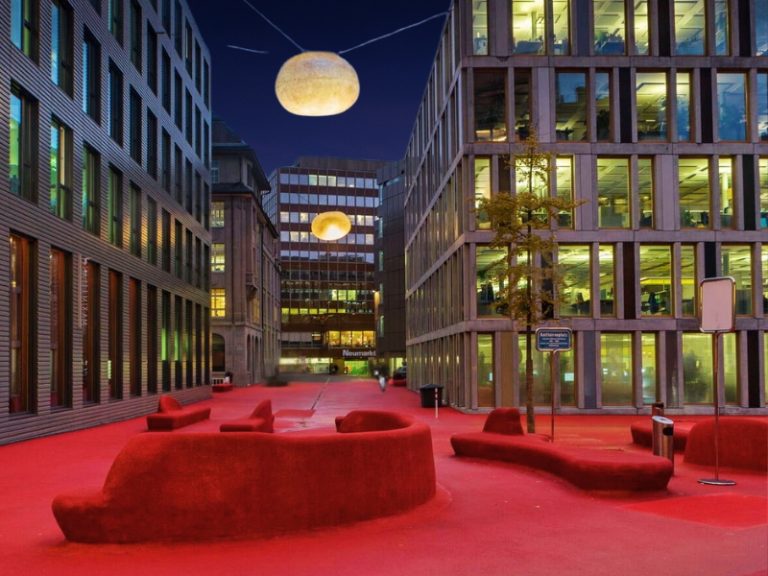
The Stadtlounge, known locally as the Red Square, is an open-air living room created by the artist Pipilotti Rist and the architect Carlos Martinez and opened in 2005. A red rubber-granulate surface covers the ground and the street furniture alike, and large oval lamps hang above it like floating clouds.
Read the full story →
3Broderbrunnen
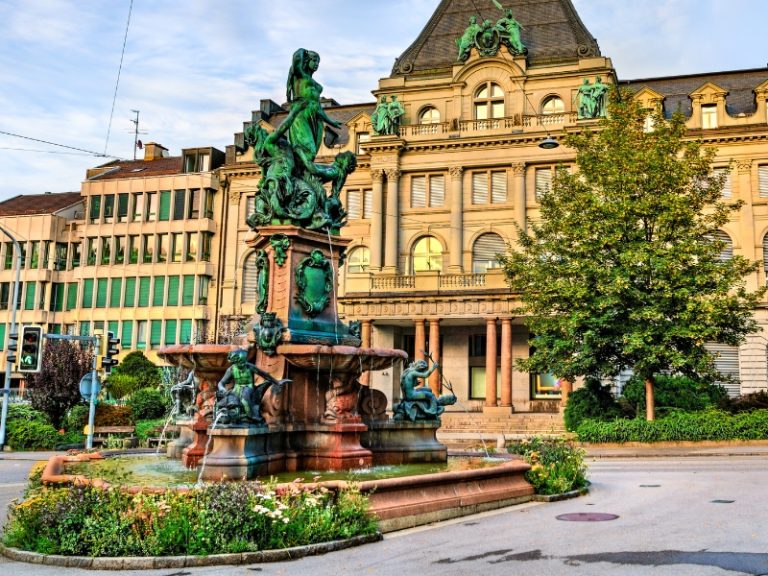
This large, richly decorated fountain was unveiled in 1896 to celebrate the city's new drinking-water supply from Lake Constance. Take a close look at its bronze figures and the many places where the water spouts out, a proud display of what was then a modern feat of engineering.
4Textile Museum
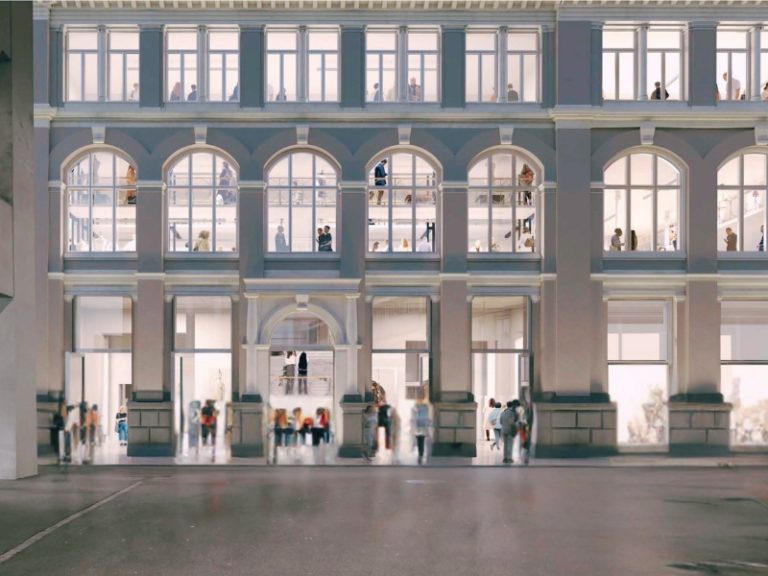
The Textile Museum tells the story of the lace and embroidery that made the city famous: around 1900 embroidery was one of Switzerland's most important exports, and much of it came from the St Gallen region. Its collection of fabric samples and pattern books was started in the 19th century to inspire local designers.
5St. Gallus Fountain
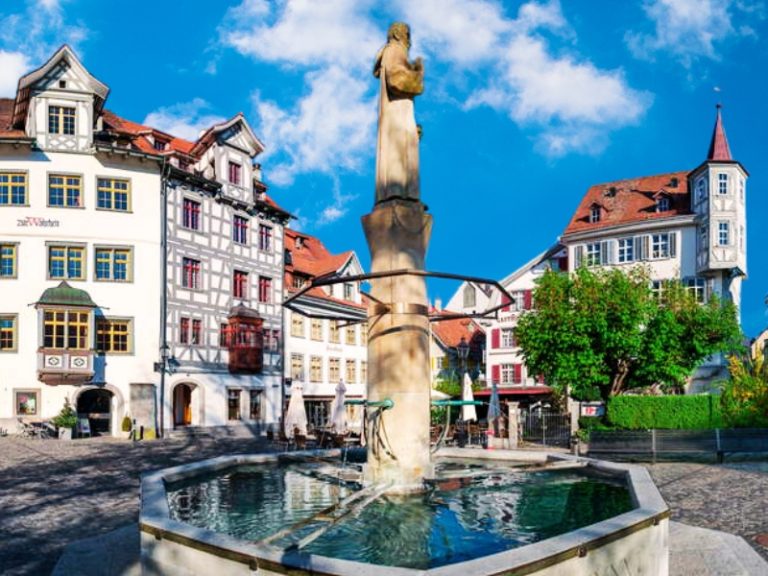
This fountain on Gallusplatz honours Gallus, the Irish-born monk who according to tradition settled by the Steinach stream in 612 and gave the city its name. Legend says a bear brought him wood for his fire and was rewarded with bread, and a bear still appears in the city's coat of arms.
6Abbey of St Gall
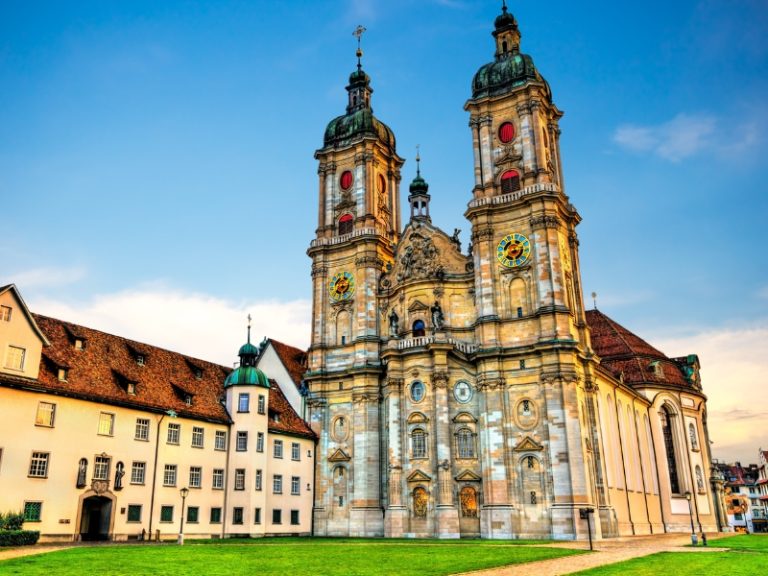
The abbey was founded in 719 on the site of Gallus's hermitage and became one of the great centres of learning in medieval Europe. Its baroque cathedral with twin towers was built between 1755 and 1766, and the abbey district has been a UNESCO World Heritage Site since 1983, together with its famous library.
7Ortsbürgergemeinde St.Gallen
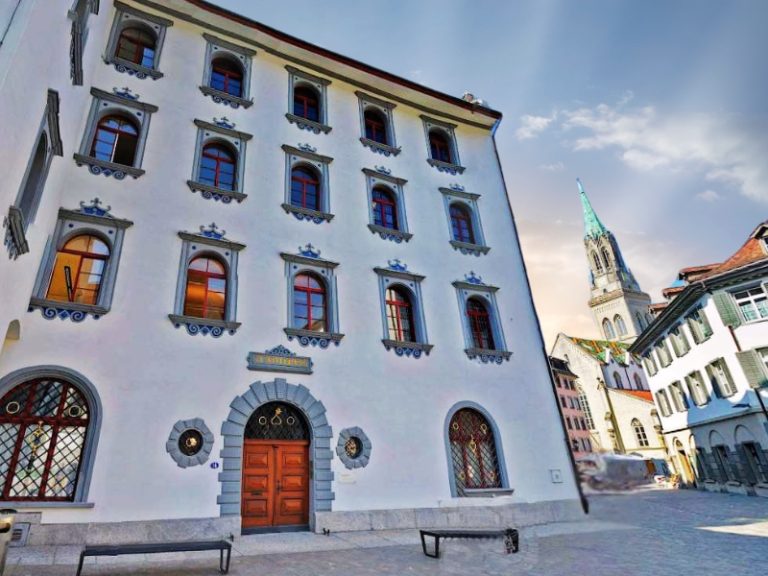
The Ortsbürgergemeinde is the community of the city's old citizen families, whose roots go back to the self-governing merchant town that grew up beside the abbey. Look up at the old-town houses around you: St Gallen is known for its carved and painted oriel windows, many paid for by wealthy linen and embroidery merchants.
8St. Laurenzen Church
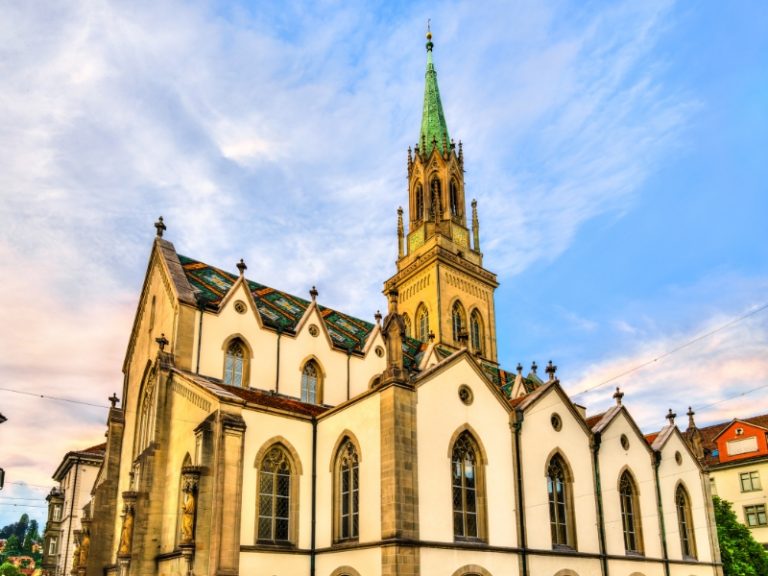
St Laurenzen is the city's main Protestant church: in the 1520s the reformer and mayor Joachim Vadian led the Reformation here, while the abbey next door remained Catholic. The church received its neo-Gothic look in a rebuilding of the 1850s, and its slender tower stands only a few steps from the cathedral.
Read the full story →
9Marktplatz
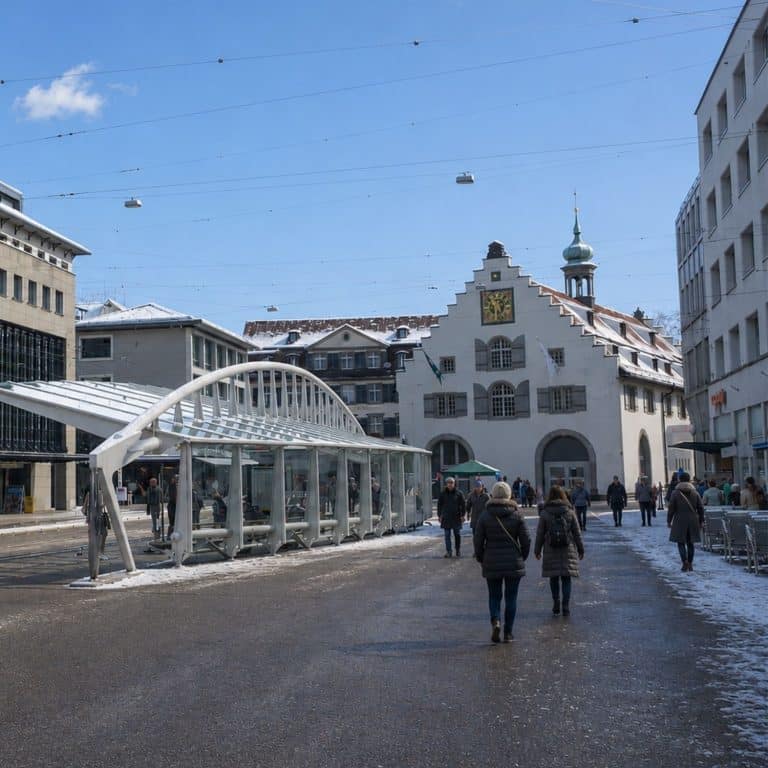
Marktplatz is the old town's busy main square, where market stalls and city buses meet. Here stands the bronze statue of Joachim von Watt, known as Vadian, humanist, doctor and mayor, unveiled in 1904, and next to the square, on the Bohl, rises the Waaghaus, the old weigh house of the 16th century.
10St. Mangen ChurchFinish
St Mangen is one of the oldest churches in the city, founded around 898 and dedicated to St Magnus. The hermit Wiborada lived walled up in a cell beside it until she was killed in a Hungarian raid in 926, and in 1047 she became the first woman canonised by a pope.
Only logged in customers who have purchased this product may leave a review.






Germany –
Collected on GetYourGuide