What is the Würzburg outdoor escape game?
The Würzburg outdoor escape game takes the escape room idea out into the old town: you play on your smartphone, and at each of the 10 stops a puzzle waits that you crack by observing the surroundings and reasoning it through. In about 2 hours you walk 3 km, roughly 35 minutes of it on the move, starting whenever you like.
Each puzzle is tied to a landmark, from the Juliusspital and the Old Main Bridge to St Kilian's Cathedral and the Residence, and each stands on its own, so you never need a storyline. Each puzzle carries clues on three levels at the outside, handed over one step at a time. The compact old town suits this format, because the stops are close enough that the game feels like one unhurried walk.
- Durationabout 2 hours
- Walkingabout 35 min · 3 km
- Stops10
- LanguagesEnglish, German, French, Italian, Spanish, Dutch
What you do during the escape game
Solve
Crack the puzzle at every stop using what you see and some logic. No knowledge of the city is required.
Study the details
Clues sit in the sculptures, façades and fountains of each place, so look at the small things as well as the big picture.
Walk
Follow Google Maps from one stop to the next, about 35 minutes on foot over roughly 3 km.
Go at your own speed
There is no countdown. Use a hint if you need one, stop for a glass of Franconian wine and come back later or another day.
See the route and attractions →
How it works
- Book online Choose the number of players. Your booking reference arrives by email straight away.
- Get the app Download the World City Trail app from the App Store or Google Play and enter your booking reference.
- Play when you like Start whenever you are ready, walk at your own pace and pause any time. No guide, no fixed schedule.
Who it is for
Friends
Every stop gives the group something to debate, and nobody has to know Würzburg beforehand.
Couples
A shared challenge that keeps you talking as you cross the bridge and wander the squares, with no clock to watch.
Team building
Teams of up to 5 each play on their own phone, so colleagues can share the reasoning across the route.
Good to know
- Bring a charged smartphone with mobile data; a power bank helps.
- Best started in daylight, so you can see the details the puzzles ask about.
- No entry tickets needed: everything happens outside the buildings. Going inside is optional and paid separately.
- Family friendly; children must be accompanied by an adult.
- Not suitable for wheelchair users and difficult with strollers.
- Teams of up to 5 work best; bigger groups split into several teams, one ticket per player.
- Every purchase helps support stray cats and dogs in Greece.
The puzzle trail: from the Juliusspital to the Residence
10 stops · about 35 min walking · start: Juliusspital · finish: Residenzplatz
The first puzzle waits at the Stiftung Juliusspital and the last on Residenzplatz in front of the Würzburg Residence. In between come the Old Crane on the Main, the Old Main Bridge, the Four Tubes Fountain, City Hall, the Marktplatz with the Falkenhaus, St Kilian's Cathedral and the Chronos Fountain. Daylight makes the best start, since the puzzles are solved outdoors and rain slows everything down. Google Maps guides you between stops, you can change the order in the app, and no entry tickets are needed.
Open the route map ↗
1JuliusspitalStart
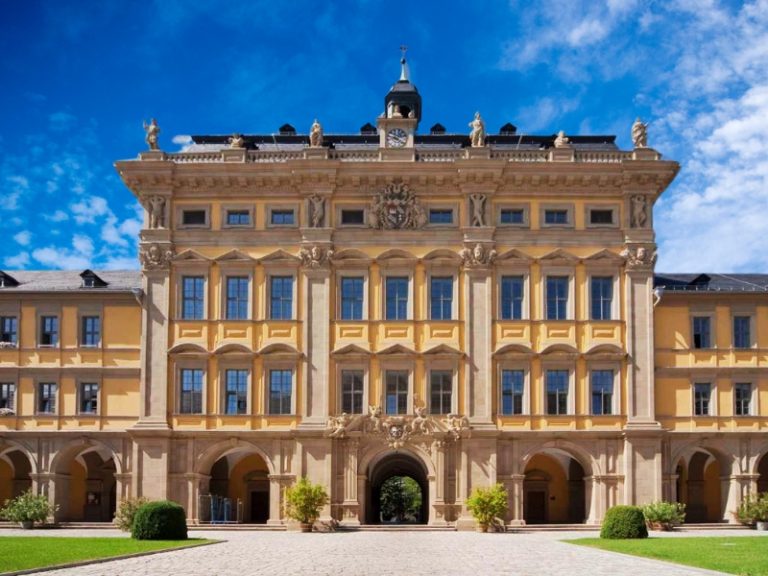
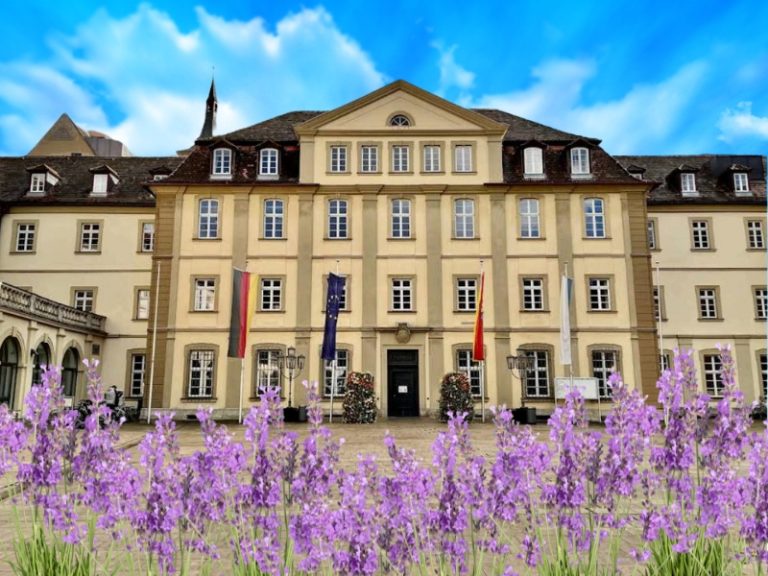
Prince-Bishop Julius Echter von Mespelbrunn founded this charitable foundation in 1576 to care for the sick and the poor, and it still looks after the sick and elderly today. Part of its income comes from its own wine estate, one of the largest in Germany, and its long baroque wings frame a quiet garden courtyard.
2Old Crane
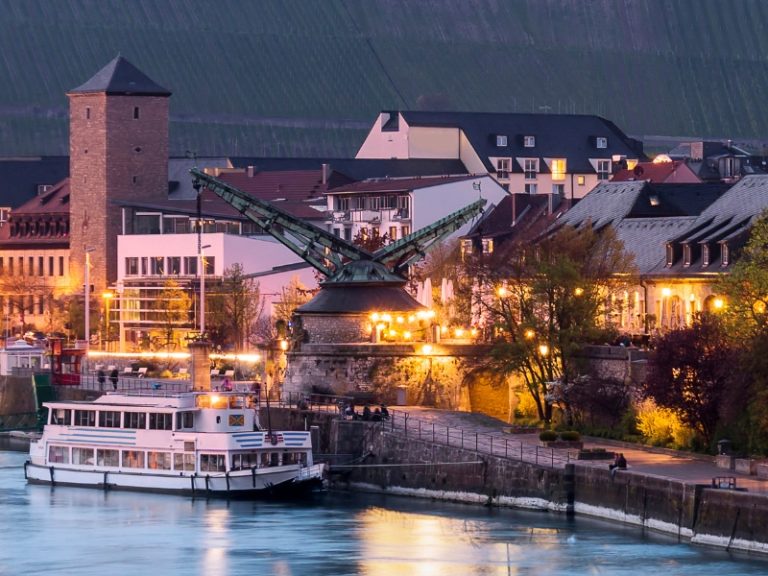
The Old Crane, the Alter Kranen, was built on the bank of the Main in the second half of the 18th century by Franz Ignaz Michael Neumann, a son of the architect Balthasar Neumann. Its two jibs once lifted goods from the river boats, and from here you look across the Main to the Marienberg Fortress.
3Old Main Bridge
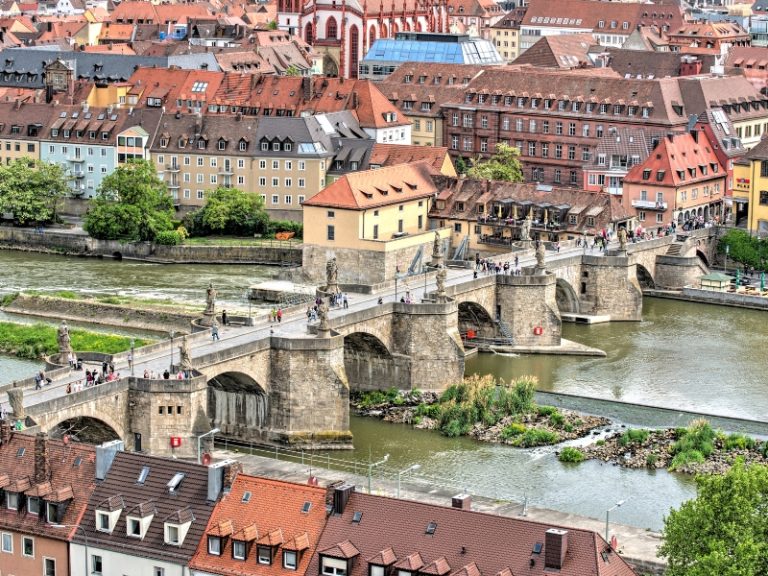
Würzburg's oldest bridge over the Main was built from 1473 onwards to replace a Romanesque predecessor. In the 18th century twelve larger-than-life baroque statues of saints and rulers were set on its piers, among them St Kilian, the patron of the city, and today people like to stand here with a glass of Franconian wine and look up at the Marienberg Fortress.
Read the full story →
4Four Tubes Fountain
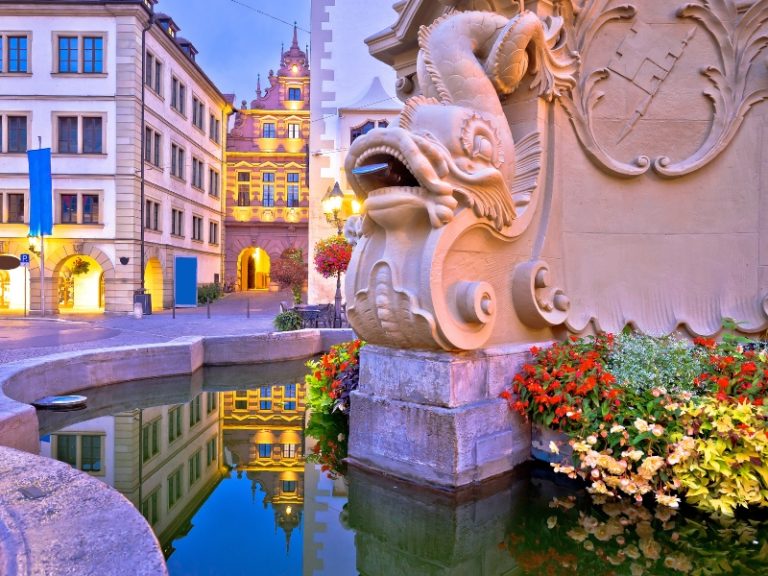
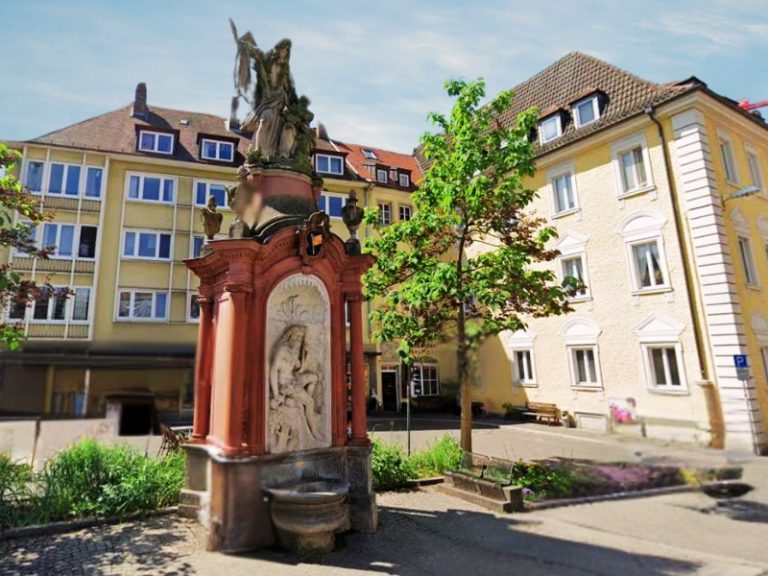
The Vierröhrenbrunnen in front of the City Hall was built in the 1760s under Prince-Bishop Adam Friedrich von Seinsheim. Water flows from four pipes, which give the fountain its name, and figures of the four cardinal virtues sit around its tall central column.
5City Hall
Würzburg's City Hall, known as Grafeneckart, is named after a medieval official of the prince-bishop, and the citizens have used it as their council house since 1316. Its Romanesque tower is the oldest part, while the red wing beside it, the Roter Bau, was added in the 17th century.
6Marktplatz
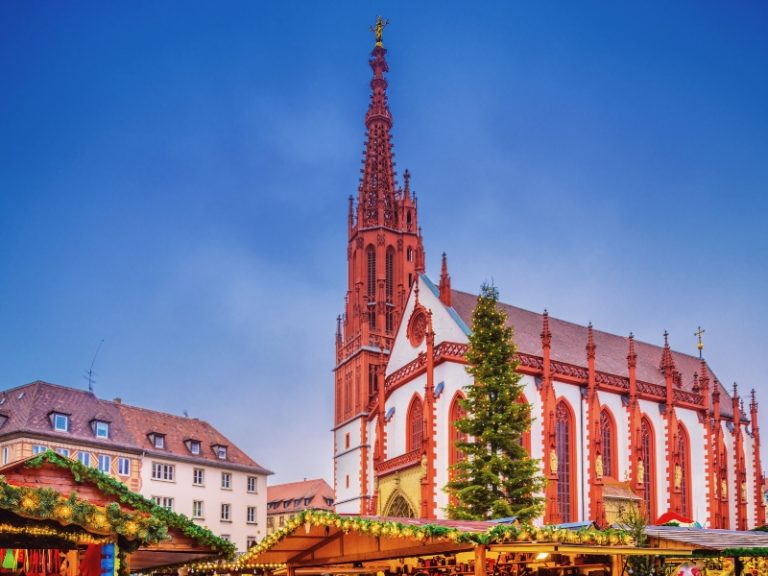
The market square is framed by the Gothic Marienkapelle, a citizens' church begun in 1377, and by the rococo Falkenhaus. Copies of Tilman Riemenschneider's Adam and Eve stand at one of the chapel's portals, and the baroque architect Balthasar Neumann is buried inside.
Read the full story →
7Falkenhaus
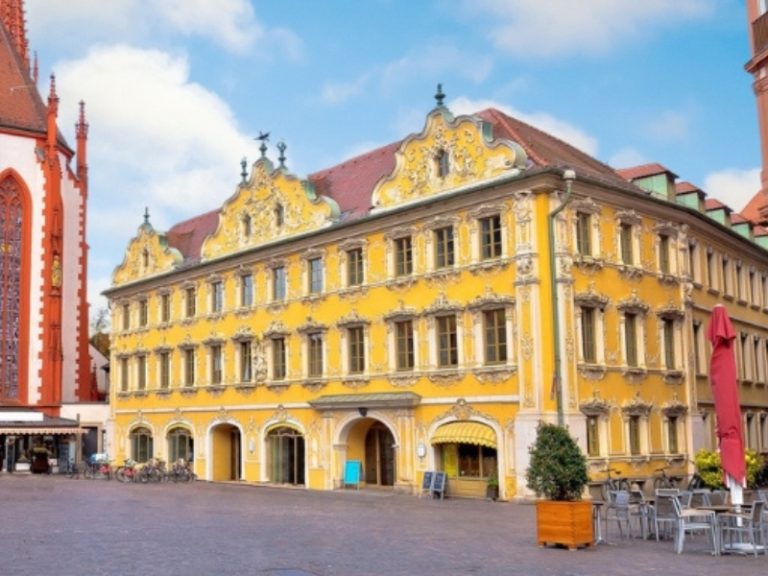
This house on the market square takes its name from the inn Zum Falken that once stood here. Its rococo stucco façade dates from the middle of the 18th century, was destroyed in 1945 and carefully reconstructed after the war. Today the building houses the tourist information and the city library.
8St Kilian's Cathedral
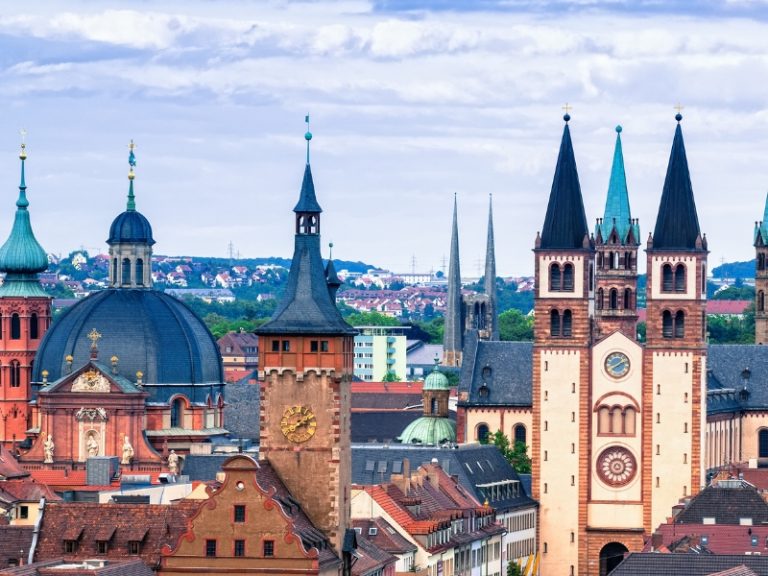
Würzburg Cathedral was begun in 1040 and is one of the largest Romanesque churches in Germany. It is dedicated to St Kilian, an Irish missionary who according to tradition was killed in Würzburg in 689 together with his companions Kolonat and Totnan. The church was badly damaged in 1945 and rebuilt after the war.
9Chronos Fountain
This fountain on the way from the cathedral to the Residence is named after Chronos, the personification of time in ancient Greek thought. Take a close look at its sculpture, because the details are what this stop is about.
10ResidenzplatzFinish
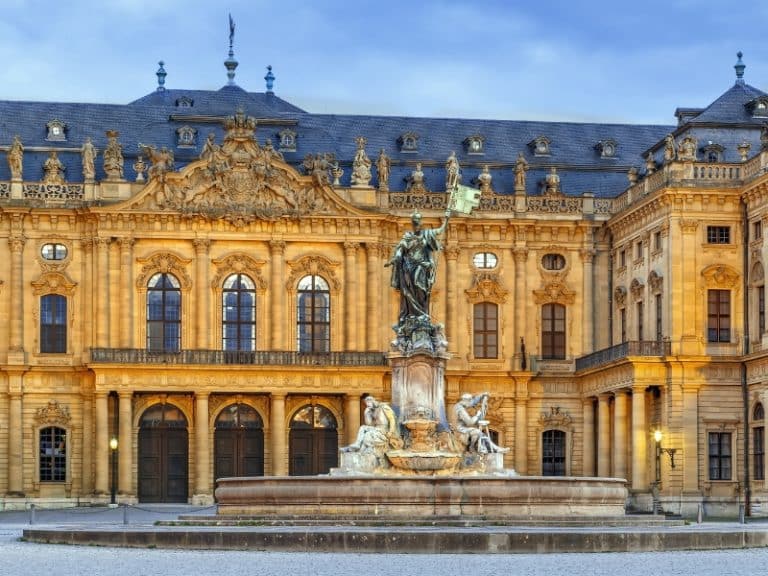
The wide square opens in front of the Würzburg Residence, the palace of the prince-bishops, built from 1720 to designs by Balthasar Neumann and a UNESCO World Heritage Site since 1981. In the middle stands the Franconia Fountain of 1894, with statues of the poet Walther von der Vogelweide, the sculptor Tilman Riemenschneider and the painter Matthias Grünewald.
Only logged in customers who have purchased this product may leave a review.





Reviews
There are no reviews yet.