
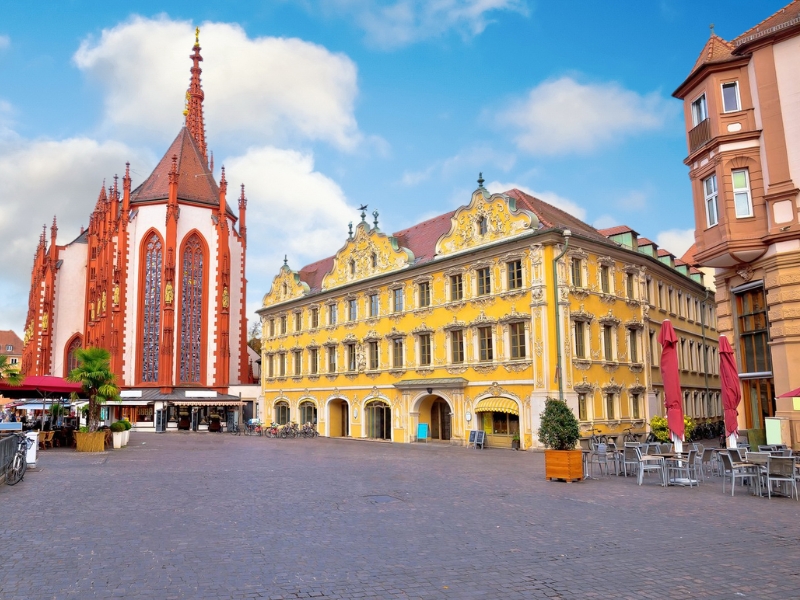
The Marktplatz is Würzburg's main market square, in the old town just a few minutes' walk from the cathedral. Two buildings set the scene: the red-and-white Gothic Marienkapelle, built on the site of a medieval synagogue, and right beside it the Falkenhaus, whose white Rococo façade is one of the most ornate in southern Germany.
The Marktplatz at a glance
- Where: in Würzburg's old town, a short walk from the cathedral and the river Main.
- Built: the Marienkapelle between 1377 and 1479, the Falkenhaus façade in 1751; much of the square was rebuilt after the air raid of 16 March 1945.
- What it is today: the city's market square, with market stalls, the tourist information and city library in the Falkenhaus, and the Christmas market in Advent.
- Time needed: 20 to 40 minutes, longer if you go inside the Marienkapelle.
From synagogue site to market chapel
In the Middle Ages this was the area of Würzburg's Jewish community. Its synagogue was destroyed in a pogrom on 21 April 1349, and in 1377 work began on the Marienkapelle on the same site. The tower roof was finished in 1479. Although it is the size of a large church, it was never given parish rights, which is why it is still called a chapel. In 1751 the widow of the innkeeper who owned the house next door had its plain front covered with the lavish stucco that makes the Falkenhaus so recognisable.
On 16 March 1945 a British air raid destroyed about 90 per cent of Würzburg in 17 minutes. The Marienkapelle burned out and the houses around the square were wrecked. The chapel was rebuilt between 1948 and 1961 and consecrated again in 1962, and the Falkenhaus was reconstructed to its old design. Since 1952 it has housed the city library and the tourist information, so many visitors start their day in Würzburg here.
What to look for
- The Marienkapelle: a tall Gothic hall church with red sandstone trim on white walls and a slender tower crowned by a gilded Madonna.
- Adam and Eve: the figures at the chapel's portal are copies of statues by Tilman Riemenschneider, delivered in 1493. The originals were moved to a museum in 1894.
- The Schwalbenlädle: tiny shops built against the chapel's outer walls, which have earned the church rent since 1437. Look for the one that calls itself Würzburg's smallest café.
- Balthasar Neumann's grave: the architect of the Würzburg Residence was buried inside the chapel in 1753, and a bronze plaque now marks the place.
- The Falkenhaus façade: curving gables and dense white Rococo stucco on a three-storey house. Step inside for maps and advice at the tourist information.
- The obelisk fountain: a classicist fountain topped by an obelisk, one of the city's many old fountains.
The square through the year
The Marktplatz still lives up to its name. Stalls with fruit, vegetables and flowers set up here regularly, and in Advent the square fills with the huts of the Würzburg Christmas market around the Marienkapelle. In summer the café tables spill out onto the cobbles, and the square becomes a natural meeting point between the shopping streets and the cathedral.
Tips for your visit
- Come in the morning if you want to see the market stalls; later in the day the square is busier with shoppers and visitors.
- For a photo of the whole chapel and its tower, stand on the far side of the square.
- The Marienkapelle is a working church: keep your voice down inside and avoid wandering around during services.
- Pick up a city map at the tourist information in the Falkenhaus before heading to the Residence or the fortress.
Nearby
- Würzburg Cathedral: the Romanesque cathedral of St Kilian, built from 1040 to 1225, a few minutes' walk away.
- Alte Mainbrücke: the old stone bridge over the Main, lined with statues of saints and popular for a glass of Franconian wine with a view of the Marienberg fortress.
- Grafeneckart: the old town hall, with its medieval tower, between the market square and the river.
- Würzburg Residence: the prince-bishops' Baroque palace by Balthasar Neumann, a UNESCO World Heritage Site, around 10 to 15 minutes' walk east.
See Würzburg with World City Trail
Our Würzburg scavenger hunt turns the old town into a game you play on your phone. The route links 10 stops and takes around 2 hours, with about 35 minutes of walking. The Marktplatz is one of the stops, along with Würzburg Cathedral and the Würzburg Residence.
If you prefer a different format, there is also a self-guided walking tour of Würzburg and an outdoor escape game in the city.
Play the Würzburg scavenger hunt →
Take the self-guided walking tour of Würzburg →
Play the outdoor escape game in Würzburg →
Facts checked in October 2026.