
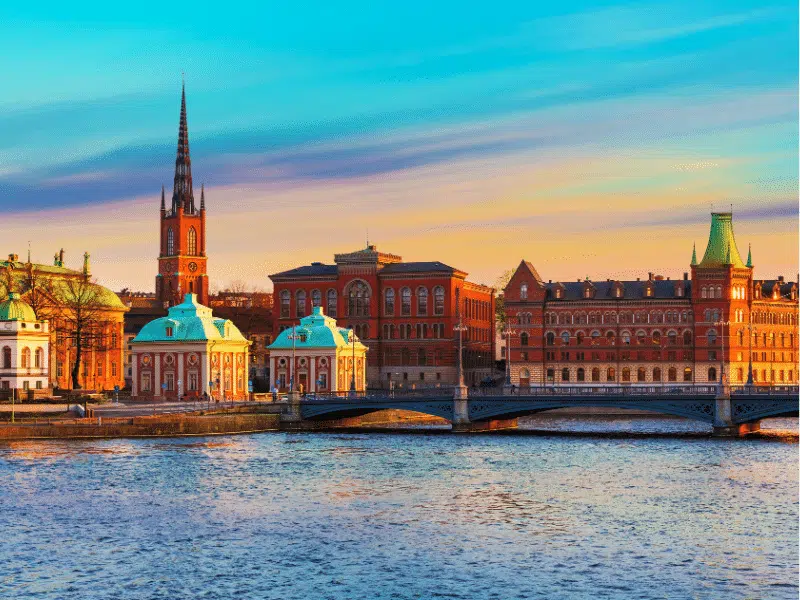
Stockholm is spread across 14 islands where Lake Mälaren meets the Baltic Sea. Its old town, Gamla Stan, still follows the lines of the medieval city, and every December the Nobel Prize ceremonies take place here. Here are the facts and stories that make the city special.
10 fun facts about Stockholm
- A city on 14 islands: Stockholm is built on 14 islands linked by dozens of bridges.
- Eight million bricks: Stockholm City Hall, designed by Ragnar Östberg, was inaugurated on 23 June 1923 and built from around eight million bricks. Its 106-metre tower is crowned by the Three Crowns, Sweden's national symbol.
- The Blue Hall that isn't blue: the Nobel banquet is held every 10 December in the City Hall's Blue Hall. Östberg planned to paint the brick walls blue but liked the bare red brick too much to cover it, and the name stayed.
- Kings and queens under one roof: Riddarholmen Church began as the church of a Franciscan monastery in the late 13th century. It has been the burial church of Swedish monarchs for centuries, from Magnus Ladulås in 1290 to Gustaf V in 1950.
- Chairs signed by laureates: the Nobel Prize Museum is housed in the Stock Exchange Building on Stortorget, built in 1773–1776. In the museum's bistro, visiting laureates sign the underside of a chair.
- An alley 90 centimetres wide: Mårten Trotzigs gränd in Gamla Stan is Stockholm's narrowest lane, just 90 cm across at its tightest point and climbed by 37 steps.
- The city's smallest statue: behind the Finnish Church in Gamla Stan sits the Iron Boy, a figure only 15 cm tall by the sculptor Liss Eriksson.
- A warship that barely left port: the Vasa sank in Stockholm harbour on her maiden voyage on 10 August 1628. She was raised in 1961 and is now the centrepiece of the Vasa Museum.
- The world's longest art gallery: more than 90 of the 100 stations on Stockholm's metro, the tunnelbana, are decorated with paintings, sculptures and installations.
- A term named after a bank raid: 'Stockholm syndrome' comes from a 1973 robbery at a bank on Norrmalmstorg, where hostages held for six days later took their captors' side.
The Stockholm Bloodbath
In November 1520 the Danish king Christian II was crowned king of Sweden in Stockholm and held days of celebrations at the castle. Leading Swedish nobles, bishops and burghers were accused of heresy, and on Stortorget around 80 to 90 of them were executed. The massacre backfired. Gustav Vasa, a young nobleman whose father was among the dead, led a rebellion, and on 6 June 1523 he was elected king of an independent Sweden. That date is now Sweden's National Day. Look at the red house at Stortorget 20: its façade has 82 white stones, and legend says there is one for each victim, although the stones were only added in 1628.
Gamla Stan, explained
Stockholm is first mentioned in writing in 1252, in letters from the regent Birger Jarl, and for centuries the city was little more than the island now called Gamla Stan. Its narrow lanes still follow the medieval street plan. On the northern side stands the Royal Palace, with more than 600 rooms, built on the site of the Tre Kronor castle that burned down in 1697.
What to eat in Stockholm
- Köttbullar: Swedish meatballs with cream sauce, lingonberry jam, potatoes and pickled cucumber.
- Kanelbulle: the cinnamon bun, flavoured with cardamom and best with coffee during fika, the Swedish coffee break. Sweden even has a Cinnamon Bun Day on 4 October.
- Semla: a cardamom bun filled with almond paste and whipped cream. It belongs to Shrove Tuesday, but bakeries sell it for weeks before.
- Gravlax: salmon cured with salt, sugar and dill, served thinly sliced with a sweet mustard and dill sauce.
- Toast Skagen: prawns in dill mayonnaise on butter-fried bread, topped with fish roe.
Good to know before you go
- Stockholm is largely cashless. Many shops, cafés and even some sights do not accept cash, so carry a card or pay by phone.
- City Hall can only be visited on guided tours, and it sometimes closes for official events. Check the schedule before you go.
- For the classic view over Gamla Stan and City Hall, walk along Monteliusvägen, a path on the cliffs of Södermalm.
- Drottningholm Palace, the home of the Swedish royal family and a UNESCO World Heritage Site since 1991, makes an easy half-day trip, by boat in summer.
Explore Stockholm with World City Trail
Our Stockholm scavenger hunt turns these sights into a game you play on your phone. The route links 10 stops and takes around three hours, with about 40 minutes of walking: City Hall, Riddarholmen Church, the Nobel Prize Museum and the lanes of Gamla Stan.
At each stop you solve a puzzle and hear a short story, at your own pace. You can start whenever you like and play in English, German, French, Italian, Spanish or Dutch.
Play the Stockholm scavenger hunt →
Facts checked in October 2026.