
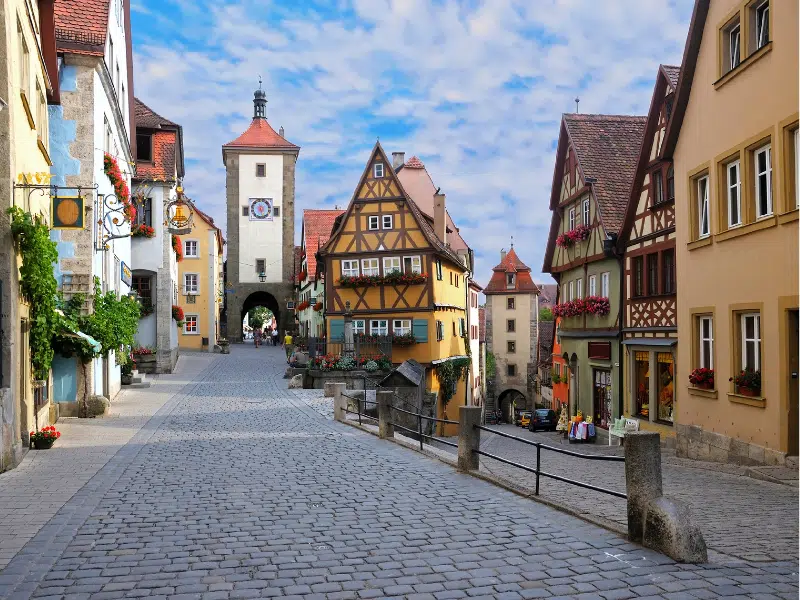
Rothenburg ob der Tauber stands on a ridge above the Tauber valley, a walled Franconian town of half-timbered houses, towers and gates. After the Thirty Years' War it lost its wealth and largely stopped growing, which is exactly why its medieval centre survived. Here are the facts and stories that make the town special.
10 fun facts about Rothenburg
- A free imperial city for over 500 years: King Rudolf of Habsburg granted Rothenburg the privileges of a free imperial city in 1274. It answered only to the emperor until 1803, when it became part of Bavaria.
- Walls you can walk on: much of the town wall still has its covered wooden walkway, and you can follow it for a long stretch around the old town, looking down into gardens and backyards.
- Names in the wall: after the Second World War, the damaged walls were rebuilt with donations from around the world. Many of the stones on the walkway carry the names of the people who paid for them.
- A third of the town destroyed: on 31 March 1945 an air raid destroyed about 275 houses, roughly a third of the town's buildings, mostly in the eastern part of the old town.
- Saved from the guns: in April 1945 the US Assistant Secretary of War, John J. McCloy, who knew how historic the town was, asked that it not be taken by artillery. Rothenburg made him an honorary citizen in 1948.
- A town hall in two styles: the rear, Gothic part of the Town Hall dates from the 13th century, while the Renaissance front facing the Market Square was begun in 1572. Its tower is almost 61 metres tall.
- A church that took 173 years: St Jacob's Church was finished in 1485. Its Holy Blood Altar, carved by Tilman Riemenschneider in the early 1500s, holds a relic said to contain a drop of Christ's blood.
- A street under a church: the west end of St Jacob's was built across Klingengasse, so the street passes through an arched tunnel right underneath the church.
- A church built into the wall: St Wolfgang's Church, from around 1500, is part of the fortifications at the Klingentor, with gun loops in its walls. It is known as the shepherds' church.
- The Plönlein: this small, sloping square where two streets split around a half-timbered house, framed by the Siebers Tower and the Kobolzell Gate, is one of the most photographed corners in Germany.
The legend of the Master Draught
In 1631, during the Thirty Years' War, the imperial general Count Tilly captured Protestant Rothenburg after a short siege. The legend says he ordered the town councillors to be executed and the town to be set on fire. To calm him down, the councillors offered him wine in a huge ceremonial tankard holding about three and a quarter litres. In a better mood, Tilly promised to spare the town if one of them could empty it in a single draught. The former mayor, Georg Nusch, stepped forward and drank the lot, and the town was saved. Historians doubt it happened this way, but the story has been performed as a festival play, Der Meistertrunk, since 1881. Several times a day, the windows beside the clock on the Councillors' Tavern on the Market Square open, and figures of Tilly and Nusch replay the scene.
What to eat in Rothenburg
- Schneeballen: snowballs made of strips of shortcrust pastry, fried and dusted with sugar or dipped in chocolate. They are crumbly, so eat them over a napkin.
- Schäufele: roast pork shoulder with crisp crackling, served with potato dumplings and dark beer gravy.
- Franconian bratwurst: grilled sausages with sauerkraut and a slice of rye bread, a classic at the town's inns.
- Franconian wine: dry Silvaner and other white wines from the region, often sold in the flat, round Bocksbeutel bottle.
Good to know before you go
- Tour groups fill the streets in the middle of the day. Stay overnight or arrive early to see the Plönlein and the Market Square quiet.
- The Town Hall tower is reached by narrow stairs and steep ladders near the top, and space on the viewing platform is very limited.
- The night watchman's tour starts on the Market Square in the evening and is a fun way to hear the town's stories.
- During Advent the Christmas market fills the centre, and the town's Christmas shops and German Christmas Museum are open all year.
Explore Rothenburg with World City Trail
Our Rothenburg scavenger hunt turns these sights into a game you play on your phone. The route links 10 stops and takes around two hours, with about 21 minutes of walking. Along the way you visit St Jacob's Church, St Wolfgang's Church and the Town Hall.
At each stop you solve a puzzle and hear a short story, at your own pace. You can start whenever you like.
Play the Rothenburg scavenger hunt →
Facts checked in October 2026.