
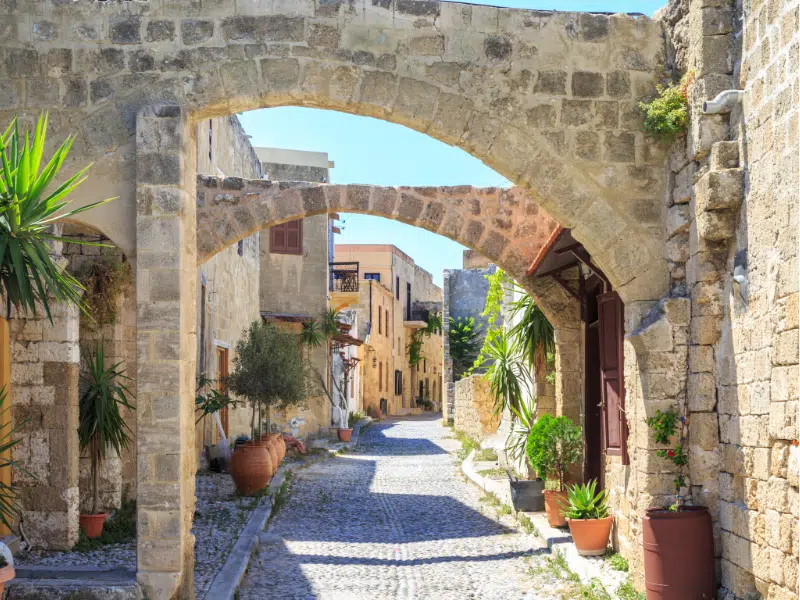
Rhodes Town has two pasts on top of each other: the ancient city that built the Colossus, and the walled medieval town that the Knights of St John raised over it. Behind its walls you will also find mosques, a synagogue and Italian-era buildings, all within a few minutes' walk. Here are the facts and stories that make the city special.
10 fun facts about Rhodes
- Three cities made one: Rhodes Town was founded in 408 BC, when the island's three older cities, Ialysos, Kamiros and Lindos, joined forces to build a new capital at its northern tip.
- Deer instead of a giant: two bronze deer on columns guard the entrance to Mandraki harbour. Many visitors are told the Colossus stood here, but historians think it more likely stood on land, perhaps near the ancient acropolis.
- Two centuries of knights: the Knights of St John, a military religious order founded in Jerusalem, ruled Rhodes from 1309 to 1522 and turned the town into one of the strongest fortresses in the Mediterranean.
- A siege with an honourable end: in 1522 Sultan Suleiman the Magnificent besieged Rhodes for about six months. The knights finally surrendered and were allowed to leave with their arms, and a few years later they settled in Malta.
- A living medieval town: the Medieval City of Rhodes has been a UNESCO World Heritage Site since 1988. People still live, work and shop inside its walls.
- A street of national inns: the knights were organised by language into groups called tongues, and each had its own inn. Several of them, including the Inn of France, line the cobbled Street of the Knights.
- Italian for 35 years: Italy took Rhodes and the other Dodecanese islands in 1912. They became part of Greece only in 1948, after the Second World War.
- Butterflies that are moths: in the Valley of the Butterflies, Petaloudes, thousands of insects gather on the trees in summer. They are in fact Jersey tiger moths, attracted by the shade and the scent of the storax trees.
- A temple above the village: in Lindos, a whitewashed village on the east coast, the acropolis with the Temple of Athena Lindia rises on a rock above the sea.
- Centuries of Jewish life: the Kahal Shalom Synagogue in the old Jewish quarter is one of the oldest synagogues in Greece. Most of the island's Jewish community was deported to Auschwitz in 1944, and a memorial in the Square of the Jewish Martyrs remembers them.
The story of the Colossus
In 305 BC, Demetrius Poliorcetes, the Besieger, laid siege to Rhodes for a year and failed. When he sailed away, he left his siege machines behind, and the Rhodians sold them to pay for a thank-you to their protector, the sun god Helios. The sculptor Chares of Lindos spent about twelve years building a bronze statue of Helios some 33 metres tall, one of the Seven Wonders of the Ancient World. It stood for only about 54 years: an earthquake around 226 BC snapped it at the knees. The famous image of the Colossus straddling the harbour entrance is a later invention, as a bronze figure that size could not have stood that way. The ruins lay on the ground for centuries, and the Roman writer Pliny said that few people could wrap their arms around its thumb. Legend says that when they were finally sold for scrap in the 7th century, it took 900 camels to carry the bronze away.
The Palace of the Grand Master, explained
The fortress-palace at the top of the Street of the Knights was the seat of the knights' Grand Master. In 1856 gunpowder stored in the nearby Church of St John exploded after a lightning strike and wrecked the palace. What you see today is largely a reconstruction built by the Italian authorities in the late 1930s. Inside, several floors are covered with ancient mosaics brought from the neighbouring island of Kos.
What to eat in Rhodes
- Pitaroudia: fritters of chickpeas, tomato, onion and mint, the island's classic meze.
- Melekouni: a bar of sesame seeds and honey with almonds and spices, traditionally handed out at weddings and christenings.
- Symi shrimp: tiny shrimps from the neighbouring island of Symi, fried crisp and eaten whole, shell and all.
- Souma: a strong clear spirit distilled on the island, served cold in small glasses.
- Local wine: vineyards around Embonas, on the slopes of Mount Attavyros, grow the white Athiri grape, one of the island's own varieties.
Good to know before you go
- In summer the Old Town heats up fast. Walk it early in the morning or in the evening, when the stone streets are cooler and quieter.
- For a different view of the fortifications, walk along the dry moat between the inner and outer walls.
- Lindos is an easy day trip by bus or boat. The path up to the acropolis is steep and exposed, so go early.
- Ferries and excursion boats from Mandraki harbour go to the island of Symi, with its colourful harbour town.
Explore Rhodes with World City Trail
Our Rhodes scavenger hunt turns these sights into a game you play on your phone. The route links 10 stops and takes around two hours, with about 30 minutes of walking, and leads you through the medieval Old Town to the Street of the Knights and the Palace of the Grand Master, among other sights.
At each stop you solve a puzzle and hear a short story, at your own pace. You can start whenever you like and play in English, German, French, Italian, Dutch, Polish or Greek.
Play the Rhodes scavenger hunt →
Facts checked in October 2026.