
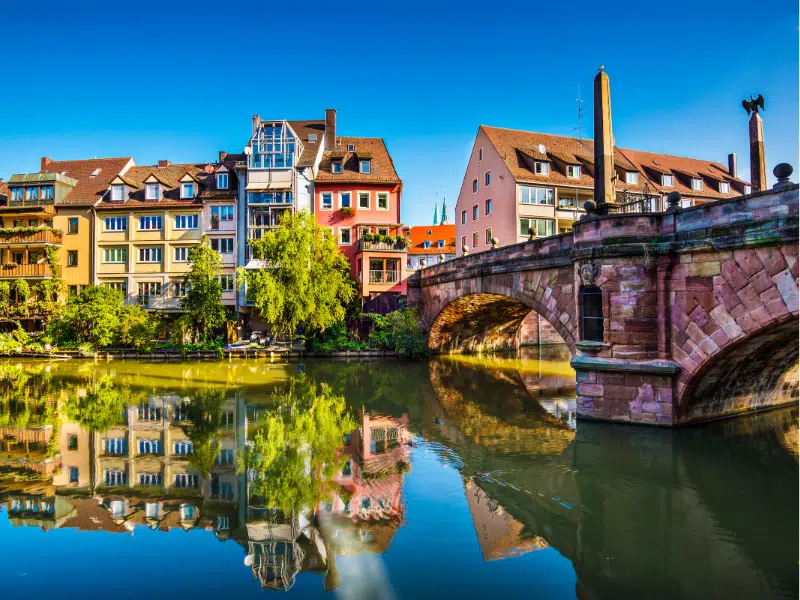
Nuremberg was one of the great cities of the Holy Roman Empire, a city of emperors, merchants, inventors and artists such as Albrecht Dürer. Most of its old town was destroyed in the Second World War and carefully rebuilt behind its medieval walls, and the city deals openly with its darker 20th-century history. Here are the facts and stories that make it special.
10 fun facts about Nuremberg
- A city of emperors: the Golden Bull of 1356 required every newly elected German king to hold his first Imperial Diet in Nuremberg, and from 1424 to 1796 the imperial regalia, including the crown, were kept here.
- A clock that remembers the Golden Bull: every day at noon, the Männleinlaufen on the Frauenkirche sets the seven prince-electors circling the emperor. The mechanism was installed between 1506 and 1509.
- A church on the site of a synagogue: the Frauenkirche was built from 1352 to 1362 where the synagogue had stood until the pogrom of 1349, after which Emperor Charles IV had the Jewish quarter cleared to make room for the Main Market.
- A fountain shaped like a spire: the Schöner Brunnen on the Main Market, built between 1385 and 1396, is about 19 metres tall. During the Second World War it was encased in concrete to protect it from the bombing.
- Dürer's city: Albrecht Dürer was born in Nuremberg in 1471. The house below the castle where he lived and worked from 1509 until his death in 1528 is now a museum.
- A masterpiece by Veit Stoss: in St Lorenz hangs the Angelic Salutation, life-size limewood figures of Mary and the angel Gabriel carved by Veit Stoss in 1517–1518 for the merchant Anton Tucher. Stoss also carved the high altar of St Mary's in Kraków.
- The oldest surviving globe: Martin Behaim's 'Erdapfel', made in Nuremberg in the early 1490s, is the oldest terrestrial globe that survives. It shows the world as Europeans knew it just before Columbus's voyages, and it is kept in the Germanisches Nationalmuseum.
- Germany's first railway: on 7 December 1835 the steam locomotive Adler made the first run on the Ludwigsbahn between Nuremberg and Fürth, the first railway line in Germany.
- Four great round towers: the city walls are guarded by four massive round towers, including the one at the Frauentor, built in the 1550s and 1560s after the Second Margrave War. Before then, all the towers on the wall were square.
- A sausage with a protected name: Nürnberger Rostbratwürste are only about finger-length, and to carry the name they must be made in the city. They are a protected geographical indication in the EU.
The legend of the ring in the Schöner Brunnen
Set into the wrought-iron grille around the Schöner Brunnen is a brass ring that visitors turn for luck. Legend says an apprentice of the master craftsman who made the grille fell in love with his master's daughter. The master refused to let them marry, so the apprentice secretly worked a ring into the grille, so finely made that no one could see how it had been fitted, to prove his skill before he left the city for good. Whether the story is true or not, the ring has been polished bright by the hands of countless visitors, and turning it is part of any first visit to the Main Market.
Nuremberg in the 20th century
The Nazis held their party rallies in Nuremberg every year from 1933 to 1938, and the anti-Jewish Nuremberg Laws were announced at the 1935 rally. On 2 January 1945 a heavy air raid destroyed most of the old town. After the war, the Allies chose the city for the trial of the leading Nazi war criminals, which opened on 20 November 1945 in Courtroom 600 of the Palace of Justice. Today the Memorium Nuremberg Trials tells that story, and the Documentation Centre on the former rally grounds examines how the regime used the city.
What to eat in Nuremberg
- Nürnberger Rostbratwürste: grilled over beechwood and served six or twelve at a time with sauerkraut, or 'drei im Weggla', three in a bread roll.
- Saure Zipfel: the same small sausages, poached in a broth of vinegar, onions and spices.
- Lebkuchen: soft spiced gingerbread. The finest kind, Elisenlebkuchen, is made with plenty of nuts and very little flour.
- Schäufele: roast pork shoulder with crackling, served with potato dumplings and dark beer gravy, a Franconian Sunday classic.
- Franconian beer: the region is known for its many small breweries, so try a local Rotbier or Kellerbier.
Good to know before you go
- The Kaiserburg sits on the sandstone ridge above the old town. The climb is short, and the castle gardens and terraces look out over the red roofs.
- The Christkindlesmarkt on the Main Market is one of Germany's best-known Christmas markets. It opens with the Christkind's prologue from the Frauenkirche balcony and is very busy at weekends.
- The Memorium Nuremberg Trials and the Documentation Centre are outside the old town but easy to reach by public transport. Check their websites before you go.
- Bamberg, with its own UNESCO-listed old town and its smoked beer, is less than an hour away by train.
Explore Nuremberg with World City Trail
Our Nuremberg scavenger hunt turns these sights into a game you play on your phone. The route links 10 stops and takes around two hours, with about 41 minutes of walking: the Frauentor, St Lorenz Church and the Schöner Brunnen on the Main Market.
At each stop you solve a puzzle and hear a short story, at your own pace. You can start whenever you like.
Play the Nuremberg scavenger hunt →
Facts checked in October 2026.