
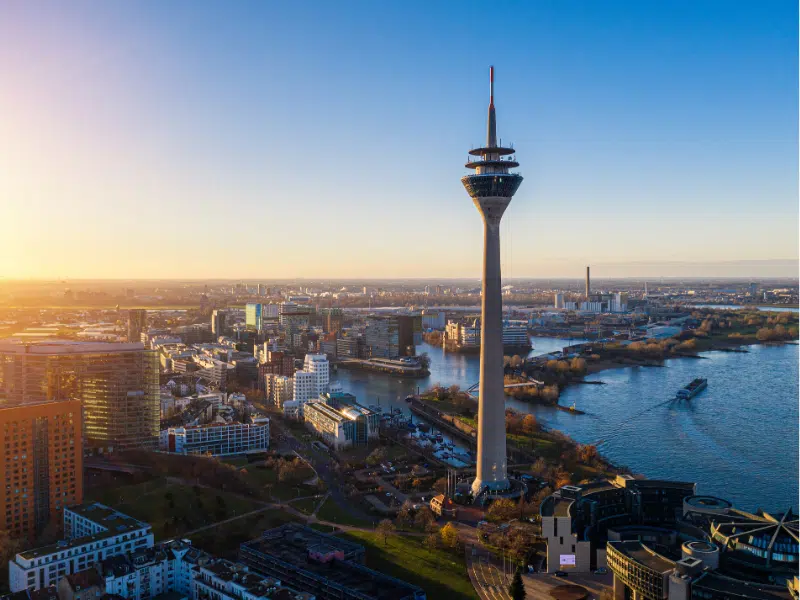
Düsseldorf grew from a small village on a stream called the Düssel into the capital of Germany's most populous state, a city of art academies, fashion fairs and dark beer. Its compact Altstadt sits right on the Rhine, so brewery taverns, a twisted church spire and one of Germany's great art collections are only a few streets apart. Here are the facts and stories that make the city special.
10 fun facts about Düsseldorf
- A village that kept its name: Düsseldorf simply means the village on the Düssel, a small river that flows into the Rhine here. It received its town charter in 1288, after the Count of Berg defeated the Archbishop of Cologne at the Battle of Worringen.
- A capital that is not the biggest city: Düsseldorf has been the capital of North Rhine-Westphalia since the state was created in 1946, even though neighbouring Cologne is larger.
- Children who turn cartwheels: the Radschläger, a cartwheeling boy, is the city's mascot. One legend says children cartwheeled through the streets to celebrate the victory of 1288. A cartwheeling competition has been held since 1937, and today more than 500 children take part each year.
- A spire with a twist: the spire of St Lambertus Basilica is visibly crooked. It was rebuilt after a fire in 1815 with damp timber that warped as it dried, and after the Second World War the people of Düsseldorf asked for it to be rebuilt crooked again.
- A church for the city's patron: St Lambertus was consecrated in 1394, and the relics of St Apollinaris, Düsseldorf's patron saint, rest there in a silver-gilt shrine donated in 1665. The pope raised the church to a minor basilica in 1974.
- A Renaissance town hall and a bronze elector: the Old Town Hall on the Marktplatz was built between 1570 and 1573. In front of it rides Jan Wellem, the Elector Johann Wilhelm, in a bronze statue by Gabriel de Grupello finished in 1711.
- The longest bar in the world: that is the nickname of the Altstadt, where pubs and brewery taverns stand door to door in a handful of streets between the Marktplatz and the river.
- A tower that tells the time: the Rheinturm, about 240 metres tall and completed in 1981, carries a light sculpture by Horst H. Baumann on its shaft. Its rows of lights show hours, minutes and seconds, and it is often called the largest digital clock in the world.
- 88 pictures by Paul Klee: in 1960 the state bought 88 works by Klee, and they became the heart of the Kunstsammlung Nordrhein-Westfalen. Its main building, K20 on Grabbeplatz, opened in 1986.
- A poet's birthplace: Heinrich Heine was born in 1797 on Bolkerstraße, in the middle of the Altstadt. The city's university has carried his name since 1988.
Carnival, Düsseldorf's fifth season
In Düsseldorf, carnival is not just a few days in February. The season opens every year on 11 November at 11:11, when the Hoppeditz, a jester figure, wakes up and climbs out of a giant mustard pot in front of the Town Hall to deliver a mocking speech to the city council. The high point comes months later on Rose Monday, when a long parade winds through the city centre. Its satirical floats, many built by the sculptor Jacques Tilly, regularly make international news. On Ash Wednesday the Hoppeditz is symbolically buried, and the season is over until the next November.
What to eat in Düsseldorf
- Altbier: a dark, top-fermented beer brewed in the old-town brewery taverns. The waiters, called Köbes, bring a new glass as soon as yours is empty, until you put your beer mat on top.
- Halve Hahn: despite the name, which means half a chicken, it is a rye roll with a thick slice of mature Gouda, mustard and onions.
- Düsseldorfer Mostert: the city's sharp, dark mustard, served with almost everything and sold in stoneware pots.
- Rheinischer Sauerbraten: beef marinated for days in vinegar and spices, served with a sweet-and-sour sauce with raisins, red cabbage and potato dumplings.
- Himmel un Ääd: heaven and earth, a mash of potatoes and apples served with fried black pudding and onions.
Good to know before you go
- The Rhine promenade runs from the Altstadt past the Rheinturm to the MedienHafen and is the easiest way to see the city's old and new sides on one walk.
- The Kunstsammlung has two main buildings a short walk apart: K20 on Grabbeplatz for classic modern art and K21 in the Ständehaus for contemporary art.
- Around 11 November and during the carnival days, the Altstadt is packed and hotels fill up early. The same goes for the big trade fairs, so check the fair calendar before booking.
- Cologne, with its cathedral, is a short train ride south, an easy day trip or add-on.
Explore Düsseldorf with World City Trail
Our Düsseldorf scavenger hunt turns these sights into a game you play on your phone. The route links 10 stops and takes around two hours, with about 24 minutes of walking. Along the way you visit St Lambertus Basilica, the Old Town Hall and the Kunstsammlung.
At each stop you solve a puzzle and hear a short story, at your own pace. You can start whenever you like.
Play the Düsseldorf scavenger hunt →
Facts checked in October 2026.