
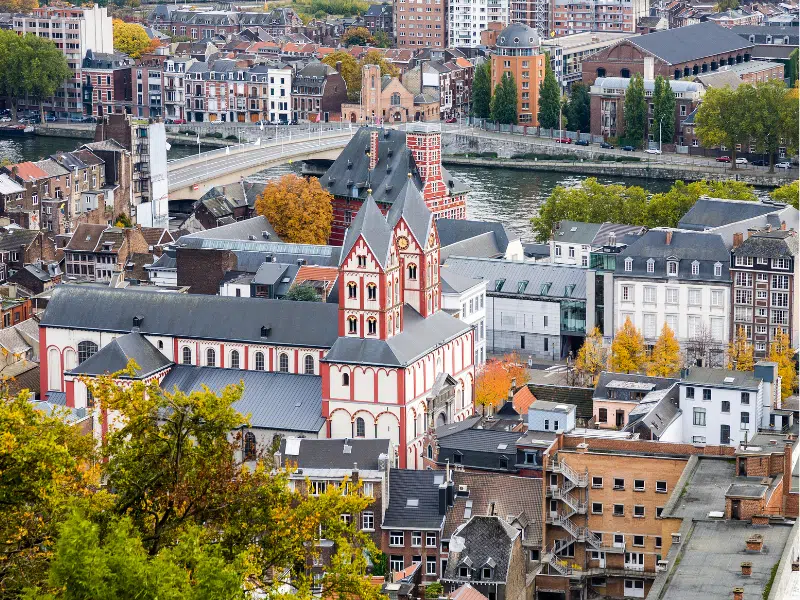
For eight centuries Liège was not part of any kingdom: it was the capital of its own state, ruled by prince-bishops. That past still shapes the city on the Meuse, from its palace and churches to a stubborn local pride in freedom. Here are the facts and stories that make the city special.
10 fun facts about Liège
- A state ruled by bishops: from 980 until 1795, Liège was the capital of a prince-bishopric, an independent principality governed by its bishops. Their palace on Place Saint-Lambert now houses the city's courts.
- A cathedral that vanished: the great Cathedral of Saint Lambert was torn down by the city's revolutionaries in the 1790s. Saint Paul's became the cathedral instead, and its treasury keeps a golden reliquary given by Charles the Bold, the duke who had sacked Liège.
- 374 steps straight up: the Montagne de Bueren, a stairway completed in 1881, climbs from the Hors-Château street towards the Citadelle. It is named after Vincent de Bueren, one of the leaders of the 600 Franchimontois.
- A painted Gothic sky: the Collegiate Church of Saint-Jacques began as a Benedictine abbey founded in 1015. Its Gothic nave has a richly painted vault, while the west end is still Romanesque.
- Charlemagne on horseback: a bronze statue of Charlemagne by Louis Jehotte was unveiled on Boulevard d'Avroy in 1868. Around its base stand six of his ancestors, among them Pepin of Herstal, named after a town just downstream from Liège.
- The Perron, symbol of freedom: the column on Place du Marché stands for the city's liberties. After crushing Liège in 1468, Charles the Bold had it carried off to Bruges, and it only came back after his death. The Three Graces on top were designed by Jean Del Cour in 1697.
- A city honoured by France: Liège's forts held up the German army in August 1914, and France awarded the city the Legion of Honour. The café liégeois, coffee with ice cream and whipped cream, is said to have been renamed in Paris in its honour.
- Maigret's creator was born here: Georges Simenon was born in Liège in 1903 and grew up in the Outremeuse district.
- The oldest of cycling's classics: Liège–Bastogne–Liège, first raced in 1892, is known as La Doyenne, the old lady.
- A station without walls: Santiago Calatrava's Liège-Guillemins station, opened in 2009, is covered by a vast arched roof of white steel and glass.
1468: Charles the Bold and the 600 Franchimontois
In 1468 Liège rose once again against the Duke of Burgundy. Charles the Bold marched on the city and forced the French king, Louis XI, to come with him. One night in late October, a few hundred men from the Franchimont region, remembered as the 600 Franchimontois, slipped into the enemy camp hoping to kill the duke and the king. They were discovered and almost all of them died. Charles then had Liège plundered and burned. The city recovered, but it never forgot that night: the Montagne de Bueren still carries the name of one of its leaders.
Outremeuse and Tchantchès, explained
Across the river lies Outremeuse, a working-class district that likes to call itself a free republic. Its hero is Tchantchès, a puppet in a cap and patched clothes who stands for the cheeky, warm-hearted spirit of Liège. A statue of him stands in the district, and puppet theatres still put him on stage. Every year around 15 August, Outremeuse holds its big popular festival, with processions, music and plenty of péket.
What to eat in Liège
- Gaufre de Liège: a dense, yeasted waffle with pearl sugar that caramelises in the iron. Eat it warm from a street stall.
- Boulets à la liégeoise: large meatballs in a sweet-sour sauce made with sirop de Liège, usually served with fries.
- Salade liégeoise: green beans, potatoes and bacon, dressed warm with vinegar and onions.
- Sirop de Liège: a dark, sticky spread made from cooked-down pears and apples, eaten on bread or with cheese.
- Péket: the local juniper spirit, served in small glasses and drunk freely during the 15 August festivities.
Good to know before you go
- On Sunday mornings the Batte market stretches along the quays of the Meuse, with food, flowers, clothes and much more.
- For the best view, climb the Montagne de Bueren and continue through the Coteaux de la Citadelle, terraced gardens with paths and viewpoints over the roofs.
- The Grand Curtius museum, in a Renaissance mansion on the river, covers the region's art and history in one visit.
- Maastricht and Aachen are easy to reach by train, and Spa, the town that gave its name to spas everywhere, makes a good day trip.
Explore Liège with World City Trail
Our Liège scavenger hunt turns these sights into a game you play on your phone. The route links 10 stops and takes around three hours, with about 54 minutes of walking, past sights such as Liège Cathedral, the Collegiate Church of Saint-Jacques, the Charlemagne statue and the Aquarium-Muséum.
At each stop you solve a puzzle and hear a short story, at your own pace. You can start whenever you like.
Play the Liège scavenger hunt →
Facts checked in October 2026.