
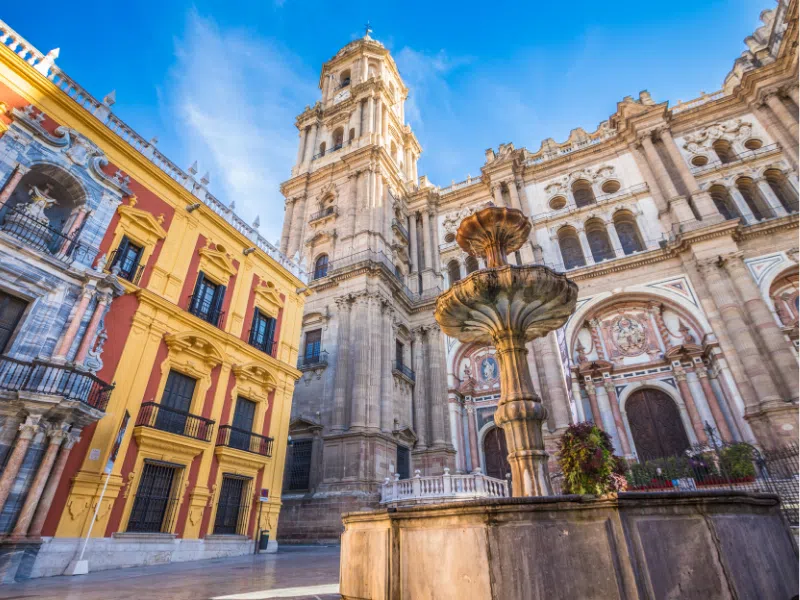
Málaga was founded by the Phoenicians around 2,800 years ago, and its centre squeezes a Roman theatre, a Moorish fortress and a Renaissance cathedral into a few streets. It is also the city where Pablo Picasso was born. Here are the facts and stories that make it special.
10 fun facts about Málaga
- Picasso's first home: Pablo Picasso was born on 25 October 1881 in a house on Plaza de la Merced, now a museum dedicated to him. Since 2008 a bronze Picasso by the sculptor Francisco López Hernández has sat on a bench in the same square.
- A family gift: the Museo Picasso Málaga opened in 2003 in the 16th-century Palacio de Buenavista, built around works donated by Picasso's daughter-in-law Christine and grandson Bernard.
- A theatre found by accident: the Roman Theatre was built under Emperor Augustus in the 1st century BC and lay buried for centuries. It was rediscovered in 1951 during building works, and the building that stood on top of it was later demolished.
- A fortress built from Roman stone: the Alcazaba was built by Muslim rulers in the 11th century, and its builders reused columns and stones from the Roman theatre below.
- A castle named after a lighthouse: the Castillo de Gibralfaro, above the Alcazaba, was enlarged in the 14th century by Yusuf I of Granada. Its name combines Arabic and Greek words for 'mountain of the lighthouse'.
- The one-armed lady: the cathedral was built between 1528 and 1782, but its south tower was never finished, which earned it the nickname La Manquita. Its completed north tower is 84 metres tall.
- A street for the rich and the strollers: Calle Larios, the city's elegant main shopping street, opened in 1891 and is named after the Larios family, who helped pay for it.
- France's colourful cube: in 2015 Málaga became home to the first Centre Pompidou outside France, housed under a glass cube at the port decorated with colour by the French artist Daniel Buren.
- A Moorish gate in an iron market: the 19th-century Mercado de Atarazanas incorporates a 14th-century Nasrid gateway from the shipyard that once stood on the site.
- An obelisk for executed rebels: the obelisk in Plaza de la Merced honours General José María Torrijos and his companions, shot on a Málaga beach in 1831 after a failed uprising against the absolutist King Ferdinand VII.
The prisoner set free every Holy Week
In 1759, the story goes, an epidemic struck Málaga and the processions could not go out. Prisoners in the city jail asked to carry the image of Jesus the Nazarene known as El Rico through the stricken streets. When permission was refused they broke out, carried the image anyway, and then returned to their cells without a single one escaping. Moved by their behaviour, King Charles III granted the brotherhood of El Rico the privilege of freeing one prisoner every year. Whatever the truth of the legend, the privilege is real: every Holy Wednesday a pardoned prisoner walks free in front of the image.
Holy Week, explained
Málaga's Semana Santa is one of the biggest in Spain. Brotherhoods carry enormous floats, called tronos, through the centre; the largest need more than 200 bearers. On Maundy Thursday, soldiers of the Spanish Legion land at the port and carry the Christ of the Good Death through the streets, singing their anthem 'El novio de la muerte'.
What to eat in Málaga
- Espetos de sardinas: sardines skewered on a cane and grilled over a wood fire, often in an old boat filled with sand, at the beach bars of Pedregalejo and El Palo.
- Pescaíto frito: lightly fried fish, especially anchovies; people from Málaga are even nicknamed boquerones, after the fresh anchovy.
- Ajoblanco: a cold soup of almonds, garlic, bread and olive oil, traditionally served with grapes on hot days.
- Málaga wine: sweet wines made from Moscatel and Pedro Ximénez grapes. Antigua Casa de Guardia, founded in 1840, still pours them from the barrel and chalks your bill on the counter.
- Coffee, Málaga style: the city has its own names for coffee, from a mitad (half coffee, half milk) to a sombra and a nube, with ever more milk. The system was popularised by Café Central, which closed in 2022.
Good to know before you go
- Climb up to Gibralfaro in the morning, before the heat, for the best view over the port, the bullring and the cathedral roofs.
- The Caminito del Rey, a cliffside walkway in the gorge of El Chorro, reopened in 2015 after restoration. Visits must be booked in advance.
- The Antequera Dolmens, huge prehistoric burial chambers inland from Málaga, have been a UNESCO World Heritage Site since 2016 and make an easy day trip.
- During Holy Week and the August fair, the centre is packed. Book accommodation early if you plan to visit then.
Explore Málaga with World City Trail
Our Málaga scavenger hunt turns these sights into a game you play on your phone. The route links 10 stops and takes around two hours, with about 31 minutes of walking, including Plaza de la Merced with its Picasso statue and the Roman Theatre.
At each stop you solve a puzzle and hear a short story, at your own pace. You can start whenever you like and play in English, German, French, Italian, Spanish or Dutch.
Play the Málaga scavenger hunt →
Facts checked in October 2026.