
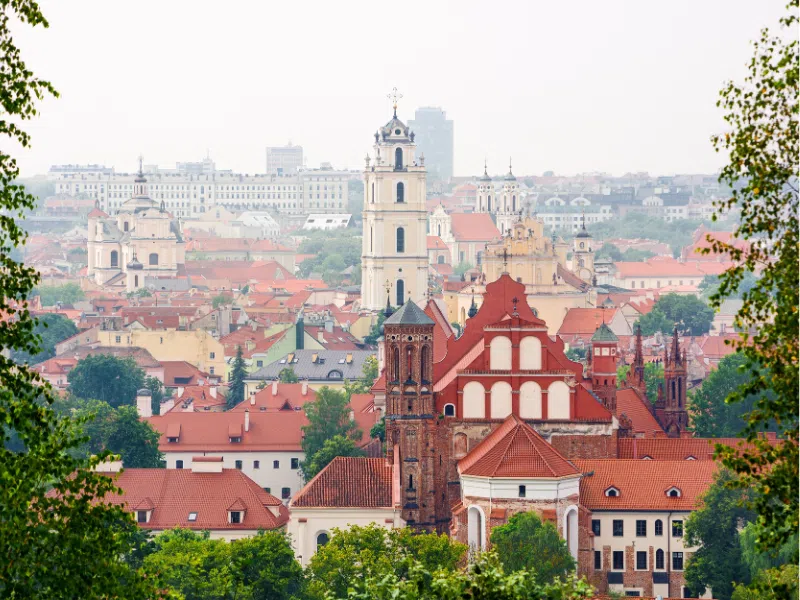
Vilnius is a capital where Baroque church towers rise above a medieval street plan, and where one neighbourhood has written its own constitution. The Old Town is one of the largest surviving medieval old towns in Northern Europe, and it is small enough to cross on foot in an afternoon. Here are the facts and stories that make the city special.
10 fun facts about Vilnius
- The last gate standing: the Gate of Dawn, built between 1503 and 1514, was one of nine gates in the city wall. When the walls were pulled down around 1800, it was the only one left intact. Its chapel holds an icon of the Virgin Mary that draws Catholic and Orthodox pilgrims alike.
- A huge medieval core: the Old Town covers about 350 hectares and has been a UNESCO World Heritage Site since 1994.
- Founded in a letter: Vilnius is first mentioned as a capital in 1323, in Latin letters sent by Grand Duke Gediminas to invite merchants and craftsmen to settle in his lands.
- One of the oldest universities in the region: Vilnius University was founded in 1579 by Stephen Báthory, King of Poland and Grand Duke of Lithuania. Its courtyards and the bell tower of St John's Church are in the heart of the Old Town.
- A church Napoleon wanted to take home: St Anne's Church, finished around 1500, was built with 33 different kinds of brick. Legend says that Napoleon, passing through in 1812, wished he could carry it back to Paris in the palm of his hand.
- A rock star with no Lithuanian ties: since 1995 a bronze bust of Frank Zappa has stood in the city centre. It was made by Konstantinas Bogdanas, a sculptor who had earlier cast portraits of Lenin.
- A street of small artworks: since 2009, artists have fixed around 200 small plaques, sculptures and objects to the walls of Literatų Street, each one dedicated to a writer linked to Vilnius or Lithuania.
- Balloons over the rooftops: Vilnius is one of just a few European capitals that allow hot-air balloons to fly over their historic centre. On calm summer evenings you can often spot them above the Old Town.
- Where a human chain began: on 23 August 1989 around two million people joined hands from Vilnius to Tallinn in the Baltic Way. A tile marked Stebuklas, meaning miracle, in Cathedral Square marks the spot, and people turn around on it to make a wish.
- The Jerusalem of the North: for centuries Vilnius was a major centre of Jewish learning, home to the 18th-century scholar Elijah ben Solomon, known as the Vilna Gaon. Most of the city's Jewish community was murdered in the Holocaust.
The legend of the Iron Wolf
Vilnius has a founding legend that every Lithuanian child knows. Grand Duke Gediminas went hunting in the forests where the Vilnia flows into the Neris and camped for the night below a hill. He dreamt of a huge iron wolf standing on the hilltop and howling as loudly as a hundred wolves. The pagan high priest Lizdeika explained the dream: the duke should build a castle and a city on that spot, and its fame would spread across the world like the wolf's howl. Gediminas did, and the red brick tower on Gediminas Hill still carries his name.
Užupis, explained
Across the little Vilnia river from the Old Town lies Užupis, a former run-down quarter that artists made their own. Every 1 April it celebrates its independence day as a self-declared republic, half joke and half philosophy. Its constitution is fixed to a wall in Paupio Street in many languages, with articles such as 'A dog has the right to be a dog' and 'Everyone has the right to make mistakes'. The bronze Angel of Užupis, unveiled in 2002, watches over the main square.
What to eat in Vilnius
- Cepelinai: large potato dumplings shaped like zeppelins, usually filled with minced meat and topped with sour cream and bacon. One plate is a full meal.
- Šaltibarščiai: a cold soup of beetroot and kefir, bright pink, with dill, cucumber and egg. It is served in summer with hot boiled potatoes on the side.
- Kibinai: pastries filled with mutton or other meat, brought to Lithuania by the Karaim community, whose home is the lake town of Trakai.
- Kepta duona: strips of dark rye bread fried with garlic, often with a cheese dip. Lithuania's favourite snack with beer.
- Šakotis: a tall 'tree cake' baked layer by layer on a rotating spit over an open fire, served at weddings and festivals.
Good to know before you go
- Trakai Island Castle, a red brick castle on a lake, is a short train or bus ride west of Vilnius and makes an easy half-day trip.
- The Gate of Dawn chapel is an active place of worship. You can see the icon through the window from the street, or climb the stairs to the chapel quietly.
- For a view over the Old Town, go up Gediminas Hill or the Hill of Three Crosses. Paths on Gediminas Hill have been closed at times after landslides, so check before you go.
Explore Vilnius with World City Trail
Our Vilnius scavenger hunt turns these sights into a game you play on your phone. The route links 10 stops and takes around three hours, with about 58 minutes of walking, and leads you past the Gate of Dawn, Town Hall Square and Literatų Street, among other sights.
At each stop you solve a puzzle and hear a short story, at your own pace. You can start whenever you like and play in English, German, French, Italian, Spanish or Dutch.
Play the Vilnius scavenger hunt →
Facts checked in October 2026.