
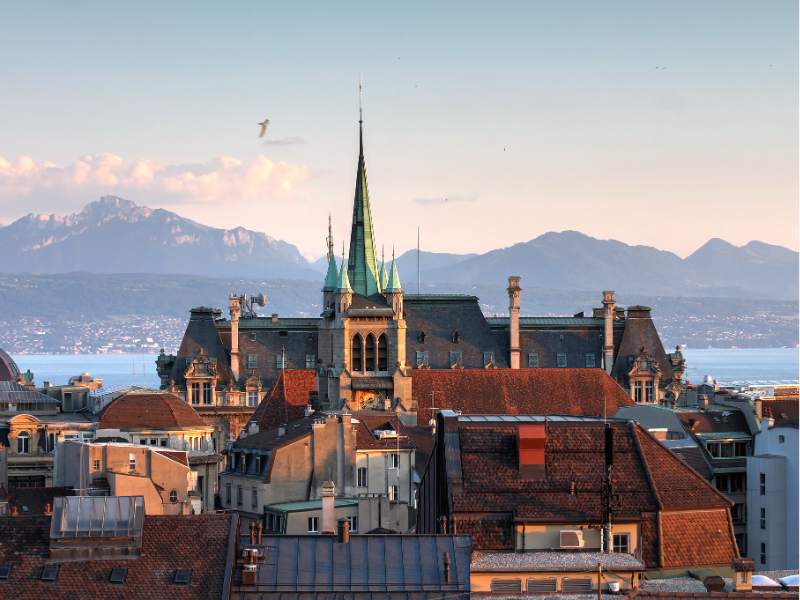
Lausanne climbs steeply from the shore of Lake Geneva up to its Gothic cathedral, so in this city you go up and down as much as along. It is the home of the Olympic movement and Switzerland's highest court, and it still keeps a medieval night watchman. Here are the facts and stories that make it special.
10 fun facts about Lausanne
- A night watchman since 1405: every night from 10 pm to 2 am, a watchman, le guet, climbs the cathedral tower and calls out the hour over the city. Lausanne is one of the last places in Europe to keep this tradition.
- A cathedral consecrated by a pope: Lausanne Cathedral was consecrated in 1275 by Pope Gregory X, in the presence of King Rudolf of Habsburg. It is often called the finest Gothic building in Switzerland.
- The Olympic Capital: the International Olympic Committee moved its headquarters to Lausanne in 1915 at the invitation of Pierre de Coubertin, and the IOC named Lausanne the Olympic Capital in 1994.
- The world's steepest metro: the M2 line, opened in 2008, climbs from the lakeshore at Ouchy to the upper city with gradients of up to 12 percent, the steepest of any metro line in the world.
- Switzerland's highest court: the Federal Supreme Court has its seat in Lausanne, in the Mon-Repos park, not in the capital Bern.
- A treaty that redrew a map: the Treaty of Lausanne, signed in the Palais de Rumine on 24 July 1923, set the borders of modern Turkey.
- Medieval stairs with a roof: the covered wooden Escaliers du Marché lead from Place de la Palud up towards the cathedral, as they have since the Middle Ages.
- A clock with a show: on Place de la Palud, an animated clock built for the 1964 Swiss National Exhibition opens on the hour and figures from Vaud's history parade past.
- A museum born from a painter's collection: the Collection de l'Art Brut opened in 1976, built on the works by outsiders and self-taught artists that the French painter Jean Dubuffet gave to the city.
- Vineyards on the World Heritage List: the Lavaux terraces, which drop to the lake just east of Lausanne, have been a UNESCO World Heritage Site since 2007.
The voice in the tower
For more than 600 years, Lausanne has been watched over at night from the cathedral tower. The guet's original job was to look out for fires in a city of wooden houses and to raise the alarm. Today the role is purely a tradition, but it has never stopped. Every hour from 10 pm to 2 am, the watchman leans out from each side of the belfry and calls: 'C'est le guet ! Il a sonné l'heure', 'This is the watch! The hour has struck', followed by the time. If you stand below the cathedral late in the evening, you can hear the call drift over the rooftops.
Lausanne and the Olympics, explained
Pierre de Coubertin, who revived the modern Olympic Games, settled the IOC in Lausanne during the First World War because neutral Switzerland was a safe base, and he later lived in the city himself. Today dozens of international sports federations have offices in and around Lausanne. The Olympic Museum, which opened in 1993 in a park on the lakeshore at Ouchy, tells the story of the Games through torches, medals and kit, and its terraced gardens are free to walk around.
What to eat in Lausanne
- Papet vaudois: a creamy mix of leeks and potatoes, served with a saucisse aux choux, the local cabbage sausage.
- Malakoffs: deep-fried cheese fritters from the Vaud lakeside. Legend says soldiers from the region brought the recipe home from the siege of the Malakoff fort in the Crimean War.
- Filets de perche: small perch fillets from Lake Geneva, pan-fried in butter and served with chips, a lakeside classic.
- Taillé aux greubons: a flaky savoury pastry made with crackling, the crispy bits left after rendering pork fat.
- Chasselas: the white grape of the Lavaux terraces, light and mineral, the natural partner for cheese dishes.
Good to know before you go
- Lausanne is very steep. Use the M2 to go uphill and walk down, or the other way round, and wear comfortable shoes.
- If you stay overnight in a hotel, ask for the Lausanne Transport Card, which covers public transport in the city for the length of your stay.
- The trains along the lake through Lavaux stop at small wine villages such as Cully and Chexbres, and the walking paths between the terraces make an easy half-day trip.
- Boats from Ouchy cross Lake Geneva to Évian in France and sail along the shore to Vevey and Montreux.
Explore Lausanne with World City Trail
Our Lausanne scavenger hunt turns these sights into a game you play on your phone. The route links 10 stops and takes around three hours, with about 41 minutes of walking, from Lausanne station via the Esplanade de Montbenon to Place de la Palud.
At each stop you solve a puzzle and hear a short story, at your own pace. You can start whenever you like and play in English, German, French, Italian, Spanish or Dutch.
Play the Lausanne scavenger hunt →
Facts checked in October 2026.