
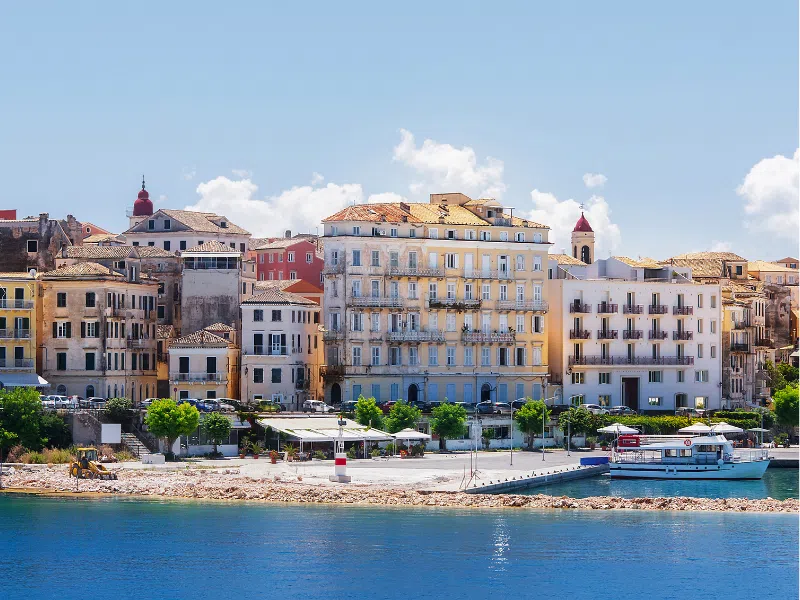
Corfu Town looks more Italian than almost anywhere else in Greece. For four centuries the island belonged to Venice, and the French and British who followed added arcades, palaces and even a taste for cricket. Its Old Town, squeezed between two fortresses, is a UNESCO World Heritage Site. Here are the facts and stories that make the city special.
10 fun facts about Corfu
- Never under Ottoman rule: Venice held Corfu from 1386 to 1797, and its fortifications withstood major Ottoman sieges in 1537 and 1716. The island is one of the few parts of Greece that the Ottomans never ruled.
- A fortress on its own island: the Old Fortress sits on a rocky headland that the Venetians cut off from the town with a sea moat. The New Fortress guards the other side of the Old Town.
- World Heritage since 2007: the Old Town of Corfu was added to the UNESCO list in 2007 for its Venetian-era fortifications and its tightly packed historic streets.
- A piece of Paris: the Liston arcades were built in 1807, during French rule, by the imperial commissioner Mathieu de Lesseps, and were inspired by the Rue de Rivoli in Paris.
- Cricket in a Greek square: the British, who ran the Ionian Islands for half a century until 1864, brought cricket with them, and matches are still played on the Spianada, the great open square in front of the Liston.
- A palace for British governors: the Palace of St Michael and St George, built between 1819 and 1824, was the residence of the British Lord High Commissioners. Today it houses the Museum of Asian Art.
- Greece's first modern university: the Ionian Academy, founded in Corfu in 1824 by the British philhellene Lord Guilford, is regarded as the first Greek university of modern times.
- A town of brass bands: Corfu Town has several philharmonic bands that march at every big festival. The oldest, the Philharmonic Society of Corfu, was founded in 1840.
- Famous births: Ioannis Kapodistrias, the first head of state of independent Greece, was born in Corfu Town in 1776. Prince Philip, Duke of Edinburgh, was born at the Mon Repos estate just south of the town in 1921.
- An empress's palace: Empress Elisabeth of Austria, known as Sisi, had the Achilleion built in the hills south of the town in 1890 and 1891, and dedicated it to the hero Achilles.
Saint Spyridon, the island's protector
Corfu's patron saint is Spyridon, a 4th-century bishop from Cyprus. His relics were brought to Corfu in the 15th century and rest in the church of Agios Spyridon, whose tall bell tower with its red dome rises above the Old Town. Legend credits the saint with saving the island several times: from famine, from plague and, in 1716, from the Ottoman siege, which was lifted suddenly in August of that year. Four times a year, on Palm Sunday, Holy Saturday, 11 August and the first Sunday of November, his relics are carried through the streets in a procession with bands playing. So many Corfiot men are named Spyros after him that the name has become a symbol of the island.
Easter in Corfu, explained
Easter is the biggest event of the Corfiot year. On Good Friday, the epitaphios processions of the different parishes wind through the Old Town, each accompanied by a philharmonic band. On the morning of Holy Saturday comes the island's best-known custom: people throw large clay pots full of water from their balconies, and they smash on the streets below to cheers from the crowd. At midnight, the Resurrection is celebrated on the Spianada with candles, church bells and fireworks.
What to eat in Corfu
- Pastitsada: rooster or beef slowly cooked in a spiced tomato sauce and served with thick pasta, a Sunday dish with Venetian roots.
- Sofrito: thin slices of veal in a sauce of garlic, white wine vinegar and parsley.
- Bourdeto: a fiery fish stew with red pepper, traditionally made with scorpionfish.
- Kumquat: the small citrus fruit grown in the north of the island is turned into liqueur, sweets and preserves sold all over the Old Town.
- Tsitsibira: Corfiot ginger beer, a refreshing leftover from British rule that you will find in cafés around the Spianada.
Good to know before you go
- For the classic view of Pontikonisi, Mouse Island, and the Vlacherna monastery, go to Kanoni, south of the town, where planes land right overhead on the nearby runway.
- Climb to the top of the Old Fortress for a view over the Old Town, the sea and the Albanian coast.
- Easter week is the most popular time to visit Corfu Town, so book your accommodation well in advance.
- The Achilleion and the west-coast bays of Paleokastritsa are each an easy half-day trip from town by bus or car.
Explore Corfu with World City Trail
Our Corfu scavenger hunt turns these sights into a game you play on your phone. The route links 10 stops and takes around two hours, with about 26 minutes of walking, past places including Spianada Square and the Liston arcades.
At each stop you solve a puzzle and hear a short story, at your own pace. You can start whenever you like and play in English, German, French, Italian, Dutch or Greek.
Play the Corfu scavenger hunt →
Facts checked in October 2026.