
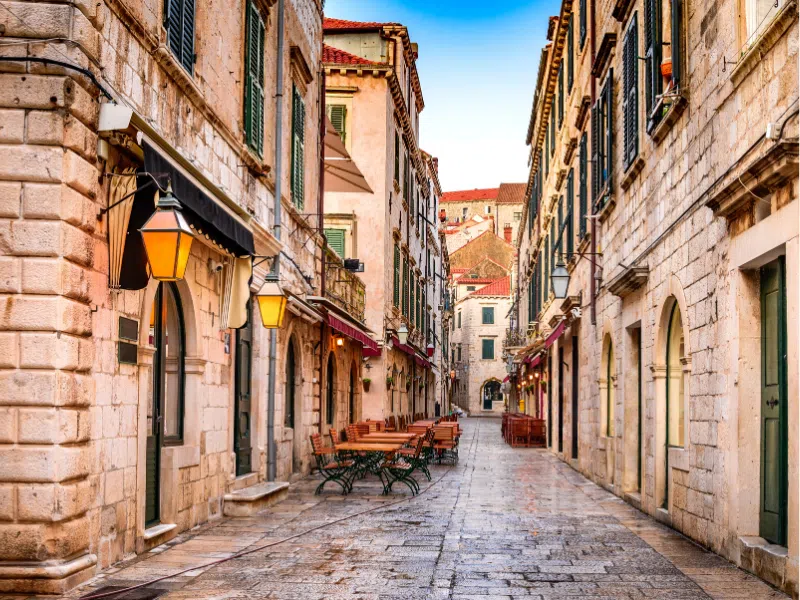
For centuries Dubrovnik was the capital of its own small state, the Republic of Ragusa, which survived between Venice and the Ottoman Empire by trade and clever diplomacy. Its walled old town on the Adriatic still looks much as it did when the Republic ended in 1808. Here are the facts and stories that make the city special.
10 fun facts about Dubrovnik
- Walls you can walk all the way round: the city walls run for about 1,940 metres around the old town, with towers and forts along the way. Walking the full circuit is the best way to see the sea of terracotta roofs inside.
- Freedom above all: the Republic's motto was Libertas. Above the entrance to Fort Lovrijenac is the inscription 'Non bene pro toto libertas venditur auro', freedom is not sold for all the gold in the world.
- One of the first quarantines: in 1377 the Republic ordered people arriving from plague areas to spend 30 days in isolation before entering the city, one of the earliest quarantine laws in the world. The later quarantine buildings, the Lazareti, still stand outside the eastern gate.
- A pharmacy open since 1317: the pharmacy in the Franciscan monastery near Pile Gate is one of the oldest pharmacies in Europe still in business.
- An early ban on the slave trade: in 1416 the Republic's council voted to forbid the slave trade, centuries before most of Europe did the same.
- Sixteen stone faces: Onofrio's Great Fountain, built from 1438, was the end point of an aqueduct that brought fresh water to the city. Water still pours from 16 carved masks around its base.
- A knight as a measuring stick: Orlando's Column, set up in 1418 in front of St Blaise's Church, shows a medieval knight. The length of his forearm served as the Republic's official unit of length, the Dubrovnik ell.
- Rebuilt after the great earthquake: in 1667 an earthquake destroyed much of the city. The main street, Stradun, was rebuilt with rows of matching stone houses, and its limestone paving has been polished smooth by centuries of feet.
- Damaged and restored: the old town became a UNESCO World Heritage Site in 1979. During the siege of 1991–92 it was shelled, and a map near Pile Gate shows where the shells fell. The roofs were repaired, but you can still spot the newer, brighter tiles.
- King's Landing on screen: from its second season, Game of Thrones used Dubrovnik as King's Landing, with Fort Lovrijenac and the Jesuit Stairs among the best-known locations.
The legend of Saint Blaise
Dubrovnik's patron saint is Saint Blaise, an Armenian bishop of the 4th century, and the city's love for him comes from a legend. In the 10th century, Venetian ships anchored off the coast, claiming they only needed water and supplies. Saint Blaise appeared in a vision to a priest named Stojko and warned him that the Venetians were planning a surprise attack. Stojko alerted the city's leaders, the defences were readied and the Venetians sailed away. Since then Saint Blaise has watched over the city: his statue stands above the gates and on the walls, usually holding a model of Dubrovnik in his hand. His feast on 3 February is the city's biggest celebration, with processions, flags and relics carried through the streets, and it is on UNESCO's list of intangible cultural heritage.
Pile Gate, explained
Pile Gate is the main entrance to the old town from the west. The outer gate dates from 1537, and a wooden drawbridge on chains crosses the old moat. In the days of the Republic the bridge was raised every evening and the gates were locked, cutting the city off for the night. Look up to see Saint Blaise in a niche above the arch. Through the inner gate, Onofrio's Great Fountain and the long, straight line of Stradun open up in front of you.
What to eat in Dubrovnik
- Black risotto: crni rižot, made with cuttlefish and its ink, is the classic dish along the Dalmatian coast.
- Ston oysters: from the bay of Mali Ston, about an hour's drive north-west, and best eaten raw with a squeeze of lemon.
- Rožata: Dubrovnik's custard pudding with caramel, traditionally flavoured with a rose liqueur.
- Arancini: in Dubrovnik this means candied orange peel, a sweet that families make at home and sell at markets.
- Plavac Mali: the red grape of the nearby Pelješac peninsula, behind well-known wines such as Dingač and Postup.
Good to know before you go
- Walk the walls early in the morning or late in the afternoon. There is little shade up there, and visitors walk the circuit in one direction only.
- The old town is busiest in the middle of the day, when cruise ship passengers arrive. Evenings are much calmer.
- For the classic view over the walls and islands, take the cable car or the zigzag footpath up Mount Srđ.
- Boats from the old port take you to the island of Lokrum in about a quarter of an hour, for swimming, shady paths and peacocks.
Explore Dubrovnik with World City Trail
Our Dubrovnik scavenger hunt turns these sights into a game you play on your phone. The route links 10 stops and takes around two hours, with only about 17 minutes of walking, and includes Pile Gate and Onofrio's Great Fountain.
At each stop you solve a puzzle and hear a short story, at your own pace. You can start whenever you like.
Play the Dubrovnik scavenger hunt →
Facts checked in October 2026.