
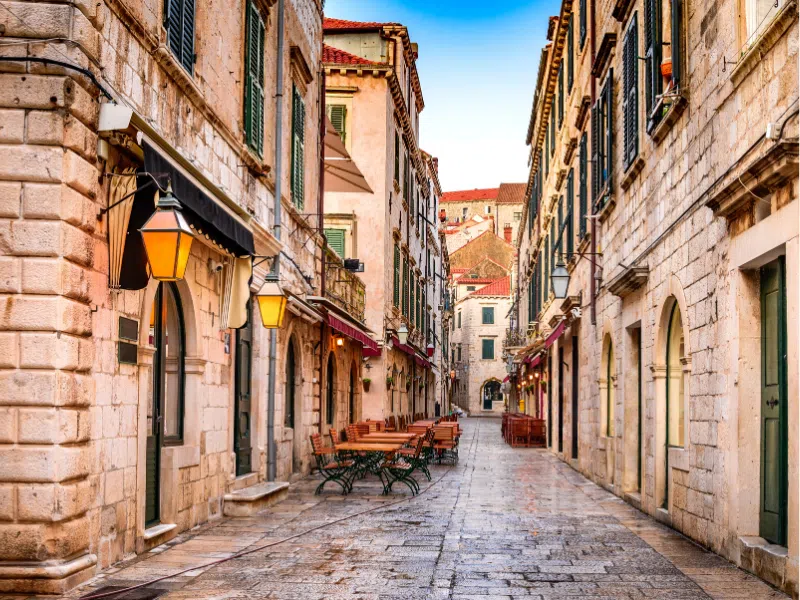
Eeuwenlang was Dubrovnik de hoofdstad van een eigen kleine staat, de Republiek Ragusa, die zich tussen Venetië en het Ottomaanse Rijk staande hield met handel en slimme diplomatie. De ommuurde oude stad aan de Adriatische Zee ziet er nog grotendeels uit zoals toen de republiek in 1808 ophield te bestaan. Dit zijn de feiten en verhalen die de stad bijzonder maken.
10 leuke weetjes over Dubrovnik
- Muren waar je helemaal omheen loopt: de stadsmuren lopen over zo’n 1.940 meter rond de oude stad, met torens en forten onderweg. De hele ronde lopen is de beste manier om de zee van terracottadaken te zien.
- Freedom above all: the Republic's motto was Libertas. Above the entrance to Fort Lovrijenac is the inscription 'Non bene pro toto libertas venditur auro', freedom is not sold for all the gold in the world.
- Een van de eerste quarantaines: in 1377 besloot de republiek dat wie uit pestgebieden kwam eerst 30 dagen in afzondering moest, voordat hij de stad in mocht. Het is een van de vroegste quarantainewetten ter wereld. De latere quarantainegebouwen, de Lazareti, staan nog buiten de oostpoort.
- Een apotheek sinds 1317: de apotheek in het franciscanenklooster bij de Pilepoort is een van de oudste nog werkende apotheken van Europa.
- An early ban on the slave trade: in 1416 the Republic's council voted to forbid the slave trade, centuries before most of Europe did the same.
- Sixteen stone faces: Onofrio's Great Fountain, built from 1438, was the end point of an aqueduct that brought fresh water to the city. Water still pours from 16 carved masks around its base.
- A knight as a measuring stick: Orlando's Column, set up in 1418 in front of St Blaise's Church, shows a medieval knight. The length of his forearm served as the Republic's official unit of length, the Dubrovnik ell.
- Herbouwd na de grote aardbeving: in 1667 verwoestte een aardbeving een groot deel van de stad. De hoofdstraat, de Stradun, werd herbouwd met rijen gelijke stenen huizen, en het kalkstenen plaveisel is door eeuwen voetstappen glad gesleten.
- Beschadigd en hersteld: de oude stad staat sinds 1979 op de Werelderfgoedlijst van UNESCO. Tijdens het beleg van 1991–92 werd ze beschoten, en een kaart bij de Pilepoort laat zien waar de granaten insloegen. De daken zijn hersteld, maar de nieuwere, lichtere dakpannen vallen nog op.
- King's Landing on screen: from its second season, Game of Thrones used Dubrovnik as King's Landing, with Fort Lovrijenac and the Jesuit Stairs among the best-known locations.
De legende van Sint-Blasius
Dubrovnik's patron saint is Saint Blaise, an Armenian bishop of the 4th century, and the city's love for him comes from a legend. In the 10th century, Venetian ships anchored off the coast, claiming they only needed water and supplies. Saint Blaise appeared in a vision to a priest named Stojko and warned him that the Venetians were planning a surprise attack. Stojko alerted the city's leaders, the defences were readied and the Venetians sailed away. Since then Saint Blaise has watched over the city: his statue stands above the gates and on the walls, usually holding a model of Dubrovnik in his hand. His feast on 3 February is the city's biggest celebration, with processions, flags and relics carried through the streets, and it is on UNESCO's list of intangible cultural heritage.
De Pilepoort uitgelegd
Pile Gate is the main entrance to the old town from the west. The outer gate dates from 1537, and a wooden drawbridge on chains crosses the old moat. In the days of the Republic the bridge was raised every evening and the gates were locked, cutting the city off for the night. Look up to see Saint Blaise in a niche above the arch. Through the inner gate, Onofrio's Great Fountain and the long, straight line of Stradun open up in front of you.
Wat je moet eten in Dubrovnik
- Zwarte risotto: crni rižot, met inktvis en zijn inkt, is het klassieke gerecht van de Dalmatische kust.
- Ston oysters: from the bay of Mali Ston, about an hour's drive north-west, and best eaten raw with a squeeze of lemon.
- Rožata: Dubrovnik's custard pudding with caramel, traditionally flavoured with a rose liqueur.
- Arancini: in Dubrovnik zijn dat gekonfijte sinaasappelschillen, die families thuis maken en op markten verkopen.
- Plavac Mali: de blauwe druif van het nabije schiereiland Pelješac, waarvan bekende wijnen als Dingač en Postup worden gemaakt.
Goed om te weten voor je gaat
- Loop vroeg in de ochtend of laat in de middag over de muren. Er is daarboven weinig schaduw, en je loopt de ronde maar in één richting.
- De oude stad is midden op de dag het drukst, als de passagiers van cruiseschepen aankomen. ‘s Avonds is het veel rustiger.
- Voor het klassieke uitzicht over de muren en eilanden neem je de kabelbaan of het zigzagpad de berg Srđ op.
- Boten vanuit de oude haven brengen je in ongeveer een kwartier naar het eiland Lokrum, om te zwemmen, over schaduwrijke paden te lopen en pauwen te zien.
Ontdek Dubrovnik met World City Trail
Our Dubrovnik scavenger hunt turns these sights into a game you play on your phone. The route links 10 stops and takes around two hours, with only about 17 minutes of walking, and includes Pile Gate and Onofrio's Great Fountain.
Bij elke stop los je een puzzel op en hoor je een kort verhaal, in je eigen tempo. Je kunt beginnen wanneer je wilt.
Speel de schattenjacht in Dubrovnik →
Feiten gecontroleerd in oktober 2026.