
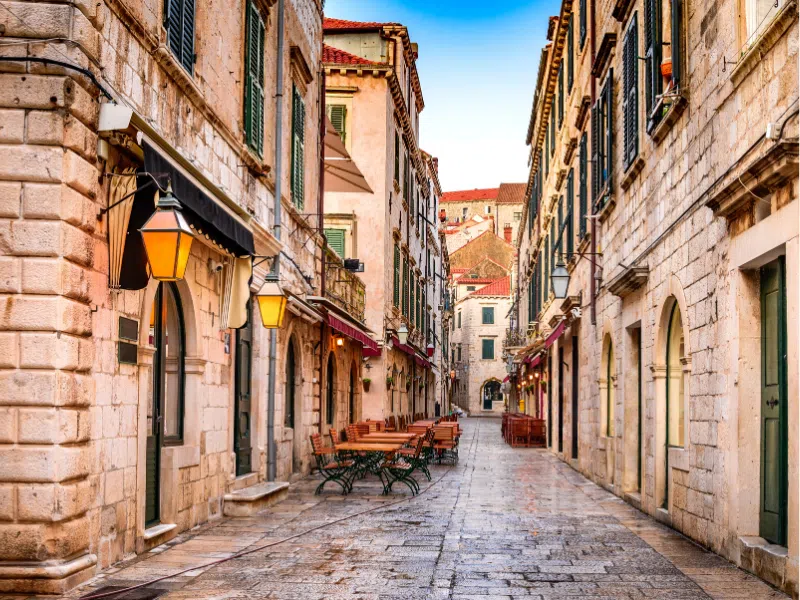
Durante siglos, Dubrovnik fue la capital de su propio pequeño Estado, la República de Ragusa, que sobrevivió entre Venecia y el Imperio otomano gracias al comercio y a una diplomacia hábil. Su casco antiguo amurallado junto al Adriático se parece mucho todavía a como era cuando la República desapareció en 1808. Estos son los datos y las historias que hacen especial a la ciudad.
10 curiosidades sobre Dubrovnik
- Murallas que se recorren enteras: la muralla rodea el casco antiguo a lo largo de unos 1.940 metros, con torres y fuertes por el camino. Dar la vuelta completa es la mejor manera de ver el mar de tejados de terracota.
- Freedom above all: the Republic's motto was Libertas. Above the entrance to Fort Lovrijenac is the inscription 'Non bene pro toto libertas venditur auro', freedom is not sold for all the gold in the world.
- Una de las primeras cuarentenas: en 1377 la República obligó a quienes llegaban de zonas con peste a pasar 30 días aislados antes de entrar en la ciudad, una de las primeras leyes de cuarentena del mundo. Los edificios de cuarentena construidos después, los Lazareti, siguen en pie junto a la puerta este.
- Una farmacia abierta desde 1317: la farmacia del monasterio franciscano, cerca de la Puerta de Pile, es una de las más antiguas de Europa que siguen funcionando.
- An early ban on the slave trade: in 1416 the Republic's council voted to forbid the slave trade, centuries before most of Europe did the same.
- Sixteen stone faces: Onofrio's Great Fountain, built from 1438, was the end point of an aqueduct that brought fresh water to the city. Water still pours from 16 carved masks around its base.
- A knight as a measuring stick: Orlando's Column, set up in 1418 in front of St Blaise's Church, shows a medieval knight. The length of his forearm served as the Republic's official unit of length, the Dubrovnik ell.
- Reconstruida tras el gran terremoto: en 1667 un terremoto destruyó gran parte de la ciudad. La calle principal, el Stradun, se reconstruyó con hileras de casas de piedra iguales, y su pavimento de caliza está pulido por siglos de pisadas.
- Dañada y restaurada: el casco antiguo es Patrimonio Mundial de la UNESCO desde 1979. Durante el asedio de 1991–92 fue bombardeado, y un mapa junto a la Puerta de Pile muestra dónde cayeron los proyectiles. Los tejados se repararon, pero aún se distinguen las tejas más nuevas y claras.
- King's Landing on screen: from its second season, Game of Thrones used Dubrovnik as King's Landing, with Fort Lovrijenac and the Jesuit Stairs among the best-known locations.
La leyenda de San Blas
Dubrovnik's patron saint is Saint Blaise, an Armenian bishop of the 4th century, and the city's love for him comes from a legend. In the 10th century, Venetian ships anchored off the coast, claiming they only needed water and supplies. Saint Blaise appeared in a vision to a priest named Stojko and warned him that the Venetians were planning a surprise attack. Stojko alerted the city's leaders, the defences were readied and the Venetians sailed away. Since then Saint Blaise has watched over the city: his statue stands above the gates and on the walls, usually holding a model of Dubrovnik in his hand. His feast on 3 February is the city's biggest celebration, with processions, flags and relics carried through the streets, and it is on UNESCO's list of intangible cultural heritage.
La Puerta de Pile, explicada
Pile Gate is the main entrance to the old town from the west. The outer gate dates from 1537, and a wooden drawbridge on chains crosses the old moat. In the days of the Republic the bridge was raised every evening and the gates were locked, cutting the city off for the night. Look up to see Saint Blaise in a niche above the arch. Through the inner gate, Onofrio's Great Fountain and the long, straight line of Stradun open up in front of you.
Qué comer en Dubrovnik
- Risotto negro: el crni rižot, con sepia y su tinta, es el plato clásico de la costa dálmata.
- Ston oysters: from the bay of Mali Ston, about an hour's drive north-west, and best eaten raw with a squeeze of lemon.
- Rožata: Dubrovnik's custard pudding with caramel, traditionally flavoured with a rose liqueur.
- Arancini: en Dubrovnik son cáscaras de naranja confitadas, que las familias preparan en casa y venden en los mercados.
- Plavac Mali: la uva tinta de la cercana península de Pelješac, de la que salen vinos conocidos como el Dingač y el Postup.
Antes de ir
- Recorre las murallas a primera hora de la mañana o al final de la tarde. Arriba hay muy poca sombra, y el circuito se hace en un solo sentido.
- El casco antiguo está más lleno a mediodía, cuando llegan los pasajeros de los cruceros. Por la noche hay mucha más calma.
- Para la vista clásica sobre las murallas y las islas, sube al monte Srđ en teleférico o por el sendero en zigzag.
- Los barcos del puerto viejo te llevan a la isla de Lokrum en un cuarto de hora, para bañarte, pasear a la sombra y ver pavos reales.
Descubre Dubrovnik con World City Trail
Our Dubrovnik scavenger hunt turns these sights into a game you play on your phone. The route links 10 stops and takes around two hours, with only about 17 minutes of walking, and includes Pile Gate and Onofrio's Great Fountain.
En cada parada resuelves un acertijo y escuchas una historia breve, a tu ritmo. Puedes empezar cuando quieras.
Juega a la búsqueda del tesoro de Dubrovnik →
Datos comprobados en octubre de 2026.