
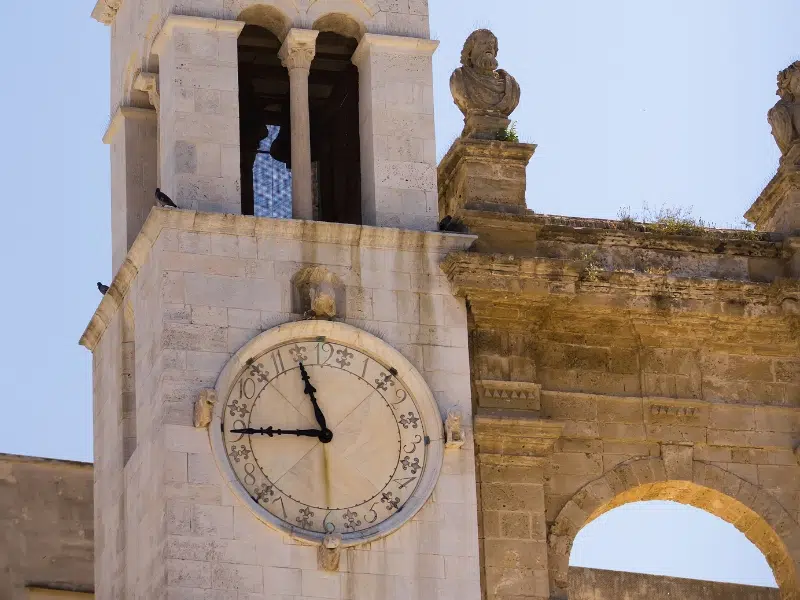
Piazza Mercantile is the main square of Bari Vecchia, the old town of Bari, a few steps from the seafront. For centuries it was where the city traded and where it was governed, and both sides of that history are still standing: the Palazzo del Sedile, seat of the council of nobles, and in the corner the Column of Justice, where, according to tradition, debtors were tied up and punished in public.
Piazza Mercantile at a glance
- Where: on the south-eastern edge of Bari Vecchia, next to Piazza del Ferrarese and a short walk from the seafront promenade.
- Created: a market and civic square since the Middle Ages; its main building, the Palazzo del Sedile, dates from 1543.
- What it is today: a pedestrian square lined with cafés and restaurant terraces, busiest in the evening, when Bari comes out for a stroll.
- Time needed: 15–20 minutes for the column and the facades, longer if you sit down for a drink.
Where Bari traded and judged
In the Middle Ages this was the political centre of Bari as well as its marketplace. Merchants traded here, and the leading families of the city built their houses around the square; several of their palazzi still line it. The most important building is the Palazzo del Sedile, also called the Sedile dei Nobili, dated 1543. From the 1600s to the 1800s it was the seat of the city council, and it was rebuilt several times, which is why it does not fit one style: look for touches of 18th-century Neapolitan taste.
Justice was done in the open. At the far end of the square stands the Colonna della Giustizia, the Column of Justice, with a stone lion beside it that may be Roman. Tradition says that people who could not pay their debts were tied to the column and whipped or exposed to public ridicule, and marks on the stone have been read as signs that thieves were bound to it too. Today the square has gentler habits: by evening its terraces are full, and it is one of the liveliest places in the old town.
What to look for
- The Palazzo del Sedile, the long civic building with a tower on its west side. Its mix of styles shows how often it was rebuilt over three centuries of use.
- The Column of Justice in the north-east corner of the square, a plain stone column that was the city's pillory.
- The stone lion at the foot of the column. Its origin is uncertain, and it may be a Roman piece reused here.
- The palazzi of old Bari families on the other sides of the square, with balconies, coats of arms and arched doorways at street level.
- Next door in Piazza del Ferrarese, a stretch of old paving kept on view, with grooves worn by carts entering the city.
Column of Justice or column of shame?
Locals know the pillar by both names: the official Colonna della Giustizia and the more popular colonna infame, the column of shame. The stories told about it vary, from debtors being whipped to simply being made to stand there in disgrace, and there is no single documented account of how it was used. Treat the details as tradition. What is clear is the message: in a square full of merchants, the city kept a reminder of what happened if you broke your word.
Tips for your visit
- Come in the early morning for photos of an almost empty square, and come back after dark to see it at its liveliest.
- Bari Vecchia is a lived-in neighbourhood, not an open-air museum. Keep your voice down in the side lanes and don't photograph people's doorways without asking.
- In early May, during the feast of St Nicholas, the old town is packed and Piazza del Ferrarese next door becomes one of the centres of the celebrations.
- Combine the square with a walk along the seafront promenade, which starts just beyond Piazza del Ferrarese.
Nearby
- Piazza del Ferrarese: the square next door, with the former fish market of 1840 and the old paving with cart grooves.
- Basilica di San Nicola: the Romanesque basilica built to house the relics of St Nicholas, brought to Bari by sailors in 1087, a few minutes' walk through the old town.
- Cattedrale di San Sabino: Bari's Romanesque cathedral in the middle of the old town, with a crypt under the altar.
- Castello Normanno-Svevo: the massive castle on the western edge of Bari Vecchia, rebuilt under Frederick II in the 13th century.
See Bari with World City Trail
Our Bari scavenger hunt turns the old town into a game you play on your phone. The route links 10 stops and takes around 2 hours, with about 35 minutes of walking. It leads you through Bari Vecchia and to the Basilica di San Nicola.
If you prefer a different format, there is also a self-guided walking tour and an outdoor escape game in Bari.
Play the Bari scavenger hunt →
Take the self-guided walking tour of Bari →
Play the outdoor escape game in Bari →
Facts checked in October 2026.