
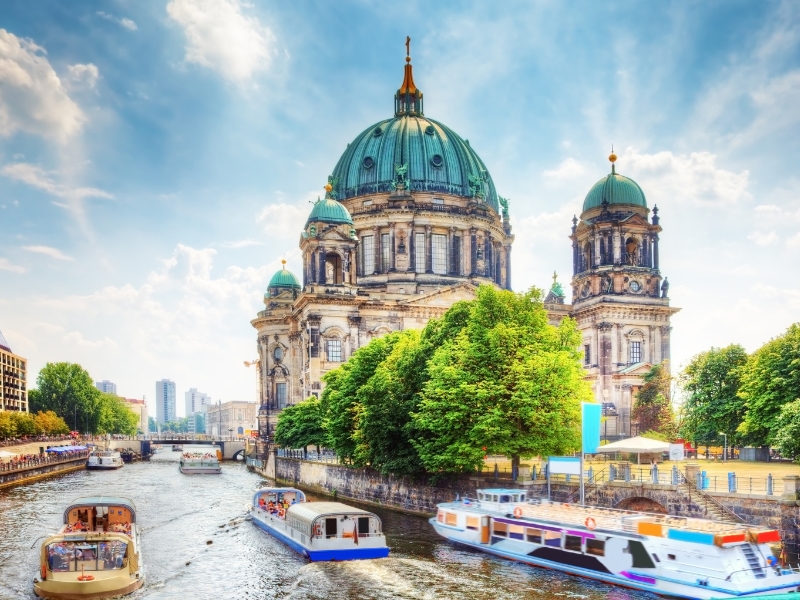
Berlin Cathedral, the Berliner Dom, is the huge domed church on the Lustgarten at the southern end of Museum Island. It is the largest Protestant church in Germany and the burial place of the Hohenzollern family who ruled Brandenburg, Prussia and the German Empire. Yet, despite its name, it has never been a cathedral in the strict sense: no bishop has ever had his seat here.
Berlin Cathedral at a glance
- Where: Am Lustgarten on Museum Island, between the Lustgarten park, the Spree and the Humboldt Forum.
- Built: 1894–1905, consecrated in February 1905; the interior was restored after war damage by 2002.
- By: the architect Julius Raschdorff, for Emperor Wilhelm II.
- What it is today: a Protestant parish church that also hosts state ceremonies, concerts and services, with the Hohenzollern crypt below.
- Time needed: about 1 to 1.5 hours for the church, the dome walk and the crypt.
From court chapel to imperial church
The story begins in 1450s Berlin, when the Elector of Brandenburg moved into his new palace on the Spree island and set up a chapel there. In 1465 the pope attached a college of canons to it, and in German a collegiate church is called a Dom, which is how the name stuck even though there was never a bishop. The court church later moved into a former Dominican church south of the palace, and from 1545 the Hohenzollerns began to bury their dead there. Frederick the Great replaced it with a Baroque church on the present site, opened in 1750, which Karl Friedrich Schinkel remodelled in a plain classical style in the early 19th century.
For a new empire, that modest church was not enough. Emperor Wilhelm II had it demolished in 1893, and Julius Raschdorff's Neo-Renaissance building rose between 1894 and 1905, meant to rival the great churches of Europe. In 1944 Allied bombing set the dome on fire and the building was badly damaged. The East German state rebuilt it slowly and in simplified form: the dome lost some of its height, and the Memorial Church on the north side was demolished in the 1970s. The main church reopened in 1993, and the restoration of the interior was finished in 2002.
What to look for
- The dome: today 98 metres high and capped by a cross. Its walkway sits 50 metres up and is reached by 270 steps, with views over Museum Island, Unter den Linden and the Reichstag.
- The mosaics inside the dome: eight scenes of the Beatitudes look down on the vast octagonal Sermon Church below.
- The Reformers: statues of Martin Luther, Philipp Melanchthon, Huldrych Zwingli and John Calvin stand around the main space, a reminder that this was the chief church of Prussian Protestantism.
- The Sauer organ: built in 1905 with more than 7,000 pipes, some of them ten metres tall, and one of the largest surviving late Romantic organs in Germany.
- The royal sarcophagi: the gilded coffins of King Frederick I and Queen Sophie Charlotte, designed by Andreas Schlüter, stand in the church itself rather than in the crypt.
The Hohenzollern crypt
Below the church lies one of the largest dynastic crypts in Europe, with 91 coffins spanning five centuries, from plain early coffins to richly decorated sarcophagi. Moisture and the warmth of many visitors had damaged them, so the crypt was closed for almost six years of renovation. It reopened in March 2026 with a new layout, and a visit there is now the quietest part of the building, a sharp contrast to the gold and marble upstairs.
Tips for your visit
- Climb the dome first, while you still have energy, and leave the crypt for the end of your visit.
- For the classic photo, stand at the far side of the Lustgarten in front of the Altes Museum; for the river front, cross to the east bank of the Spree.
- Services, weddings and concerts take place regularly, and parts of the church can close for them, so check the cathedral's calendar before you go.
- Combine the visit with a walk down Unter den Linden to the Brandenburg Gate, about half an hour on foot.
Nearby
- Lustgarten and the Altes Museum: the lawn in front of the cathedral and Schinkel's columned museum of classical art on its north side.
- Humboldt Forum: the rebuilt Berlin Palace directly opposite, with Baroque facades outside and museums and exhibitions inside.
- Alte Nationalgalerie: the temple-like art museum on Museum Island, with a colonnaded garden in front, a few minutes' walk away.
- Unter den Linden: Berlin's grand boulevard begins just across the Schlossbrücke and leads west past the State Opera and the university.
See Berlin with World City Trail
Our Berlin scavenger hunt turns the city centre into a game you play on your phone. The route links 10 stops and takes around 3 hours, with about 65 minutes of walking, and includes places such as the Brandenburg Gate, the Reichstag and Unter den Linden.
If you prefer a different format, there is also a self-guided walking tour and an outdoor escape game in Berlin.
Play the Berlin scavenger hunt →
Take the self-guided walking tour of Berlin →
Play the outdoor escape game in Berlin →
Facts checked in October 2026.