
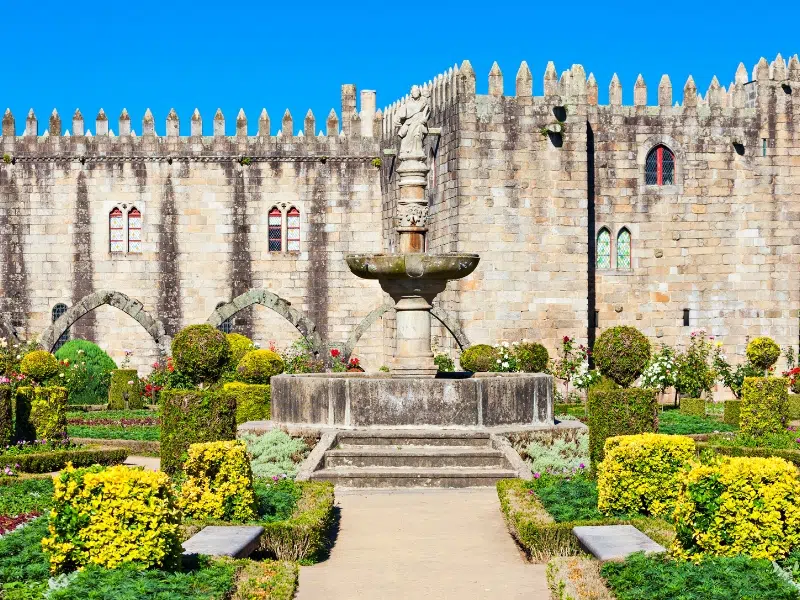
The Jardim de Santa Bárbara is a small formal garden in the centre of Braga, laid out against the medieval wing of the old Archbishop's Palace. Its clipped box hedges and flower beds surround a 17th-century fountain topped by a statue of St Barbara, and along one side run the broken Gothic arches of the palace's oldest part. It is free to enter and one of the most photographed corners of the city.
The Santa Bárbara Garden at a glance
- Where: in the historic centre, beside the eastern wing of the Archbishop's Palace, a short walk from Praça da República and the cathedral.
- Created: in its present form in 1955; the fountain dates from the 17th century and the arches from the Middle Ages.
- By: plaques on site credit the design to José Cardoso da Silva.
- What it is today: a municipal garden, free to visit, next to the palace that now houses Braga's public library and archives.
- Time needed: 15–20 minutes, longer if you sit and enjoy it.
From palace grounds to city garden
Braga has been the seat of an archbishop since the Middle Ages, and the Archbishop's Palace beside the garden grew over several centuries. It is made up of connected buildings in Gothic, Renaissance and Baroque styles, the oldest dating back to the 14th century. In 1911, after the fall of the monarchy, the archbishop was expelled and the buildings were taken over by the state; from the 1930s they were adapted to hold the public library and archives, and today they also house offices of the University of Minho.
The garden itself is younger than it looks. It was laid out in 1955, during the Estado Novo period, in a romantic style with geometric beds edged in boxwood and cedars clipped into shapes. The centrepiece was brought from elsewhere: the 17th-century fountain with St Barbara on top originally stood at the Convento dos Remédios, a convent in Braga that was later demolished. The ruined arches of the medieval palace were left standing as a backdrop.
What to look for
- St Barbara on her fountain: the statue of the garden's patron saint crowns the fountain at the centre of the garden.
- The Gothic arches: the row of broken pointed arches on the garden's edge is what remains of the medieval part of the palace.
- The box hedges: low boxwood hedges cut into geometric patterns, filled with flowers that change with the seasons.
- The topiary cedars: cedar trees clipped into tidy shapes that stand above the flower beds.
- Stone fragments: on the patio next to the garden, look for old cornices, statues and carved coats of arms gathered from the palace.
Who was St Barbara?
According to legend, Barbara was a young Christian in the early centuries of the Church whose father locked her in a tower and later killed her for her faith, after which he was struck by lightning. There is no reliable historical record of her life, but the story made her the saint people pray to against lightning and sudden death, and the patron of artillerymen, miners and firefighters. Her symbol is the tower, which you will often see beside her in statues.
Tips for your visit
- Spring and early summer bring the fullest flower beds; in autumn the low sun lights up the arches in the late afternoon.
- For the classic photo, stand at the end of the garden opposite the palace so the fountain and the arches line up.
- Stay on the paths: the box hedges and beds are delicate, and the garden is small.
Nearby
- Braga Cathedral (Sé): often called the oldest cathedral in Portugal, a few minutes' walk away, with chapels and tombs from many centuries.
- Praça da República: Braga's main square, with its fountain and the arcaded Arcada building, a short walk south.
- Rua do Souto: the old town's pedestrian main street, lined with shops and cafés, right beside the palace.
- Café A Brasileira: the historic café on Largo Barão de São Martinho, open since 1907, for a coffee after your visit.
See Braga with World City Trail
Our Braga scavenger hunt turns the old town into a game you play on your phone. The route links 10 stops and takes around 2 hours, with about 23 minutes of walking. It includes the fountain on Praça da República and Café A Brasileira. You can play in English, German, French, Italian, Spanish and Portuguese.
If you prefer a different format, there is also a self-guided walking tour and an outdoor escape game in Braga.
Play the Braga scavenger hunt →
Take the self-guided walking tour of Braga →
Play the outdoor escape game in Braga →
Facts checked in October 2026.