
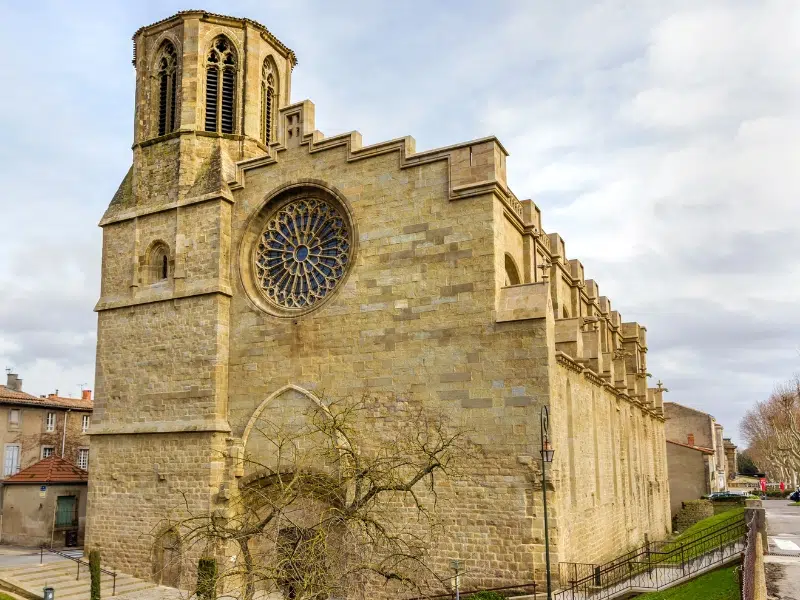
Saint-Michel Cathedral is the seat of the bishop of Carcassonne and Narbonne, yet it does not stand in the famous walled Cité on the hill. It is down in the Bastide Saint-Louis, the grid-planned lower town across the river Aude. Its most surprising chapter is a military one: after the lower town was burned in 1355, the church was built into the new town walls, and traces of that fortress past survive at its east end.
Saint-Michel Cathedral at a glance
- Where: Rue Voltaire, in the southern part of the Bastide Saint-Louis, the lower town across the Aude from La Cité.
- Built: begun in 1247, enlarged from 1283, repaired and fortified after 1355; a cathedral since 1803.
- Restored by: Eugène Viollet-le-Duc, who took charge of the works in 1857 after a fire in 1849.
- What it is today: the active cathedral of the Diocese of Carcassonne and Narbonne, listed as a historic monument since 1886.
- Time needed: 20 to 30 minutes inside.
From parish church to fortress to cathedral
The church was begun in 1247 on the orders of King Louis IX, to replace a sanctuary destroyed when Raymond II Trencavel besieged Carcassonne in 1240. The first building soon proved too small and was enlarged from 1283. In 1355, during the Hundred Years' War, the troops of the Black Prince set fire to the lower town. Saint-Michel was one of the few buildings still standing, but it was badly damaged. When the town was rebuilt, the church was made part of the new fortifications, and ditches up to 10 metres wide were dug around it. They were filled in during the 19th century and replaced by the broad tree-lined boulevards you walk along today.
For centuries the bishops of Carcassonne sat up in the Cité, in the church of Saint-Nazaire. In 1803 the bishop's seat moved down to Saint-Michel, and the parish church became a cathedral. Work to adapt it was well under way when a fire broke out on the night of 4 to 5 November 1849. Léon Ohnet led the repairs from 1850, and in 1857 the project passed to Eugène Viollet-le-Duc, the architect who also restored the ramparts of the Cité. The cathedral was listed as a historic monument in 1886, and a major renovation campaign began in 2009.
What to look for
- The west front: almost bare stone, with one large rose window about 8 metres across as its only decoration. Plain façades with a big rose are typical of the southern Gothic style of the region.
- The bell tower: square for three storeys, then octagonal at the top. It holds eight swinging bells; the largest, named Saint-Michel Archange, weighs more than 1.7 tonnes.
- The single nave: there are no aisles, just one wide space of eight bays lined with side chapels. Look up at the small rose windows above the chapels, added by Viollet-le-Duc.
- The apse windows: the seven-sided choir keeps stained glass from the 14th century, carefully restored by the glass painter Alfred Gérente after the 1849 fire.
- The organ: built by Aristide Cavaillé-Coll in 1860, in an oak case designed by Viollet-le-Duc. Thirteen life-size statues stand on top, showing Saint Michael defeating the dragon among angel musicians.
- The east end from outside: walk round to the apse and look for a round tower with a military look, a reminder that the church once formed part of the town's defences.
A cathedral in the lower town
Many visitors expect Carcassonne's cathedral to be in the Cité. The Basilica of Saint-Nazaire up on the hill was the cathedral for most of the Middle Ages, and it is the church most people photograph. Since 1803, though, the bishop's chair has been here in the Bastide, in a plainer building that ordinary townspeople have used for nearly eight centuries. Visiting both shows you the two halves of Carcassonne: the fortress on the hill and the working town below.
Tips for your visit
- Come in the morning or mid-afternoon. Like many French churches it closes for part of the day, so check times before you go.
- This is a working cathedral with regular services. Dress modestly, keep your voice down and avoid walking around during Mass.
- Walk around the outside along the boulevards that replaced the old ditches: the fortified east end is easy to miss from the front.
- Combine it with the Cité: from the Bastide you can walk to the hilltop fortress across the Pont Vieux, a steady uphill walk with good views of the ramparts.
Nearby
- Place Carnot: the main square of the Bastide, with the Neptune fountain, cafés and the town market several mornings a week. It is a few minutes' walk north.
- Église Saint-Vincent: the lower town's other large Gothic church, worth comparing with Saint-Michel.
- Pont Vieux: the medieval bridge over the Aude, now for pedestrians, with one of the best views of the Cité's walls.
- La Cité: the fortified hilltop town with its double ring of walls, the Château Comtal and the Basilica of Saint-Nazaire, the former cathedral.
See Carcassonne with World City Trail
Our Carcassonne scavenger hunt turns the city into a game you play on your phone. The route links 10 stops and takes around two hours, with about 46 minutes of walking. It includes La Cité and its ramparts and the Basilica of Saint-Nazaire, so it pairs well with a visit to the cathedral down in the Bastide.
If you prefer a different format, there is also a self-guided walking tour and an outdoor escape game in Carcassonne.
Play the Carcassonne scavenger hunt →
Take the self-guided walking tour of Carcassonne →
Play the outdoor escape game in Carcassonne →
Facts checked in October 2026.