
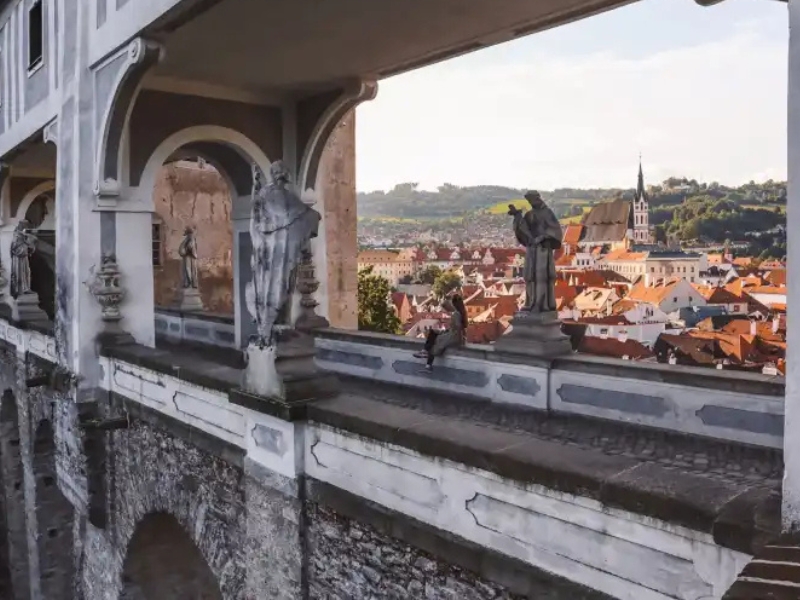
The Cloak Bridge (Plášťový most) is the tall arched bridge on the west side of Český Krumlov Castle. It spans a deep rock ravine and links the courtyards of the Upper Castle with the Baroque castle theatre and the castle garden. Its stone arches rise three tiers high, and on top run an open walkway lined with saints and a roofed corridor that let the castle's owners reach the theatre without stepping outside.
The Cloak Bridge at a glance
- Where: at the western end of Český Krumlov Castle, between the Upper Castle courtyards and the castle theatre, on the way from the castle to the castle garden.
- Built: in its present stone form in 1764, on the site of older bridges, including a wooden one.
- What it is today: part of the castle complex and a public route. You cross its open level on foot on the way to the garden; the covered corridors above belong to the castle interiors.
- Time needed: 10–15 minutes to cross, look at the statues and enjoy the view; longer if you go on into the garden.
From a wooden crossing to stone arches
The castle stands on a long, narrow rock above the Vltava, and the ravine on its western side has always cut the palace off from the higher ground beyond. A bridge with a gate stood here long before the present one. In the 17th century, when the Eggenberg family owned Krumlov, the crossing was rebuilt in wood to make it easier to reach the castle garden, and in the early 18th century covered corridors were added on top so that the court could pass from the palace to the theatre dry and out of sight.
The bridge you see today dates from the time of Prince Joseph Adam of Schwarzenberg, who had the wooden structure replaced with masonry arches. Letters from 1764 already describe the bridge as newly built and ask for its statues to be ready by St Wenceslas Day, 28 September, so that the prince could have them blessed while he was in Krumlov. The name is usually explained by the Czech word plášť, cloak or mantle, used for the outer defensive wall of the castle that the bridge crosses.
What to look for
- The arches: three tiers of stone arches climbing out of the ravine, built more like a Roman aqueduct than an ordinary bridge.
- The saints: statues along the open walkway, among them St John of Nepomuk, St Wenceslas, St Anthony of Padua and St Felix of Cantalice. Their pedestals look alike, and historians think some were moved here from elsewhere in the castle.
- The covered corridor: the roofed upper storeys with small windows above the walkway. They connected the palace and its Masquerade Hall with the theatre and its boxes.
- The view: lean on the balustrade and look over the red roofs of the old town and the castle's long row of buildings.
- The drop: look straight down into the ravine to see how high the walkway really stands.
A corridor built for the theatre
The covered passage only makes sense once you know what is at the far end. The castle theatre is one of the best-preserved Baroque theatres in the world, with its original stage machinery and scenery still in place. Next to the corridor on the palace side is the Masquerade Hall, painted in 1748 by Josef Lederer with life-size figures in carnival costume. On a night of opera or a masked ball, the prince's family and guests could walk from one to the other high above the ravine, while servants and townspeople used the open level below.
Tips for your visit
- Cross the bridge as part of a walk through the castle courtyards and on into the garden. The garden is open only in the warmer months, so check before you go.
- For a photo of the arches, look for views from the lower ground and the garden side: from on top, you only see the walkway.
- Come early in the morning or towards evening, when the tour groups have left the castle courtyards.
- The theatre and the Masquerade Hall can be seen only on guided tours, which run mainly in the main season; book ahead if you want to go inside.
Nearby
- Castle Garden: the terraced garden beyond the bridge, with the Cascade Fountain from the mid-18th century and an open-air theatre with a revolving auditorium.
- Castle Baroque Theatre: right at the end of the bridge, the reason the covered corridor was built.
- Castle Tower: the painted round tower of the oldest part of the castle, with a view over the whole town.
- Bear Moat: the moat at the castle entrance where brown bears are still kept, a tradition that goes back centuries.
See Český Krumlov with World City Trail
Our Český Krumlov scavenger hunt turns the old town into a game you play on your phone. The route links 10 stops and takes around 2 hours, with about 25 minutes of walking. It includes the castle tower, the Church of St Vitus and the monastery complex.
If you prefer a different format, there is also a self-guided walking tour and an outdoor escape game in Český Krumlov.
Play the Český Krumlov scavenger hunt →
Take the self-guided walking tour of Český Krumlov →
Play the outdoor escape game in Český Krumlov →
Facts checked in October 2026.