
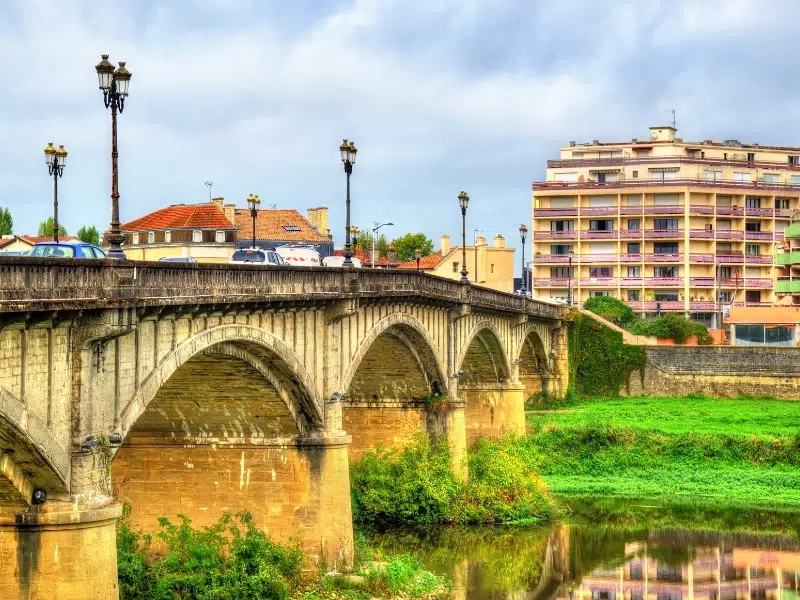
The Pont Vieux is the medieval stone bridge over the Aude in Carcassonne, linking the Bastide Saint-Louis, the lower town, with the foot of the hill crowned by the walled Cité. Finished in the early 14th century and now open only to people on foot, it is also the classic place to see the Cité across the river, especially when it is floodlit at night.
The Pont Vieux at a glance
- Where: across the Aude between the Bastide Saint-Louis and the Trivalle district below the Cité.
- Built: completed around 1320, replacing an earlier crossing; repaired after collapses in the 15th century and altered in the 16th and 19th centuries.
- What it is today: a pedestrian bridge of more than 200 metres with twelve round arches, used daily by people walking between the two halves of the city.
- Time needed: 10 minutes to cross; allow more for photos of the Cité from the middle.
A bridge between rivals
For most of the Middle Ages Carcassonne was two towns. Up on the hill stood the fortified Cité; across the river lay the Bastide Saint-Louis, the new town laid out on a grid in the 13th century. The Pont Vieux was the link between them. It was built in stages as money came in, which is why its twelve arches are not all the same size, and it was finished around 1320. An earlier wooden bridge had crossed a little further upstream.
The Aude can rise fast, and two arches collapsed in 1436 and had to be rebuilt. Other parts were reworked in 1559, and the bridge was modified again in the early 19th century. For a long time it marked a frontier as much as a connection: the two communities had separate interests, and the bridge was where their territories met. Today cars cross on the Pont Neuf upstream, and the old bridge belongs to walkers, runners and photographers. The eastern end and its approach to the Rue Trivalle were restored in 1999.
What to look for
- The twelve round arches, of uneven width: count them from the riverbank and notice how they vary.
- The pointed cutwaters on the piers, built to split the current and the debris carried by floods.
- The view of the Cité from the middle of the bridge, with its towers and the outer and inner walls stacked on the hill.
- The small chapel of Notre-Dame-de-la-Santé at the end of the bridge, once part of a hospital, which explains its name, Our Lady of Health.
- The Aude itself: on calm days the water reflects the arches; after storms it runs brown and fast.
Two towns, one view
The Cité you see from the bridge owes much to the 19th century. When the architect Eugène Viollet-le-Duc restored it from 1853 onwards, he gave many of its towers pointed slate roofs, a choice still debated today. Seen from the Pont Vieux, the whole hill reads like a picture of a medieval town, and that view helped make Carcassonne one of the most visited places in France. Since 1997 the Cité has been a UNESCO World Heritage Site.
Tips for your visit
- Come after dark: the floodlit walls of the Cité and the lit arches reflected in the river are the classic Carcassonne view.
- For a photo of the bridge itself, walk down to the riverbank park on the Bastide side.
- Wear good shoes: the climb from the bridge up through the Trivalle to the Porte Narbonnaise is steep in places.
- Use the bridge as the link between a morning in the Cité and an afternoon in the Bastide's squares and cafés.
Nearby
- La Cité: the double-walled medieval citadel on the hill, with the Château Comtal, a climb of 15 to 20 minutes from the bridge.
- Basilica of Saint-Nazaire: inside the Cité, with Romanesque and Gothic parts and fine stained glass.
- Porte d'Aude: the western gate of the Cité, reached by a steep path from near the bridge.
- Bastide Saint-Louis: the grid-planned lower town, with the Place Carnot and its fountain at its centre.
See Carcassonne with World City Trail
Our Carcassonne scavenger hunt turns the old town into a game you play on your phone. The route links 10 stops and takes around two hours, with about 46 minutes of walking, and it includes places such as La Cité and its ramparts and the Basilica of Saint-Nazaire.
If you prefer a different format, Carcassonne also has a self-guided walking tour and an outdoor escape game.
Play the Carcassonne scavenger hunt →
Take the self-guided walking tour of Carcassonne →
Play the outdoor escape game in Carcassonne →
Facts checked in October 2026.