
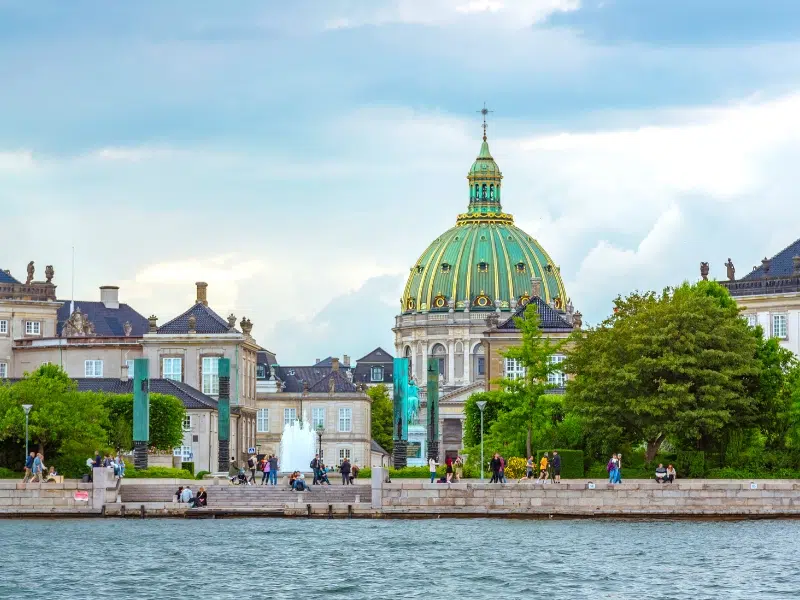
Frederik's Church, better known as the Marble Church (Marmorkirken), is the domed church at the centre of Frederiksstaden in Copenhagen, just west of Amalienborg Palace. Its dome, 31 metres across and resting on twelve columns, is one of the largest in Europe. King Frederik V laid the foundation stone in 1749, but the church was not consecrated until 1894: for more than a century it stood as an unfinished ruin.
Frederik's Church at a glance
- Where: Frederiksgade, in the Frederiksstaden district, on the same axis as Amalienborg Palace.
- Built: foundation stone laid on 31 October 1749; work stopped in 1770; completed and consecrated on 19 August 1894.
- By: first designed by Nicolai Eigtved, revised by Nicolas-Henri Jardin, and finished by Ferdinand Meldahl.
- What it is today: a working parish church of the Evangelical-Lutheran Church in Denmark, open to visitors outside services.
- Time needed: 20–30 minutes inside, longer if you join a guided climb to the dome.
A church that waited 145 years
Nicolai Eigtved, the architect of Amalienborg, designed the church around 1740 as the centrepiece of Frederiksstaden, the new district built to mark 300 years of the House of Oldenburg on the Danish throne. Frederik V laid the first stone in 1749. Building slowed after budget cuts and Eigtved's death in 1754, and Nicolas-Henri Jardin reworked the plans into a more classical church clad in Norwegian marble. The marble proved far too expensive, and in 1770 the government of Johann Friedrich Struensee abandoned the project.
For more than a hundred years the half-built walls stood as a ruin in the middle of one of Copenhagen's grandest neighbourhoods. In 1874 the finance minister sold the ruin and the square to the industrialist and banker Carl Frederik Tietgen, who agreed to finish the church and give it to the state. Ferdinand Meldahl completed it with a smaller dome than Eigtved had planned, and to save money most of the upper walls were built in Faxe limestone, a coral limestone from south of Copenhagen polished to look like marble. The church was consecrated on 19 August 1894.
What to look for
- The two kinds of stone: the lower walls from the 18th century are Norwegian marble; above them is the polished Faxe limestone of the 1890s. Look for the change in colour and texture.
- The dome from inside: twelve columns carry the 31-metre dome, and the circular space rises about 46 metres. The fresco shows the twelve apostles, painted by Chresten Overgaard from drawings by Henrik Olrik.
- The inscription over the entrance: “HERRENS ORD BLIVER EVINDELIG”, “The word of the Lord endureth for ever” (1 Peter 1:25).
- The statues around the church: at street level, figures of Danish church history including the philosopher Søren Kierkegaard, Saint Ansgar and the hymn writers Kingo, Brorson and Grundtvig; on the roof terrace, figures from Moses to Martin Luther.
- The view along the axis: stand in front of the church and look east through Amalienborg's square to the harbour.
A view lined up by design
Frederiksstaden was planned as one piece. The Marble Church sits due west of Amalienborg, and the line runs from the church through the octagonal palace square, past the equestrian statue of Frederik V in its centre, to the water. When the Copenhagen Opera House opened in 2005 on the island of Holmen, it was placed on the same axis, so from the church steps you look straight through the royal palace to the opera across the harbour.
Tips for your visit
- Check the church's own website for dome tours: on a guided climb you walk out onto the dome, with views over Frederiksstaden and the harbour.
- It is a working church: weddings, baptisms and services take place here, so keep quiet and be ready for the interior to close for a ceremony.
- For the classic photo of the dome, stand at the far side of Amalienborg's square, where the church fills the end of Frederiksgade.
Nearby
- Amalienborg Palace: the four rococo palaces of the royal family around an octagonal square, right across the street; watch the Royal Life Guards change around midday.
- Alexander Nevsky Church: the Russian Orthodox church with three gilded onion domes on Bredgade, a minute's walk away.
- Designmuseum Danmark: Danish design and crafts in the former Frederik's Hospital on Bredgade, a few minutes' walk north.
- Nyhavn: the 17th-century canal lined with colourful houses and boats, about ten minutes' walk south.
See Copenhagen with World City Trail
Our Copenhagen scavenger hunt turns the old town into a game you play on your phone. The route links 10 stops and takes around 3 hours, with about 48 minutes of walking. It includes City Hall, Copenhagen Cathedral and the Round Tower.
If you prefer a different format, there is also a self-guided walking tour and an outdoor escape game in Copenhagen.
Play the Copenhagen scavenger hunt →
Take the self-guided walking tour of Copenhagen →
Play the outdoor escape game in Copenhagen →
Facts checked in October 2026.