
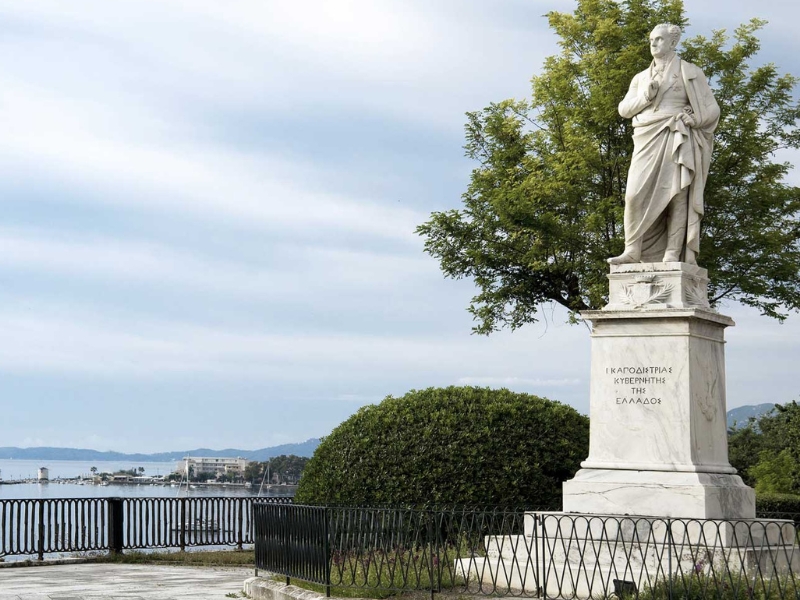
At the southern end of the Spianada, Corfu Town's great open square, a white marble statue looks out over the town where Ioannis Kapodistrias was born in 1776. He went on to become a foreign minister of the Russian Empire and then the first head of state of modern Greece, before being assassinated in 1831. Corfu unveiled this statue to its most famous son in 1887.
The Kapodistrias Statue at a glance
- Where: the south end of the Spianada (Esplanade), opposite the building of the old Ionian Academy, at the start of the seafront road towards Garitsa Bay.
- Created: unveiled on 12 April 1887.
- By: begun by the Greek sculptor Leonidas Drosis, who died in 1882 before finishing it; it was completed after his death.
- What it is today: a public monument and a natural meeting point at the edge of the Spianada, about 5 metres tall including its pedestal.
- Time needed: 5 to 10 minutes, as part of a walk around the Spianada.
From Corfu to Saint Petersburg and Nafplio
Kapodistrias was born into a noble Corfiot family when the island still belonged to Venice. He studied medicine in Padua, served the short-lived Septinsular Republic of the Ionian Islands, and then joined the Russian diplomatic service. By 1816 he was joint foreign minister of Tsar Alexander I, and at the Congress of Vienna he worked on the settlement that guaranteed Switzerland's neutrality; several Swiss cantons made him an honorary citizen.
In 1827 the newly independent Greek state elected him its first governor, and he arrived in 1828 to a country ruined by war. He founded schools, introduced the potato to Greek farming and tried to build a central state, which brought him into conflict with powerful local leaders. On 9 October 1831 he was shot and stabbed by members of the Mavromichalis family outside a church in Nafplio, then the capital. His body was later brought home, and he is buried at the Platytera Monastery on the edge of Corfu Town.
What to look for
- The figure: Kapodistrias stands in formal 19th-century dress, carved in white Pentelic marble, the same kind of marble used for the monuments of ancient Athens.
- The pedestal: look at the tall base that lifts him above the square, part of the monument's total height of around 5.2 metres.
- The Ionian Academy: the building opposite was the seat of the Ionian Academy, founded in 1824 as the first university of modern Greece; it fits the statue of a man who cared about education.
- The setting: from here you see the whole length of the Spianada, with the Old Fortress on one side and the Liston arcades on the other.
The statue that replaced an obelisk
The statue stands on a spot once occupied by an obelisk honouring Sir Howard Douglas, a British Lord High Commissioner of the Ionian Islands. Placing Kapodistrias here, some twenty years after the islands were united with Greece in 1864, was a clear statement: the town's main square now honoured a Corfiot who had led free Greece rather than a British governor. The Douglas obelisk itself was moved and still stands near Garitsa Bay.
Tips for your visit
- Come in the late afternoon, when the sun lights the marble and the Spianada fills with families and evening strollers.
- Walk on along the seafront towards Garitsa Bay for a view back over the Old Fortress.
- Combine the statue with a coffee under the Liston arcades, a few minutes' walk along the square.
Nearby
- The Spianada: one of the largest squares in Greece, with gardens, a bandstand and a cricket ground left from the British period.
- The Liston: the arcaded row of cafés on the west side of the Spianada, built under French rule in the early 19th century.
- The Old Fortress: the Venetian citadel on its rocky headland, reached by a bridge over a sea moat from the Spianada.
- The Maitland Rotunda: a small Ionic temple in the gardens of the Spianada, built in memory of the first British governor, Sir Thomas Maitland.
See Corfu with World City Trail
Our Corfu scavenger hunt turns the old town into a game you play on your phone. The route links 10 stops and takes around 2 hours, with about 26 minutes of walking, and it includes places such as Spianada Square and the Liston arcades. You can play in English, German, French, Italian, Dutch and Greek.
If you prefer a different format, Corfu also has a self-guided walking tour and an outdoor escape game.
Play the Corfu scavenger hunt →
Take the self-guided walking tour of Corfu →
Play the outdoor escape game in Corfu →
Facts checked in October 2026.