What is the Copenhagen outdoor escape game?
The Copenhagen outdoor escape game is an escape room spread across the old town: each of the 10 landmarks on the route carries a puzzle that opens on your phone and yields to observation and clear thinking rather than to prior knowledge. Allow about 2 hours, including 60 minutes of walking over 3.9 km, and set off on any day you like.
Puzzles are placed at City Hall under its tall tower, at the Church of Our Lady, at the Round Tower with its spiral ramp, along the car-free Strøget, at Christiansborg Palace, by the coloured houses of Nyhavn, at Amalienborg and at the Marble Church. Each is self-contained, so the order never traps you, and three levels of hints wait in the app. Copenhagen is flat and compact, which keeps the walking short between puzzles.
- Durationabout 2 hours
- Walkingabout 60 min · 3.9 km
- Stops10
- LanguagesEnglish, German, French, Italian, Spanish, Dutch
What you do on the escape game
Solve on the spot
Every landmark poses one puzzle, answered by looking and reasoning rather than by knowing.
Read the façades
Towers, spires, statues, gables and street signs carry what you need, all of it visible from outside.
Walk the old town
Google Maps takes you from puzzle to puzzle: 60 minutes of walking spread over 3.9 km.
Pause when you like
There is no countdown. Open a hint, sit down by the canal, come back to the game later or another day.
See the route and attractions →
How it works
- Book online Choose the number of players. Your booking reference arrives by email straight away.
- Get the app Download the World City Trail app from the App Store or Google Play and enter your booking reference.
- Play when you like Start whenever you are ready, walk at your own pace and pause any time. No guide, no fixed schedule.
Who it suits
Friends
Ten puzzles give a group plenty to disagree on, and nobody needs to have been to Copenhagen before.
Couples
A challenge to work through side by side, on a route short enough to stay relaxed.
Team building
Teams of up to 5 play on their own phones, so colleagues can compete over the same puzzles.
Good to know
- Bring a charged smartphone with mobile data; a power bank helps.
- Best started in daylight, so you can see the details the puzzles ask about.
- No entry tickets needed: everything happens outside the buildings. Going inside is optional and paid separately.
- Family friendly; children must be accompanied by an adult.
- Not suitable for wheelchair users and difficult with strollers.
- Teams of up to 5 work best; bigger groups split into several teams, one ticket per player.
- Every purchase helps support stray cats and dogs in Greece.
Puzzle route: from City Hall to the Marble Church
10 stops · about 60 min walking · start: Copenhagen City Hall (Rådhuset) · finish: Frederik's Church (Marble Church)
Puzzle one is at Copenhagen City Hall on City Hall Square, the last at Frederik's Church, the Marble Church. Between them the route passes the Church of Our Lady, the Round Tower, Strøget, Christiansborg Palace on Slotsholmen, the Royal Danish Theatre on Kongens Nytorv, Nyhavn, the Nyhavn Bridge and Amalienborg Palace. Begin while it is light: the puzzles are solved in the open, and rain or wind slow things. Google Maps shows the way, the stop order can be changed in the app, and no entry tickets are needed.
Open the route map ↗
1Copenhagen City Hall (Rådhuset)Start
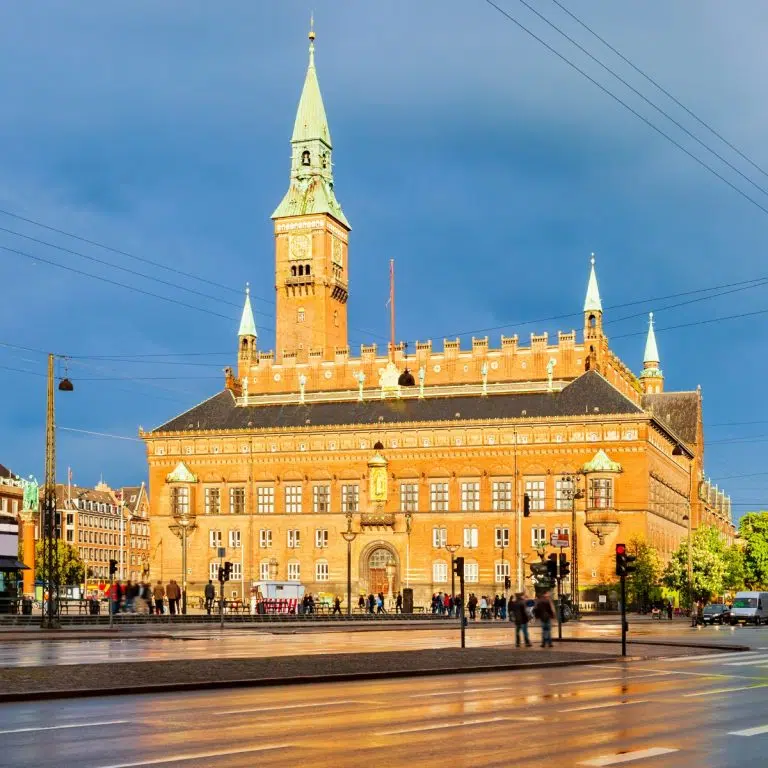
Copenhagen City Hall was designed by Martin Nyrop and inaugurated in 1905, and its tower rises 105.6 metres above City Hall Square. Look up at the main façade: above the balcony stands a gilded statue of Bishop Absalon, traditionally regarded as the founder of Copenhagen.
2Church of Our Lady (Copenhagen Cathedral)
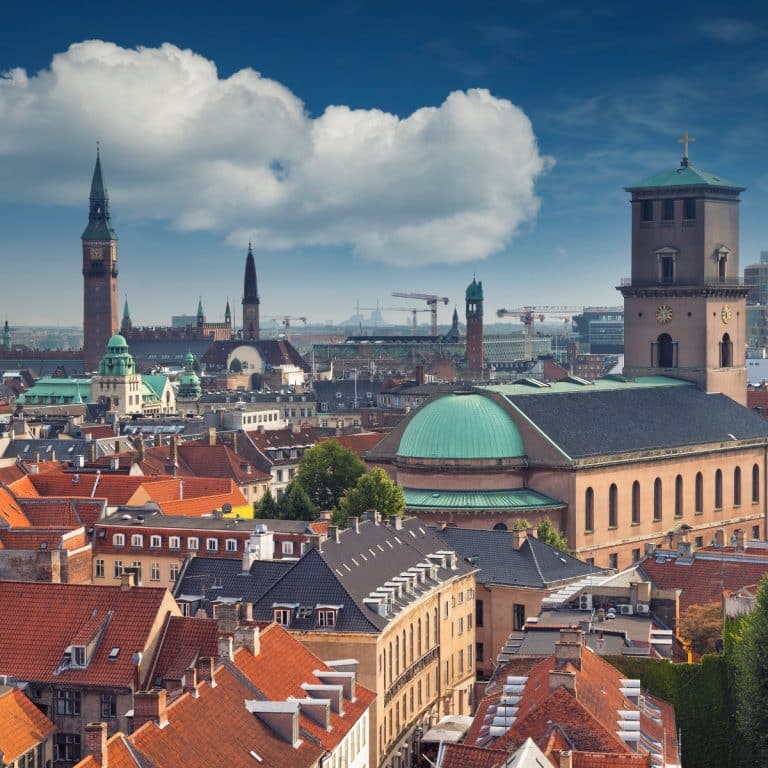
The cathedral burned down when a British fleet bombarded Copenhagen in 1807, and Christian Frederik Hansen rebuilt it in Neoclassical style; it was consecrated in 1829. Inside stand Bertel Thorvaldsen's marble statues of Christ and the apostles, and in 2004 the then Crown Prince Frederik married Mary Donaldson here.
3Round Tower (Rundetaarn)
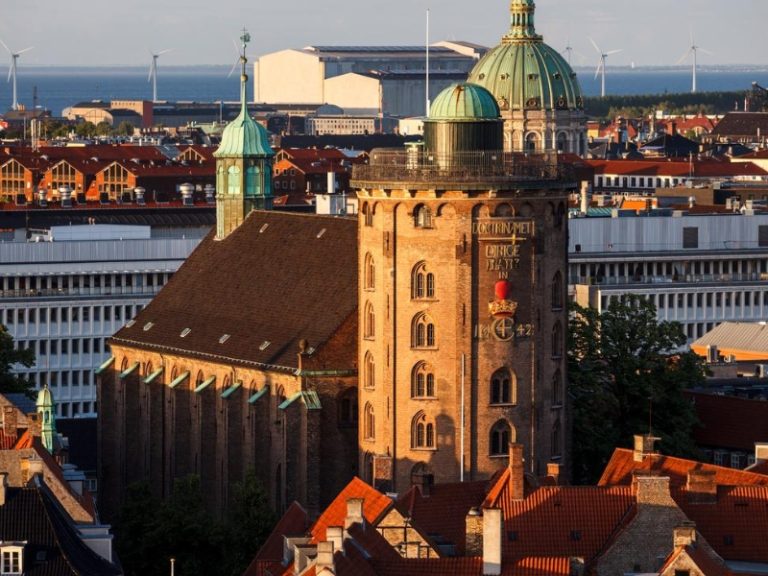
King Christian IV had the Round Tower built in 1637–1642 as an astronomical observatory. Instead of stairs, a spiral ramp winds seven and a half turns up to a platform 34.8 metres above the street, and according to the story Tsar Peter the Great rode up it on horseback in 1716.
Read the full story →
4Strøget
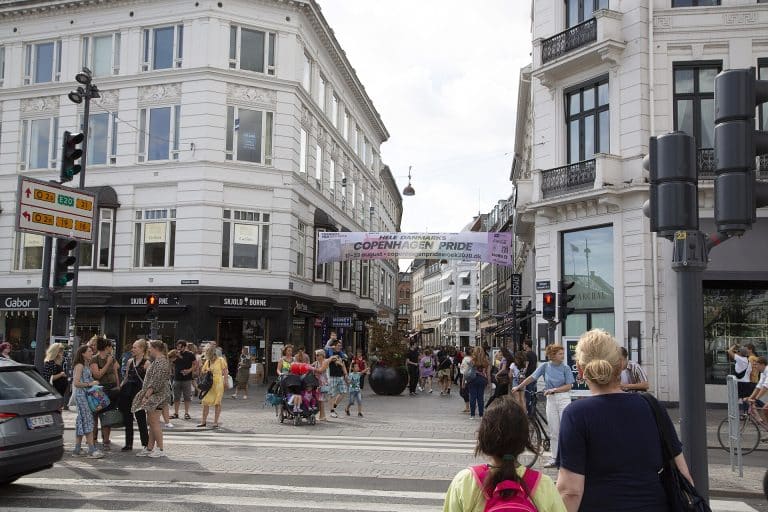
Strøget is a chain of old streets that runs for about 1.1 km from City Hall Square to Kongens Nytorv. It was closed to cars in 1962, making it one of the first and longest pedestrian shopping streets in Europe, and along the way it opens onto squares such as Amagertorv with its Stork Fountain.
5Christiansborg Palace
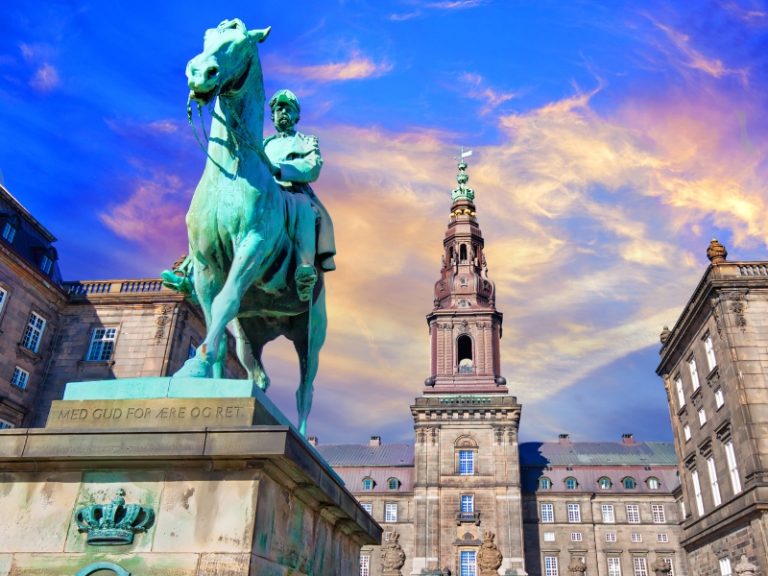
Christiansborg on the island of Slotsholmen houses the Danish Parliament, the Prime Minister's Office and the Supreme Court, and the monarch uses its Royal Reception Rooms. The present palace, the third on the site, was finished in 1928 to designs by Thorvald Jørgensen, and beneath it lie the ruins of the castle Bishop Absalon built in 1167.
6Royal Danish Theatre (Det Kongelige Teater)
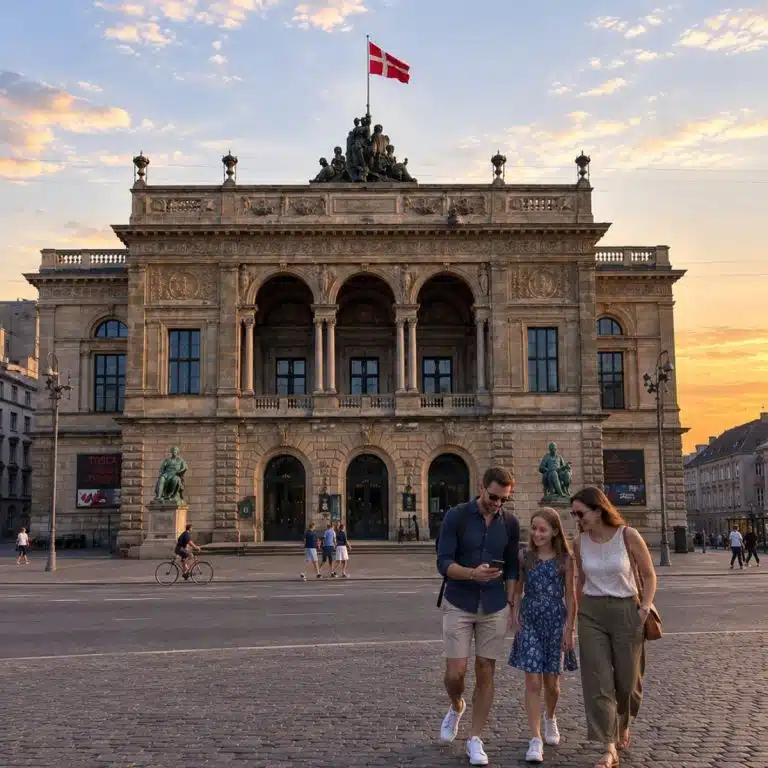
The Royal Danish Theatre was founded in 1748, and its Old Stage on Kongens Nytorv, designed by Vilhelm Dahlerup with Ove Petersen, opened in 1874. In front of the building sit bronze statues of the playwrights Ludvig Holberg and Adam Oehlenschläger.
7Nyhavn
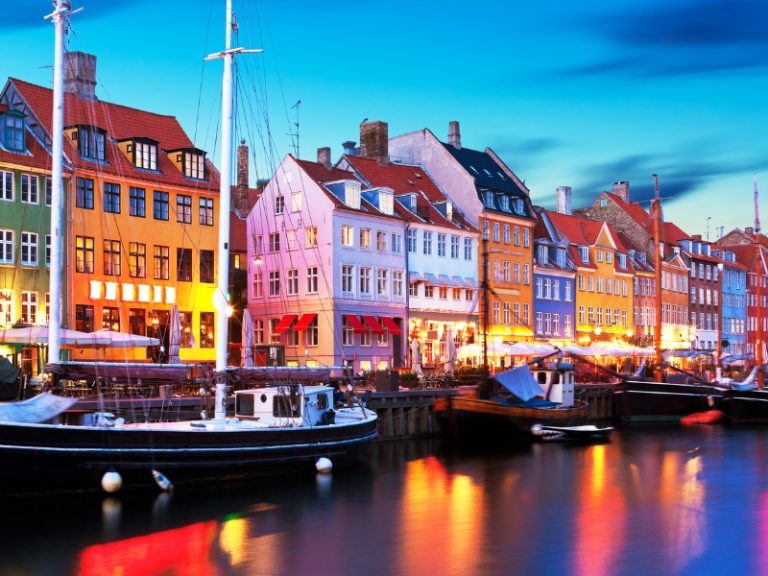
King Christian V had the Nyhavn canal dug in 1670–1675, partly by Swedish prisoners of war, as a gateway from the sea to Kongens Nytorv. Its row of colourful houses includes number 9 from 1681, the oldest on the quay, and Hans Christian Andersen lived at number 67 and later at number 18.
Read the full story →
8Nyhavn Bridge (Nyhavnsbroen)
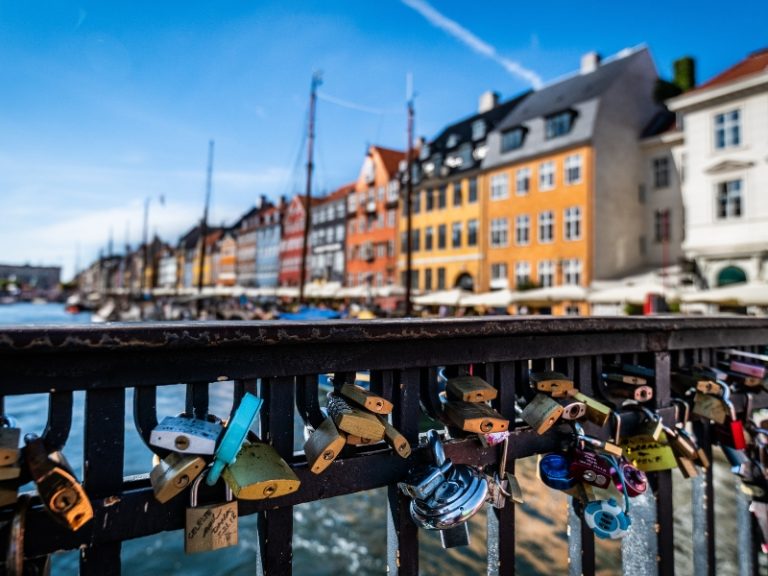
Nyhavnsbroen carries the street across the Nyhavn canal and links its two quays. From the bridge you get the classic view along the canal, with old wooden sailing ships moored below and colourful gabled houses on both sides, and on the far side the streets lead north towards Amalienborg.
Read the full story →
9Amalienborg Palace
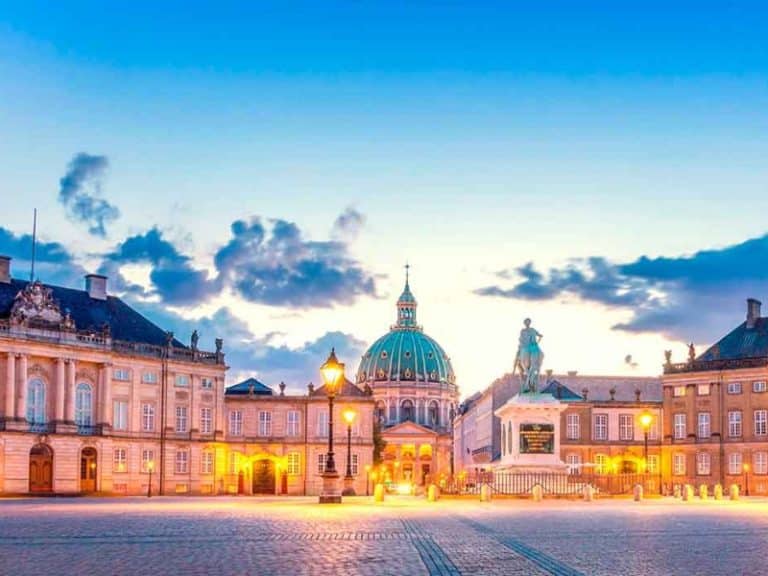
Amalienborg is made up of four almost identical Rococo palaces around an octagonal square, designed by Nicolai Eigtved and built in 1750–1760 as mansions for noble families. The royal family moved in after Christiansborg burned in 1794, and in the centre stands Jacques Saly's equestrian statue of Frederik V, unveiled in 1771.
10Frederik's Church (Marble Church)Finish
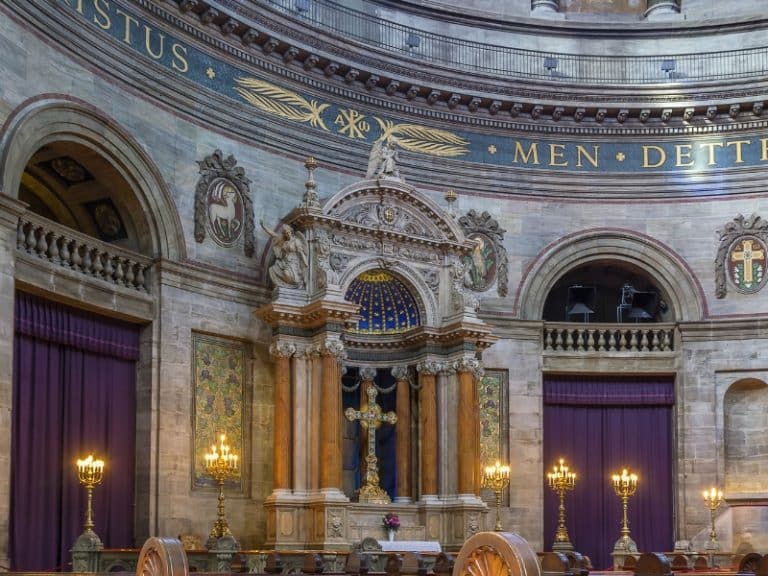
King Frederik V laid the foundation stone of the Marble Church in 1749, but work stopped in 1770 because the Norwegian marble was too expensive. The ruin stood for more than a century until the financier Carl Frederik Tietgen backed its completion by Ferdinand Meldahl, and it was consecrated in 1894 under a dome 31 metres across.
Read the full story →
Only logged in customers who have purchased this product may leave a review.




Reviews
There are no reviews yet.