
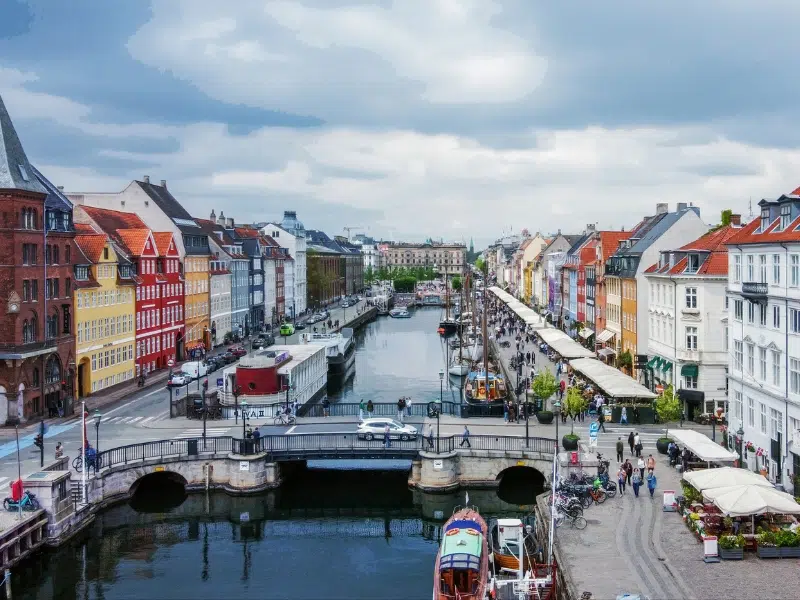
Nyhavn Bridge (Nyhavnsbroen) is the small bascule bridge that crosses Copenhagen's Nyhavn canal halfway along, between Holbergsgade and Toldbodgade. It divides the canal in two: on the inner side, towards Kongens Nytorv, lie the old wooden ships of the veteran harbour; on the outer side, the canal opens towards the Inner Harbour. Standing on it gives you the classic view of the coloured townhouses reflected in the water, without the crowds of the quay.
Nyhavn Bridge at a glance
- Where: halfway along Nyhavn, linking Holbergsgade on the south side with Toldbodgade on the north side, a few minutes' walk from Kongens Nytorv.
- Built: a temporary wooden footbridge in 1874–1875, replaced by the present bascule bridge in 1911–1912.
- What it is today: a crossing for pedestrians, cyclists and traffic, and the boundary between Nyhavn's veteran ship harbour and its outer section.
- Time needed: 5 minutes to cross, 30 minutes or more if you walk the whole canal.
From a sailors' harbour to a museum harbour
Nyhavn, the 'New Harbour', was dug in the early 1670s under King Christian V by Danish soldiers and Swedish prisoners of war. It gave ships a way from the sea right into the city at Kongens Nytorv, and for centuries it was a rough sailors' quarter of taverns and lodging houses. For two hundred years there was no bridge across it at all. The first, a temporary wooden footbridge, opened in 1874–1875, and in 1911–1912 it was replaced by the bascule bridge that stands here today.
After the Second World War, lorries took over from small cargo ships and Nyhavn emptied of vessels. In the mid-1960s local residents founded the Nyhavn Society to bring it back to life. In 1977 the inner section, between the bridge and Kongens Nytorv, was opened as a veteran ship and museum harbour, and in 1980 the quay, which had become a car park, was turned over to pedestrians. Since then Nyhavn has become one of the most visited places in Copenhagen.
What to look for
- The bascule bridge: look at the structure from the quay to see how the deck was built to lift and let tall-masted ships through.
- The veteran ships: on the inner side of the bridge, the south quay is reserved for museum ships of the National Museum, while privately owned wooden ships still in use moor on the north quay.
- Lightvessel XVII Gedser Rev: a red lightship built in 1895 and in service until 1972, now a museum ship.
- Nyhavn 9: on the sunny north side, the oldest house on the canal, dating from 1681.
- Hans Christian Andersen's homes: a plaque at Nyhavn 67, where he lived from 1845 to 1864; he also lived at Nyhavn 18 from 1871 to 1875.
- The Memorial Anchor: at the inner end of the canal, a large anchor from 1872 commemorates more than 1,700 Danish sailors who died in the Second World War.
The anchor and 5 May
The Memorial Anchor at the head of Nyhavn has its own story. It once belonged to the frigate Fyn, which lay at the Holmen naval base during the war. In 1945 a temporary wooden cross was put up on the spot, and in 1951 it was replaced by the anchor, honouring the more than 1,700 Danish officers and sailors of the navy, the merchant fleet and the Allied forces who lost their lives. Every year on 5 May, the anniversary of Denmark's liberation in 1945, an official ceremony is held here.
Tips for your visit
- Stand in the middle of the bridge and look towards Kongens Nytorv for the classic photo of the coloured houses and the old ships, ideally in the soft light of early morning.
- The north side of the canal gets the sun and the restaurant terraces; the south side is quieter for a walk.
- Canal tours leave from Nyhavn, and the harbour buses stop at the mouth of the canal next to the Royal Danish Playhouse.
- Keep an eye out for cyclists when crossing: the bridge carries everyday city traffic, not only visitors.
Nearby
- Kongens Nytorv: Copenhagen's largest square, with the Charlottenborg Palace at the corner of Nyhavn and a metro station.
- Inner Harbour Bridge: the pedestrian and cycle bridge to Christianshavn opened in 2016, nicknamed the Kissing Bridge because its two halves meet like tongues.
- Royal Danish Playhouse: the theatre on the waterfront at the mouth of Nyhavn, with a boardwalk along the harbour.
- Amalienborg: the royal palace complex with its octagonal square, a few minutes' walk north.
See Copenhagen with World City Trail
Our Copenhagen scavenger hunt turns the city centre into a game you play on your phone. The route links 10 stops and takes around 3 hours, with about 48 minutes of walking, and includes places such as City Hall, Copenhagen Cathedral and the Round Tower.
If you prefer a different format, there is also a self-guided walking tour and an outdoor escape game in Copenhagen.
Play the Copenhagen scavenger hunt →
Take the self-guided walking tour of Copenhagen →
Play the outdoor escape game in Copenhagen →
Facts checked in October 2026.