
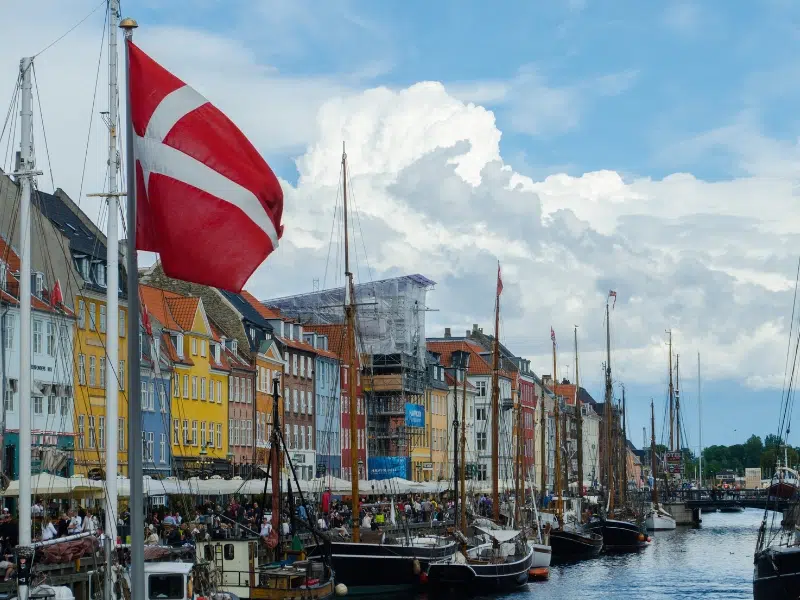
Nyhavn (New Harbour) is the short canal in central Copenhagen lined with brightly painted 17th- and 18th-century townhouses and old wooden ships. It was dug in the 1670s to bring ships from the harbour right up to Kongens Nytorv, the King's New Square. Long known for sailors' bars, it is now the city's best-known postcard view, and Hans Christian Andersen lived in three of its houses.
Nyhavn at a glance
- Where: between Kongens Nytorv and the inner harbour, in central Copenhagen.
- Built: dug from 1670 to 1675, under King Christian V.
- What it is today: a pedestrian quay with restaurants and cafés on the north side, historic ships in the water, and the departure point for many canal boat tours.
- Time needed: 30 minutes for a walk up one side and down the other, longer if you sit down or take a boat.
From sailors' quarter to postcard view
Nyhavn was dug by Danish soldiers and Swedish prisoners of war taken in the Dano-Swedish War of 1658–1660, and it opened up a new commercial harbour on the edge of the old town. Merchants built tall houses along the quay, with warehouses and lofts for goods; the oldest that still stands is No. 9, from 1681. The narrow gables and deep colours you see today come from these merchant houses, many of them rebuilt or altered in the 18th and 19th centuries.
For a long time Nyhavn had a rough name, with bars, tattoo shops and lodging houses for sailors from all over the world. As shipping moved to bigger docks, the canal emptied, and by the 1970s the quay was used for parking. In 1980 it was turned into a pedestrian area, the old ships came back as a veteran ship harbour, and the restaurants moved in. Since 2016 the Inner Harbour Bridge, a 180-metre bridge for cyclists and pedestrians, has linked the mouth of Nyhavn with Christianshavn across the water.
What to look for
- No. 9: the oldest house on the canal, built in 1681, a survivor from the first years of the new harbour.
- No. 20: Hans Christian Andersen lived here in the 1830s, when his first fairy tales were published in 1835. Look for the plaque.
- No. 67 and No. 18: Andersen also lived at No. 67 from 1845 to 1864 and at No. 18 from 1871 to 1875. There is a plaque at No. 67.
- The Memorial Anchor at the Kongens Nytorv end: an 1872 anchor from the frigate Fyn, set up in 1951 in memory of more than 1,700 Danish officers and sailors who died in the Second World War.
- The bridge across the canal, from 1912, which replaced a temporary wooden footbridge of 1874. Stop in the middle for a view along the whole row of houses.
Remembrance at the anchor
Before the anchor, a simple wooden cross stood here from 1945. Every year on 5 May, the date of Denmark's liberation in 1945, an official ceremony is held at the anchor and wreaths are laid. If you are in Copenhagen that day, it is a quiet, moving moment in a place that is otherwise all about cafés and photos.
Tips for your visit
- Come in the morning for empty quays and soft light on the coloured houses. By the afternoon the north side, which gets the sun, is packed.
- For the classic photo, stand on the bridge over the canal and look along the coloured façades, with the masts of the ships in the foreground.
- Restaurants on the quay are pricey for what they are. Many people buy a drink or a snack and sit on the edge of the quay instead.
- A canal boat tour from Nyhavn is an easy way to see the harbour, Christianshavn and the Opera from the water.
Nearby
- Kongens Nytorv: Copenhagen's largest square, at the top of the canal, with the Royal Danish Theatre and Charlottenborg Palace on its corners.
- Amalienborg: the four palaces of the royal family around an octagonal square, a short walk north, with a changing of the guard at noon.
- The Royal Danish Playhouse: the dark brick theatre on the waterfront at the mouth of Nyhavn, with a boardwalk over the harbour.
- Inner Harbour Bridge: walk across to Christianshavn and its canals, quieter and just as photogenic.
See Copenhagen with World City Trail
Our Copenhagen scavenger hunt turns the old town into a game you play on your phone. The route links 10 stops and takes around 3 hours, with about 48 minutes of walking, and includes places such as City Hall, Copenhagen Cathedral and the Round Tower.
If you prefer a different format, there is also a self-guided walking tour and an outdoor escape game in Copenhagen.
Play the Copenhagen scavenger hunt →
Take the self-guided walking tour of Copenhagen →
Play the outdoor escape game in Copenhagen →
Facts checked in October 2026.