
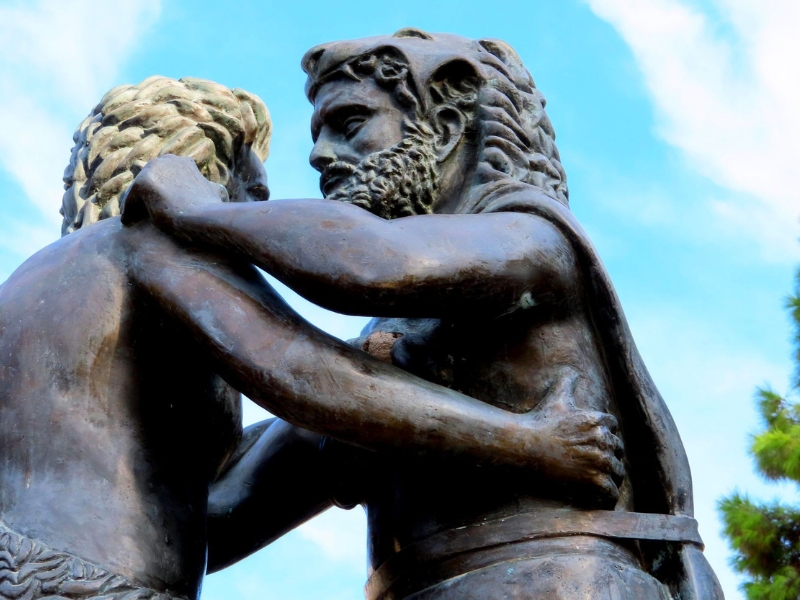
In the centre of Kos Town, a few minutes from the Ancient Agora, a modern sculpture shows two men locked in a wrestling hold: the hero Herakles and Antagoras, a strongman of ancient Kos. It recalls a local myth in which Herakles was shipwrecked on the island and had to fight his way out. The statue is a small stop, but it opens the door to one of the strangest stories in Greek mythology, and to the traces of Herakles that are still scattered around the town.
The Herakles and Antagoras statue at a glance
- Where: in Kos Town, a short walk from the Ancient Agora and the harbour.
- Created: in modern times, as a tribute to a myth told by ancient writers about Kos.
- What it is today: a public sculpture in an open square, which you can see at any time as you walk through the town.
- Time needed: 5 to 10 minutes for the statue, an hour or more if you combine it with the Ancient Agora and the harbour.
Herakles on Kos: the myth behind the statue
According to the Koan version of the myth, Herakles was sailing home after taking the girdle of the Amazon queen Hippolyta when a storm drove his ships onto the coast of Kos, near Cape Lakatera at today's Kardamena. Hungry, he and his companions went looking for food at a sheepfold belonging to Antagoras, a famous Koan athlete. A fight broke out, the Meropes, the islanders of the time, came to Antagoras' aid, and Herakles was forced to flee. To escape, he disguised himself in women's clothes; his men then regrouped and defeated the Meropes.
The story did not end with a quarrel. Still dressed as a woman, Herakles married Chalkiope, daughter of Eurypylos, the king of Kos. In Homer's Iliad, the ships from Kos and the neighbouring islands that sailed to Troy were led by Pheidippos and Antiphos, sons of Thessalos and grandsons of Herakles. In this way the islanders could claim the greatest of Greek heroes as an ancestor, and the wrestling match with Antagoras became part of Kos's own origin story.
What to look for
- The wrestling match: walk all the way round the statue; a group of two fighters like this is meant to be seen from every side.
- How to spot Herakles: in Greek art the hero usually carries a club and wears a lion skin, clues that help you recognise him in sculptures around town and in the archaeological museum.
- The lion skin in the Loggia mosque: part of the lion skin from a colossal ancient statue of Herakles, found near his sanctuary, is built into the wall of the Loggia mosque by the Plane Tree of Hippocrates.
- The Temple of Herakles: only the foundations and platform survive of this 2nd-century BC temple in Kos Town, a reminder that the hero was worshipped here long before the statue was made.
Grooms in women's clothes
The myth seems to explain an old custom. The Greek writer Plutarch, in his Greek Questions, says that on Kos the priest of Herakles at Antimacheia sacrificed wearing a woman's robe, and that bridegrooms put on women's clothing to receive their brides, in memory of Herakles' disguise. Whether the custom created the myth or the myth the custom, nobody can say, but it shows how seriously the islanders took their link with the hero.
Tips for your visit
- Come in the early morning or late afternoon: the light is softer, and in summer the middle of the day is very hot.
- Read the myth before you arrive, or tell it to children as you stand in front of the statue; it is much more fun with the story in mind.
- Use the statue as the start of a short Herakles trail: the Ancient Agora, the Loggia mosque and the Plane Tree of Hippocrates are all within walking distance.
- Finish at the harbour, where the cafés look out over the boats towards Nerantzia Castle.
Nearby
- Ancient Agora: the large excavated marketplace of ancient Kos, with columns, a stoa and temple foundations, a short walk away.
- Plane Tree of Hippocrates: the huge old plane tree where, according to tradition, Hippocrates taught his pupils; the Loggia mosque stands beside it.
- Nerantzia Castle: the castle of the Knights of St John at the entrance to the harbour, reached by a bridge over the old moat.
- Eleftherias Square: the main square of Kos Town, with the archaeological museum and the old covered market.
See Kos with World City Trail
Our Kos scavenger hunt turns the town into a game you play on your phone. The route takes around 2 hours, with about 33 minutes of walking, and includes places such as Nerantzia Castle and the Plane Tree of Hippocrates. You can play in English, German, French, Italian, Dutch or Greek.
If you prefer a different format, there is also a self-guided walking tour and an outdoor escape game in Kos.
Take the self-guided walking tour of Kos →
Play the outdoor escape game in Kos →
Facts checked in October 2026.