
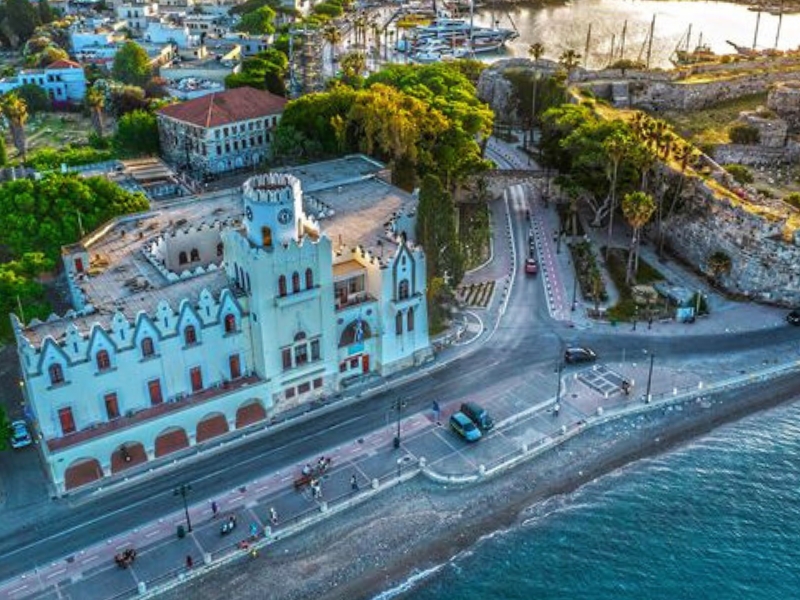
The Government House of Kos, known in Greek as the Dioikitirio and in Italian as the Palazzo del Governo, is the large Italian-era building on the harbour front of Kos town, right next to the Plane Tree of Hippocrates and the Castle of the Knights. Built when Kos was ruled by Italy, it still houses the island's courts and police, and above its entrance a Latin motto reminds everyone that "we are all servants of the law".
Government House at a glance
- Where: on the eastern seafront of Kos town, with its main entrance on Akti Miaouli and one side on the square of the Plane Tree of Hippocrates, next to Neratzia Castle.
- Built: designed in the mid-1920s and built between 1927 and about 1930, during the Italian rule of the Dodecanese.
- By: the Italian architect Florestano Di Fausto, who also designed major public buildings in Rhodes.
- What it is today: the seat of the courts and the police of Kos, so it is admired from outside rather than visited.
- Time needed: 10–15 minutes to walk around the façades, easily combined with the plane tree and the castle.
From Italian governor's seat to courthouse
Italy took the Dodecanese from the Ottoman Empire in 1912 and kept the islands until 1943. In the 1920s the new rulers gave Kos a set of official buildings meant to show Italian authority, and Florestano Di Fausto, the leading architect of the Italian Dodecanese, designed this one for the island's local administration. It is a three-storey building with a polygonal plan arranged around an inner courtyard and an eclectic mix of styles on its varied façades. During the Second World War its original dome was replaced by the clock tower you see today.
After Italy's surrender in 1943, German forces occupied Kos and used the building for their military services; from 1945 it was the seat of the British administration. On 31 March 1947, the day the British handed the Dodecanese over to Greek administration, it began its present role as the home of the island's courts and police station. The great earthquake of 1933, which destroyed much of old Kos town, led the Italians to replan the area around it, giving the harbour front much of its current look.
What to look for
- The clock tower rising above the roofline, a landmark from the harbour and the marina.
- The Latin inscription "Legum omnes servi sumus", "We are all servants of the law", a fitting motto for a courthouse.
- The coats of arms flanking the inscription and the pebbled steps at the entrance.
- The way the building wraps around its courtyard, with different façades facing the sea, the street and the plane tree square.
- An ancient-style marble sphinx near the entrance, a donation that adds a classical touch to the Italian architecture.
An island of layers
Few places show the layers of Kos history as compactly as this corner of town. Within a couple of minutes' walk you pass an ancient plane tree linked by tradition to Hippocrates, a fortress of the Knights of St John built with stones from older ruins, an Ottoman mosque and fountain, and this Italian government palace, all standing next to the excavated ancient city. The Government House is the most recent of these layers, and the only one still doing the job it was built for: governing, or at least judging.
Tips for your visit
- It is a working courthouse and police station: photograph the façades, but do not photograph people going in and out, and do not try to enter without business there.
- The best overall view is from the harbour side, where you can see the building with the castle walls beside it.
- Late afternoon light is kind to the façades, and the area is livelier in the evening.
- Combine it with the Plane Tree of Hippocrates and Neratzia Castle, both just steps away.
Nearby
- Plane Tree of Hippocrates: the huge old plane tree where, according to tradition, Hippocrates taught his pupils.
- Neratzia Castle: the 15th-century fortress of the Knights of St John guarding the harbour entrance.
- Gazi Hassan Pasha Mosque: the 18th-century Ottoman mosque on the plane tree square, also called the Loggia Mosque.
- Ancient Agora: the excavated centre of the ancient city, with columns and foundations a short walk inland.
See Kos with World City Trail
Our Kos scavenger hunt turns the old town into a game you play on your phone. The route takes around 2 hours, with about 33 minutes of walking. The Government House is not one of the stops, but the route includes Neratzia Castle and the Plane Tree of Hippocrates. You can play in English, German, French, Italian, Dutch and Greek.
If you prefer a different format, there is also a self-guided walking tour and an outdoor escape game in Kos.
Take the self-guided walking tour of Kos →
Play the outdoor escape game in Kos →
Facts checked in October 2026.