
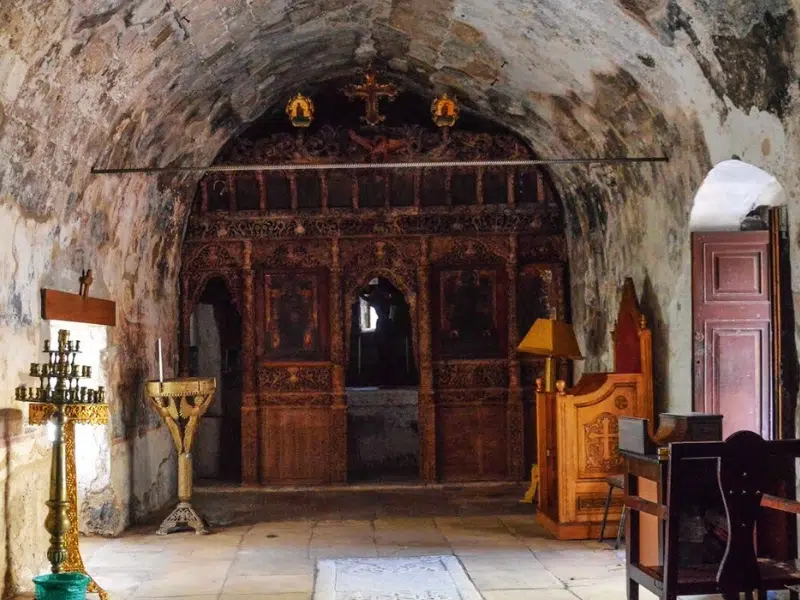
Panagia Gorgoepikoos (also spelled Gorgopikoou) is a small single-aisle church in the old walled part of Kos Town, built in the early 15th century as a cemetery church. It is easy to walk past, but inside are two layers of wall paintings from the 15th and early 16th centuries, including a family of donors dressed in Western fashion, a rare picture of Kos society under the Knights of St John.
Panagia Gorgoepikoos at a glance
- Where: Kos Town, within the area of the medieval walled town near the harbour.
- Built: early 15th century; wall paintings from the mid-15th and early 16th centuries, the wooden iconostasis from the 18th century.
- By: the later, early 16th-century paintings are attributed to the workshop of a painter called Nikolaos, which also decorated churches at Palaio Pyli on Kos and in the castle of Chora on Kalymnos.
- What it is today: a historic Orthodox church and a protected Byzantine monument.
- Time needed: 10–20 minutes if it is open; a few minutes to see the outside.
A cemetery church under the Knights
When this church was built, Kos was ruled by the Knights of St John (the Hospitallers), who held the island from the 14th century until the Ottoman conquest in the early 1520s. The Knights were Catholic, but most islanders remained Orthodox, and small churches like this one were built and paid for by local families. Panagia Gorgoepikoos began as a cemetery church. It is a simple building: a single nave under a pointed vault, a three-sided apse at the east end and two doors, on the south and the west. Look closely at the upper walls and the vault and you can spot reused ancient stones, a common practice on an island full of Greek and Roman ruins.
The church was painted twice: first in the mid-15th century and again in the early 16th century. The donor portraits show that its patrons were wealthy, and their Western-style clothes and hairstyles reflect the mixed Greek and Latin world of the Knights' Kos. The church stayed in use long after the Knights left. In the 18th century it received a carved iconostasis, and in the middle of the 19th century a gravestone was set into the floor of the nave for Hadji Constantinos Hadji Demetriou, a member of the first council of elders of Kos Town, appointed in 1843.
What to look for
- The apse: in the conch, the Deesis, Christ between the Virgin and St John the Baptist; below it the Communion of the Apostles; and at the bottom six bishops officiating.
- The Ascension painted in the vault over the sanctuary.
- Archangel Michael as the guide of souls, with a young donor kneeling at his feet.
- The Dormition of the Virgin, with the donor family beside it: father, mother and a teenage son. Scholars think the parents commissioned the paintings while praying for their son, who had probably died.
- St John the Theologian and St John Chrysostom, painted side by side as intercessors.
- The gravestone in the middle of the nave floor and the 18th-century iconostasis in front of the sanctuary.
What 'Gorgoepikoos' means
Gorgoepikoos is one of the titles of the Virgin Mary in the Orthodox Church. It means 'she who hears quickly', from the belief that the Virgin listens to the prayers of the faithful and answers without delay. Churches with the same dedication exist elsewhere in Greece, the best known being the small 12th-century church next to the cathedral in Athens. Related titles for the Virgin, such as 'swift source' and 'swift in action', express the same idea.
Tips for your visit
- Small Byzantine churches in Greece are often locked outside service times. If the door is closed, look at the outside and the reused stones in the walls, and try again on a Sunday morning or a feast day.
- Dress modestly if you go in: shoulders and knees covered. Photography of the wall paintings may not be allowed; ask before you take pictures.
- Bring a small torch or use your phone light only if allowed, and never touch the paintings: they are more than 500 years old.
Nearby
- Nerantzia Castle: the castle of the Knights of St John at the entrance to the harbour, with walls you can walk along.
- Plane Tree of Hippocrates: the huge old plane tree where, according to legend, Hippocrates taught his students; the present tree is much younger than the story.
- Ancient Agora: the large excavated area of the ancient city, uncovered after the earthquake of 1933, with columns, temples and the remains of a basilica.
- Eleftherias Square: the main square of Kos Town, with the Archaeological Museum and the Defterdar Mosque.
See Kos with World City Trail
Our Kos scavenger hunt turns Kos Town into a game you play on your phone. The route takes around 2 hours, with about 33 minutes of walking, and includes places such as Nerantzia Castle and the Plane Tree of Hippocrates. You can play in English, German, French, Italian, Dutch or Greek.
If you prefer a different format, there is also a self-guided walking tour and an outdoor escape game in Kos.
Take the self-guided walking tour of Kos →
Play the outdoor escape game in Kos →
Facts checked in October 2026.