
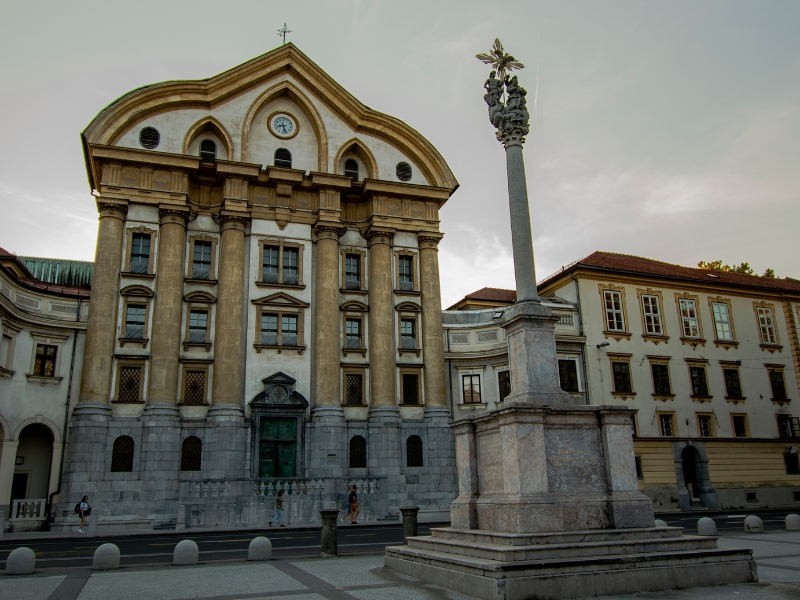
The Ursuline Church of the Holy Trinity stands on Slovenska cesta at the western edge of Congress Square, its curving white front facing the square and the park. Built in the 1720s, it is one of Ljubljana's finest Baroque churches, with a high altar of coloured African marble by Francesco Robba, the sculptor of the city's famous Robba Fountain.
The Ursuline Church at a glance
- Where: Slovenska cesta 21, on the west side of Congress Square (Kongresni trg) in central Ljubljana.
- Built: 1718–1726; the bell tower was rebuilt after the 1895 earthquake and the entrance stairway added in 1930–1931.
- By: the Friulian-born architect Carlo Martinuzzi; high altar by Francesco Robba; entrance stairs by Jože Plečnik.
- What it is today: a working parish church that belongs to the Ursuline convent, officially called Holy Trinity Church and known locally as the 'nun church'.
- Time needed: 15–20 minutes for the facade, the Trinity column and a look inside when it is open.
A merchant's gift and a Roman-style front
The church was paid for by Jakob Schell von Schellenburg, a wealthy merchant and financier, and his wife Ana Katarina, and built between 1718 and 1726 for the Ursuline nuns, whose convent still adjoins it. The architect, Carlo Martinuzzi, gave it a front that is unusual for Ljubljana: deeply modelled, with giant columns, slightly set back from the line of the street between two low curved wings, and topped by a gable inspired by the Roman architect Francesco Borromini.
Inside, the plain vaulted hall is not covered in frescoes like many Baroque churches, so the eye goes straight to Robba's marble high altar, completed in the 1740s. The 1895 earthquake destroyed the original bell tower, which was rebuilt soon after. In 1930–1931 the architect Jože Plečnik, who reshaped much of Ljubljana, added the balustraded stairway in front of the entrance. After Slovenia's independence the church appeared on the 10 tolar banknote, in use until the euro arrived in 2007.
What to look for
- The facade: giant three-quarter columns, a wall that steps in and out, and three pointed niches in the gable, often read as a reference to the Holy Trinity.
- Plečnik's stairway with its balustrade, a 20th-century addition that fits the Baroque front so well that many visitors take it for original.
- The Holy Trinity Column in front of the church, a Baroque column that Plečnik moved here in 1927 to line up with the church and the square.
- Robba's high altar of multicoloured African marble, with figures of Faith, Hope and Charity.
- The bare, white interior, which lets the architecture and the coloured marble stand out.
The column that moved
The Holy Trinity Column did not start here. A wooden column first stood in 1693 in front of a monastery in the Ajdovščina area and was replaced in stone in 1722. After repairs following the 1895 earthquake, Plečnik moved it to its present spot in 1927 as part of his redesign of Congress Square, lining it up with the church, the lamps of the square and the Philharmonic building. The original statues are kept by the City Museum of Ljubljana; the ones on the column are copies.
Tips for your visit
- This is an active convent church: visit outside service times, keep your voice down and dress respectfully.
- For the best photo of the facade and the column together, stand on the opposite side of Slovenska cesta, at the edge of Congress Square.
- The front faces east, so it is brightest in the morning sun; come early for photos.
- Combine it with a walk across Congress Square to the river and Prešeren Square, a few minutes away.
Nearby
- Congress Square and Zvezda Park: the square Plečnik redesigned, with the University of Ljubljana and the Slovenian Philharmonic on its edges.
- Nebotičnik: Ljubljana's 1930s 'skyscraper', a short walk north along Slovenska cesta.
- Prešeren Square and the Triple Bridge: the city's main meeting point by the Ljubljanica river, a few minutes' walk away.
- Franciscan Church of the Annunciation: the pink Baroque church on Prešeren Square.
See Ljubljana with World City Trail
Our Ljubljana scavenger hunt turns the old town into a game you play on your phone. The route links 10 stops and takes around 2 hours, with about 27 minutes of walking. The Ursuline Church is one of the stops, and so are the Dragon Bridge and the Franciscan Church.
For people who prefer a different format, there is also a self-guided walking tour and an outdoor escape game in Ljubljana.
Play the Ljubljana scavenger hunt →
Take the self-guided walking tour of Ljubljana →
Play the outdoor escape game in Ljubljana →
Facts checked in October 2026.