
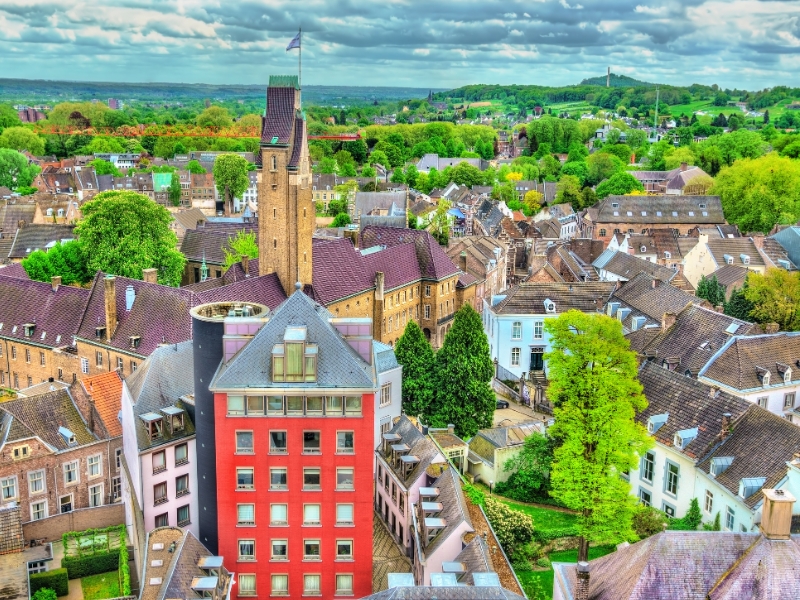
Maastricht lies on the Meuse in the far south of the Netherlands, closer to Liège and Aachen than to Amsterdam, and it shows: hearty Burgundian food, churches of yellow marl stone and a dialect of its own. The Romans founded it at a river crossing, and modern Europe signed its union here. Here are the facts and stories that make the city special.
10 fun facts about Maastricht
- Named after a river crossing: the name comes from the Latin Mosae Trajectum, the crossing of the Meuse, where the Romans built a bridge on one of their roads.
- The treaty that created the EU: the Maastricht Treaty was signed on 7 February 1992 in the provincial government building on the Meuse. It founded the European Union and paved the way for the euro.
- One of the oldest bridges in the Netherlands: the stone Sint Servaasbrug was built at the end of the 13th century and still carries pedestrians and cyclists across the Meuse.
- A bookshop in a church: the Dominicanen bookshop fills a 13th-century Dominican church. It opened as a bookshop in 2006 and regularly appears on lists of the world's most beautiful bookshops.
- A town hall by a Golden Age architect: the town hall on the Markt was designed by Pieter Post and built in the 1660s, and its tower holds a carillon.
- A saint from the fourth century: Saint Servatius, a bishop who died in 384, is buried in the crypt of the Basilica of Saint Servatius on the Vrijthof, one of the oldest churches in the Netherlands.
- The oldest surviving city gate in the country: the Helpoort, part of the first medieval walls, dates from 1229.
- A slice of geological time named after the city: the last stage of the Cretaceous period, just before the dinosaurs died out, is called the Maastrichtian, after the limestone layers of the nearby Sint-Pietersberg.
- Liberated early: American troops reached Maastricht in mid-September 1944, making it one of the first places in the Netherlands to be freed.
- An art fair for the world: TEFAF, one of the world's leading fairs for fine art and antiques, has been held in Maastricht every year since 1988.
The monster of the Meuse
In the 1770s, quarrymen working inside the Sint-Pietersberg found a huge fossil skull with rows of sharp teeth. A local surgeon and fossil collector, Hoffmann, studied it, but the canon Godding, who owned the land above the quarry, claimed it and won. When French revolutionary troops took Maastricht in 1794, they wanted the skull for Paris. Legend says they offered 600 bottles of wine to whoever found it for them. It was taken to Paris in 1795 and is still in the National Museum of Natural History there. The animal was later named Mosasaurus, the lizard of the Meuse: not a dinosaur but a giant sea reptile.
The caves under the Sint-Pietersberg
For centuries, people cut marl, a soft yellow limestone, out of the hill just south of the city, leaving a maze of thousands of passages. Much of old Maastricht is built from this stone. During the Second World War the tunnels served as a shelter, and Rembrandt's Night Watch was hidden in a specially built vault deep inside the hill. Walls covered in charcoal drawings and signatures from past centuries are still there.
What to eat in Maastricht
- Limburgse vlaai: a tart of yeast dough filled with fruit such as cherries or apricots, or with rice pudding. No celebration in the region is complete without it.
- Zuurvlees: a sweet-and-sour beef stew made with apple syrup and gingerbread, usually served with fries.
- Rommedoe: a soft, strong-smelling local cheese, eaten on rye bread with apple syrup.
- Limburg beer: local brewers such as Brand and Gulpener supply many of the city's cafés. Try one on a terrace on the Vrijthof.
Good to know before you go
- The tunnels of the Sint-Pietersberg can only be visited on a guided tour. It is cool inside all year, so bring a jacket.
- Carnival takes over the city for three days before Lent, with everyone in costume. If you plan to visit then, book your hotel well ahead.
- In summer, André Rieu, who lives in Maastricht, plays open-air concerts on the Vrijthof that bring big crowds to the centre.
- Liège, Aachen and Valkenburg are all easy day trips from Maastricht.
Explore Maastricht with World City Trail
Our Maastricht scavenger hunt turns these sights into a game you play on your phone. The route links 10 stops and takes around two hours, with about 36 minutes of walking. Stops include the Sint Servaasbrug, the Town Hall on the Markt and the Dominicanen bookshop.
At each stop you solve a puzzle and hear a short story, at your own pace. You can start whenever you like and play in English, German, French, Italian, Spanish or Dutch.
Play the Maastricht scavenger hunt →
Facts checked in October 2026.