
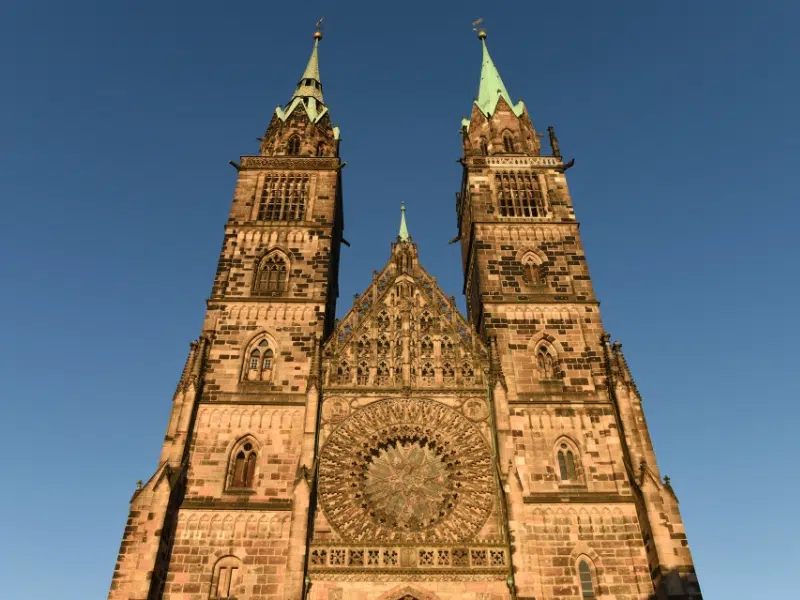
St. Lorenz (Lorenzkirche, St. Lawrence) is the large Gothic church with two pointed towers that closes off Königstraße in Nuremberg's old town, south of the river Pegnitz. It was the main parish church of the southern half of the medieval city, and it still holds the art its patrician families paid for before the Reformation. The best-known piece hangs in mid-air: Veit Stoss's carved Annunciation, suspended from the choir vault on a chain.
St. Lorenz at a glance
- Where: Lorenzer Platz, at the northern end of Königstraße in the Lorenz half of the old town, a few minutes' walk from the Hauptmarkt across the Pegnitz.
- Built: begun around 1250; the nave was finished by about 1400 and the late Gothic hall choir between 1439 and 1477.
- By: generations of Nuremberg masons; the hall choir was largely completed by Konrad Roriczer, with the vaults by Jakob Grimm.
- What it is today: a Lutheran parish church, open to visitors outside services, with towers 80 and 81 metres high and one of the largest church organs in the world.
- Time needed: 30–45 minutes for the interior.
From Catholic showpiece to Lutheran church
Building started around 1250 as a three-aisled basilica. The west front with its rose window followed in the 14th century, . From 1439 the old choir was replaced by a tall hall choir in late Gothic style, finished in 1477. The city council and patricians such as the Imhoff and Tucher families paid for its windows, altars and sculpture. In the mid-1520s Nuremberg became one of the first cities to adopt the Lutheran Reformation. St. Lorenz became Protestant, but the council and the donor families kept the Catholic-era art where it was instead of stripping the church.
In the Second World War the church was badly damaged in two nights of bombing; the roof and vaults were largely destroyed. Many works of art, among them the Annunciation, had been moved to Nuremberg's rock-cut art bunker, and Adam Kraft's tabernacle was protected inside the church. Rebuilding went quickly, and St. Lorenz was rededicated on 10 August 1952. The towers and west front are now being restored in stages, with work planned to run until around 2030, so expect some scaffolding.
What to look for
- The rose window: the round window above the west portal is about 9 metres across and dates from the 14th century. Step back across the square to see it framed between the two towers.
- The Angelic Salutation (Engelsgruß): Veit Stoss carved it in limewood in 1517–1518 for the merchant Anton Tucher. Life-size figures of Mary and the archangel Gabriel stand inside a wreath of roses set with small medallions of scenes from the lives of Mary and Christ, surrounded by little angels with bells and instruments. It hangs above the choir, so look up.
- Adam Kraft's tabernacle (Sakramentshaus): a stone tower of tracery and figures, about 19 metres high, made in 1493–1496 to a commission from Hans Imhoff. It climbs a pillar to the left of the high altar and curls over just below the vault.
- Adam Kraft himself: at the foot of the tabernacle a life-size figure of the sculptor kneels with tools in hand, holding up the structure together with two of his journeymen.
- The choir windows: late-medieval stained glass donated by Nuremberg's leading families, many with the donors' coats of arms at the bottom.
- The organ: the three-part instrument has around 12,000 pipes and 165 stops.
The cloth over the Annunciation
The Annunciation was not always on show. From 1519 it was covered with a green cloth and unveiled only on feast days, and after the Reformation it stopped being uncovered at all, partly because the preacher Andreas Osiander objected to the veneration of images. In 1817 the hemp rope that by then held it up broke, and the sculpture crashed to the floor; it was repaired and rehung.
Tips for your visit
- Come in the morning on a weekday, when the light through the choir windows is good and there are fewer groups. Sunday visiting time is shorter because of services.
- Walk to the back of the choir and look up at the Annunciation from behind the altar: from there you see the rosary medallions face-on.
- Respect services and concerts: during worship, visitors are asked to stay at the back or come back later.
- Combine the church with a walk north across the Museumsbrücke to the Hauptmarkt, or south down Königstraße to the Frauentor and the old city wall.
Nearby
- Tugendbrunnen (Fountain of the Virtues): the late-16th-century bronze fountain beside the church's north side, with figures of the virtues and Justice on top.
- Nassauer Haus: the medieval tower house on the corner of Lorenzer Platz and Karolinenstraße.
- Museumsbrücke: the bridge over the Pegnitz a few minutes' walk north, with the best view of the Heilig-Geist-Spital, the medieval hospital built over the river.
- Hauptmarkt and the Schöner Brunnen: the market square with the Frauenkirche and the gilded Gothic fountain, about five minutes' walk away.
See Nuremberg with World City Trail
Our Nuremberg scavenger hunt turns the old town into a game you play on your phone. The route links 10 stops and takes around 2 hours, with about 41 minutes of walking. St. Lorenz is one of the stops, along with the Frauentor and the Schöner Brunnen on the Hauptmarkt.
If you prefer a different format, there is also a self-guided walking tour and an outdoor escape game in Nuremberg.
Play the Nuremberg scavenger hunt →
Take the self-guided walking tour of Nuremberg →
Play the outdoor escape game in Nuremberg →
Facts checked in October 2026.