
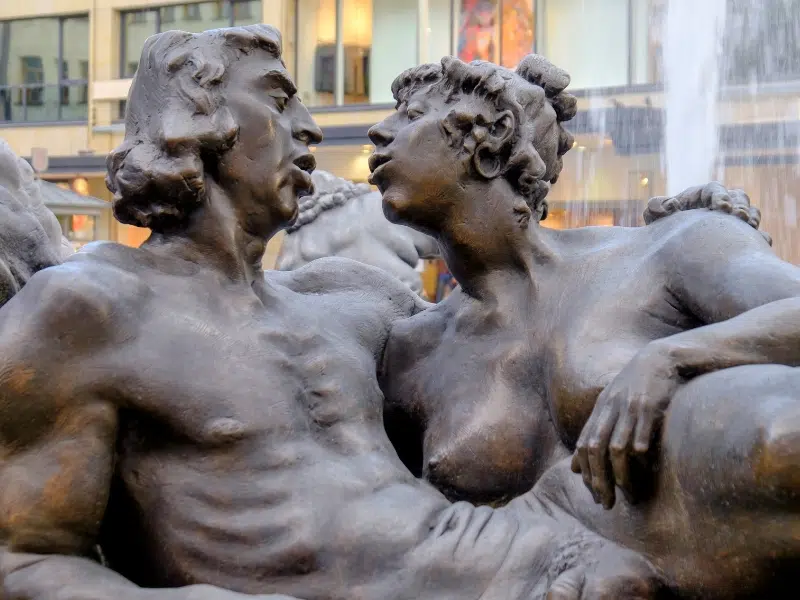
The Ehekarussell (Marriage Carousel) is a large bronze fountain at the foot of the Weißer Turm, a medieval tower on the western side of Nuremberg's old town. Its sculptor, Jürgen Weber, turned a poem written in 1541 by the Nuremberg shoemaker-poet Hans Sachs into a merry-go-round of married life, from first love to two skeletons still fighting. It has divided opinion since the day it was unveiled.
The Ehekarussell at a glance
- Where: Ludwigsplatz, on the east side of the Weißer Turm, directly above the Weißer Turm U-Bahn station.
- Created: commissioned in 1977 and completed in 1984.
- By: the sculptor Jürgen Weber.
- What it is today: a working fountain, one of the most talked-about pieces of public art in Nuremberg, and a cover for an underground ventilation shaft.
- Time needed: 15–20 minutes to walk round all six scenes.
From ventilation shaft to marriage carousel
The fountain began as a practical problem. When Nuremberg built its first U-Bahn line under Ludwigsplatz, a ventilation shaft about six metres across had to come up in the square. In 1977 the city asked Jürgen Weber to find an artistic way to hide it. He chose as his theme Hans Sachs's poem 'Das bittersüße eh'lich Leben' (The bittersweet married life) of 1541, which describes marriage as a mix of honey and gall. Weber laid it out as a carousel of six carriages, with no beginning and no end.
Making it was a huge job. Weber's plaster model was sawn into some 250 pieces, which were cast in bronze and then welded back together. The fountain was completed in 1984 and immediately caused controversy. Visitors complained about the nude figures, the bodies grown old and fat, and the bleak ending, and the debate has never quite stopped. Today it is one of the most photographed sights in the old town, and many visitors walk round it twice: once laughing, once a little uneasy.
What to look for
- Hans Sachs in the centre: the poet stands among the carriages, flanked by a goat and a fountain nymph, symbols of the love instinct.
- The swan carriage: a two-headed swan, a symbol of love, carries a young couple in love.
- The Venus shell: a naked young woman rises from a shell, serenaded by a musician.
- The pelican carriage: a pelican feeding its young stands for parental love.
- The darker carriages: a couple chained together in hatred amid hellfire, and a green-and-gold dragon carrying a dead, decaying couple who are still fighting. On one of the dragon's legs, an inscription about eternal marital strife refers to the reform of German divorce law that took effect on 1 July 1977.
- The marble heart: a red marble heart from Estremoz in Portugal is set into the pavement, engraved with the poem.
Who was Hans Sachs?
Hans Sachs (1494–1576) was a Nuremberg shoemaker and one of the best-known Meistersinger, the craftsmen-poets who wrote songs to strict rules. He wrote thousands of poems, songs and plays, many of them funny and down to earth, and he was an early supporter of Luther's Reformation. Richard Wagner made him the hero of his opera 'Die Meistersinger von Nürnberg'. His poem on marriage shows exactly the mix of humour and bluntness that Weber put into bronze.
Tips for your visit
- Walk all the way round before you decide what you think: the story only makes sense in sequence, from the swan to the dragon.
- Look down as well as up: the marble heart and many small details are at ground level.
- The water is usually turned off in the colder months, when the fountain looks starker but the figures are easier to see.
Nearby
- Weißer Turm: the tower that gives the square its name, a surviving gate tower from an older ring of the city walls.
- Elisabethkirche: the large domed church on Jakobsplatz, a couple of minutes' walk south.
- Henkersteg and Weinstadel: the covered Hangman's Bridge over the Pegnitz and the long half-timbered wine store beside it, a short walk north.
- St Lorenz: the great Gothic church with its twin towers, about 10 minutes' walk east along the shopping streets.
See Nuremberg with World City Trail
Our Nuremberg scavenger hunt turns the old town into a game you play on your phone. The route links 10 stops and takes around 2 hours, with about 41 minutes of walking. It includes the Frauentor, St Lorenz Church and the Schöner Brunnen on the Main Market.
If you prefer a different format, there is also a self-guided walking tour and an outdoor escape game in Nuremberg.
Play the Nuremberg scavenger hunt →
Take the self-guided walking tour of Nuremberg →
Play the outdoor escape game in Nuremberg →
Facts checked in October 2026.