
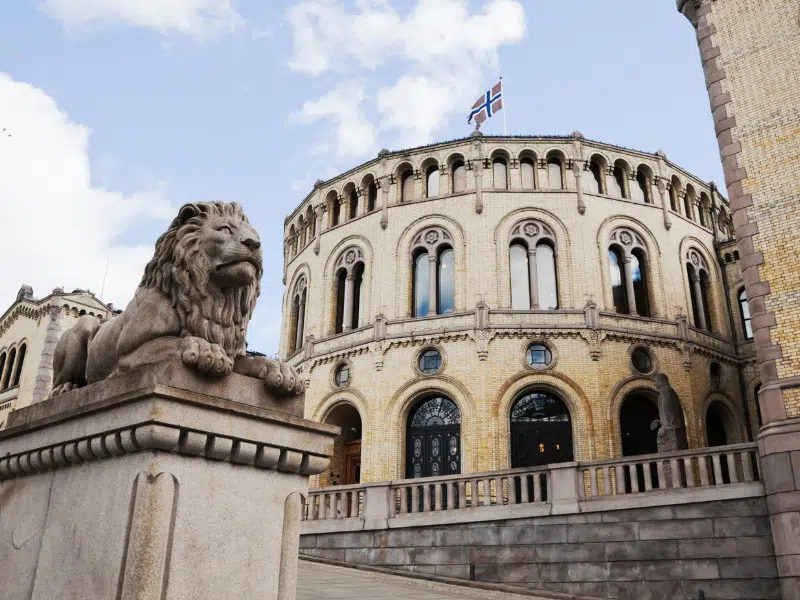
The Storting building on Karl Johans gate has been the home of Norway's parliament since 1866. The yellow brick building was designed by a Swede, Emil Victor Langlet, after the original competition winner was rejected for looking too much like a church. Two granite lions guard the ramps up to the entrance, which is why Norwegians call the slope Løvebakken, the Lions' Hill.
The Storting at a glance
- Where: on Karl Johans gate, Oslo's main street, between the Central Station and the Royal Palace, facing the Eidsvolls plass park.
- Built: 1860–1866; the cornerstone was laid on 10 October 1861 and parliament moved in on 5 March 1866.
- By: the Swedish architect Emil Victor Langlet.
- What it is today: the seat of the Storting, Norway's parliament of 169 members, elected every four years. Free guided tours are offered, mainly in summer.
- Time needed: 15 minutes outside; about an hour if you join a tour.
From borrowed rooms to Karl Johan
Norway's parliament first met in 1814 at Eidsvoll, in the private home of Carsten Anker, where the constitution was written. For the next fifty years it had no building of its own and met in borrowed premises in Christiania, as Oslo was then called, first in the cathedral school and from 1854 in the great hall of the university. A design competition in 1856 was won by Heinrich Ernst Schirmer and Wilhelm von Hanno, but the members turned their plan down because it looked too much like a church. On 18 May 1860 they chose Langlet's design instead, by 59 votes to 47. On 5 March 1866 the members walked in procession from their old rooms to the new building and celebrated that evening with turtle soup at the Hotel du Nord.
The building's darkest years came in the Second World War. German troops occupied it on 9 April 1940, and the next day Vidkun Quisling moved into the president's office. Later the Reichskommissar Josef Terboven ran the occupation from the building, and the great painting in the chamber was covered with curtains and a swastika. After liberation on 8 May 1945 the symbols came down quickly, and the first session of a free parliament was held on 14 June 1945. In the 1950s Nils Holter added a modern office wing at the back, which opened in 1956; the front has changed little since 1866.
What to look for
- The lions: put up in 1865, designed by the sculptor Christopher Borch and carved from Norwegian nordmarkite granite by prison inmates.
- The materials: yellow brick walls with details and a base of light grey granite.
- The arched entrances. According to the Storting, Langlet's arches were meant to invite people in from all sides, a symbol of democracy.
- On a tour: Oscar Wergeland's painting Eidsvold 1814, showing the constitutional assembly, which has hung behind the president's rostrum since 1885.
- Also inside: the chamber's red walls with gold trim. When the building opened, the chamber was white; it was repainted red in time for the session of January 1886.
Why it is called the Storting
The name means roughly 'the great thing', after the 'things', the assemblies of free men in old Norse society. A few habits set it apart from other parliaments. Members sit by county, not by party, so political opponents from the same region sit side by side. There are no snap elections: the constitution does not allow the Storting to be dissolved, so every parliament serves its full four years. And since the 2009 election it works as a single chamber, after the old division into Lagting and Odelsting was abolished.
Tips for your visit
- For the classic photo of the façade and the lions, stand in Eidsvolls plass across Karl Johans gate.
- Summer is the best time for a guided tour, which is free and open to everyone. Outside summer, tours are mostly for school groups.
- When parliament is sitting, you can watch from the public gallery; the entrance is from Karl Johans gate, and you go through a security check.
Nearby
- Oslo Cathedral: the city's main church, a few minutes' walk east, where Crown Prince Haakon married Mette-Marit in 2001.
- Karl Johans gate: walk up the street to the Royal Palace, passing the National Theatre and the old university buildings.
- Eidsvolls plass: the park right in front of the Storting, with a pond that becomes an outdoor skating rink in winter.
- Oslo City Hall: the twin-towered brick building on the harbour, a short walk south, where the Nobel Peace Prize is awarded every December.
See Oslo with World City Trail
Our Oslo scavenger hunt turns the city centre into a game you play on your phone. The route links 10 stops and takes around 3 hours, with about 60 minutes of walking. It includes the Tiger statue at Oslo Central Station and Oslo Cathedral.
If you prefer a different format, there is also a self-guided walking tour and an outdoor escape game in Oslo.
Play the Oslo scavenger hunt →
Take the self-guided walking tour of Oslo →
Play the outdoor escape game in Oslo →
Facts checked in October 2026.