What is the Oslo self-guided walking tour?
The Oslo self-guided walking tour is a walk you set the pace of yourself, with audio narration on your phone standing in for a guide. Allow roughly 3 hours: 60 minutes of that is walking, the route measures 4.7 km, and at 10 stops you stand still and listen. Nothing is timed, and there is no group to keep up with.
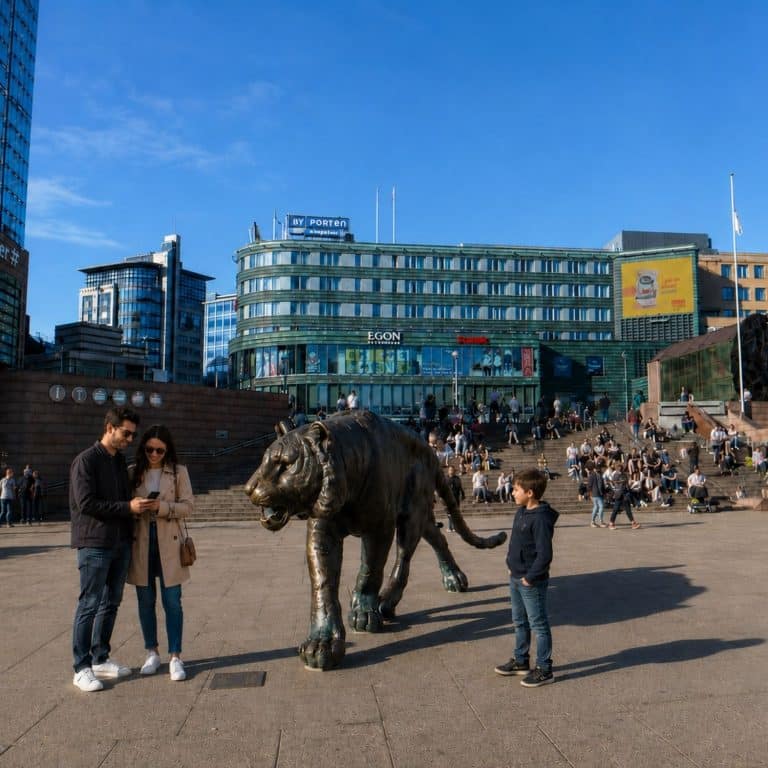
Outside the Central Station the narration begins with Elena Engelsen's bronze tiger, a present for Oslo's thousandth anniversary in 2000, and with the old nickname Tigerstaden, traced back to a poem by Bjørnstjerne Bjørnson. By the harbour you hear that the Nobel Peace Center was Oslo West railway station, built in 1872 and used by trains until 1989. Frogner Park closes with Gustav Vigeland's 212 sculptures and the 121 figures climbing his granite Monolith.
- Durationabout 3 hours
- Walkingabout 60 min · 4.7 km
- Stops10
- LanguagesEnglish, German, French, Italian, Spanish, Dutch
What you do on the walking tour
Listen
Every stop comes with the history of the place, its legends and the details you would otherwise walk past. The same text sits on screen for anyone who prefers reading.
Walk on
Google Maps points the way from stop to stop: 60 minutes on foot across 4.7 km, at the speed that suits you.
Stop a while
Sit down for a coffee or give an hour to a museum, then carry on with the walk, that day or another.
Eat and browse
Tips for places to eat and shops near the route come with the stops. Where you begin and the order you take them in are both yours to set in the app.
See the route and attractions →
How it works
- Book online Choose the number of people. Your booking reference arrives by email straight away.
- Get the app Download the World City Trail app from the App Store or Google Play and enter your booking reference.
- Walk when you like Start whenever you are ready, walk at your own pace and pause any time. No guide, no fixed schedule.
Who the walking tour is for
A first visit
One walk sorts out the centre, from the station to the palace, and explains what you are looking at.
Anyone who dislikes groups
No flag to follow and no meeting time: you stay where something holds you and move on when you feel like it.
A short stay
3 hours covers the centre, which leaves the rest of the day for the fjord, a museum or Bygdøy.
Good to know
- Bring a charged smartphone with mobile data; a power bank helps.
- No entry tickets needed: everything happens outside the buildings. Going inside is optional and paid separately.
- Family friendly; children must be accompanied by an adult.
- Not suitable for wheelchair users and difficult with strollers.
- Groups of up to 5 work best; larger groups split up, one ticket per person.
- Every purchase helps support stray cats and dogs in Greece.
The walk stop by stop: the Tiger, Karl Johans gate, City Hall, Frogner Park
10 stops · about 60 min walking · start: The Tiger (Tigeren) · finish: Frogner Park (Vigeland Park)
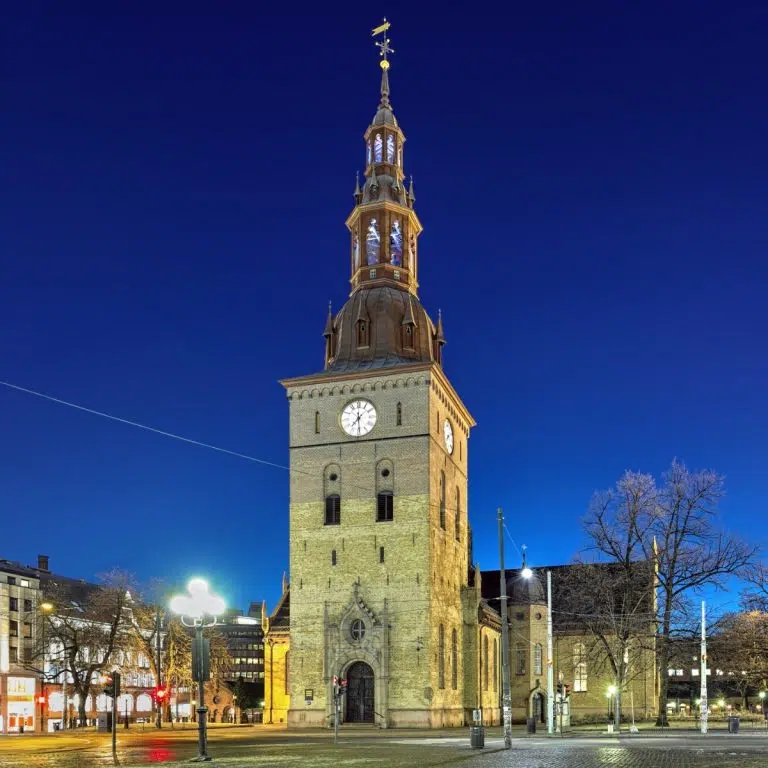
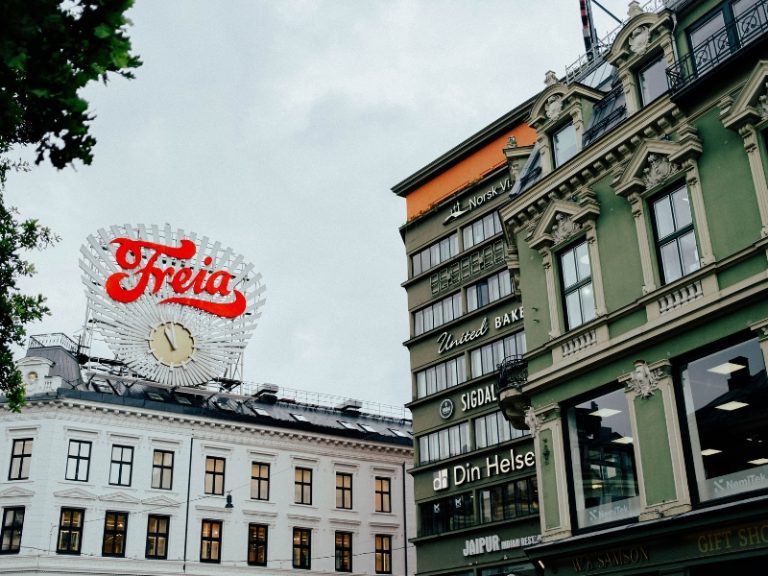
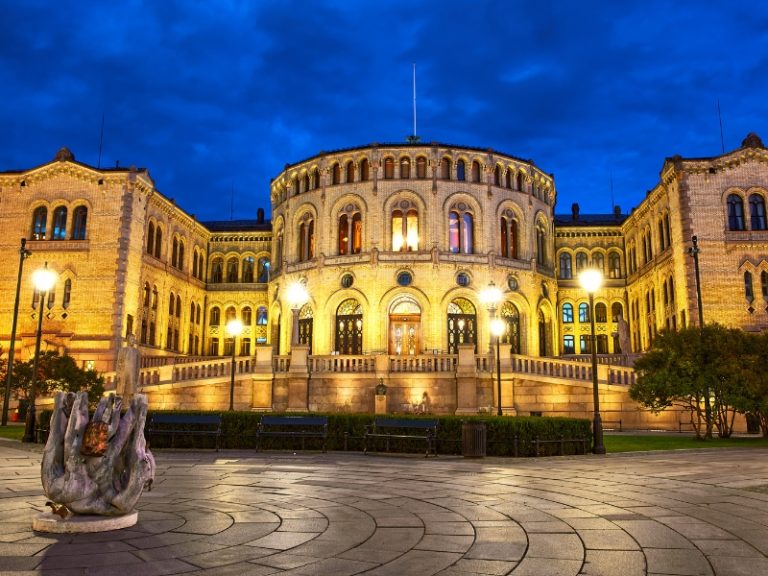
Jernbanetorget, the square in front of Oslo Central Station, holds the first stop: Engelsen's tiger. Karl Johans gate then carries you past Oslo Cathedral, the Freia clock at Egertorget and the Storting, before the route turns down to the harbour for Oslo City Hall and the Nobel Peace Center. From the National Theatre it goes on to the Royal Palace, west to Uranienborg Church, and the Vigeland sculptures in Frogner Park bring it to a close. The app lets you pick a different first stop or shuffle the order, and none needs a ticket.
Open the route map ↗
1The Tiger (Tigeren)Start
The Tiger is a bronze sculpture by Elena Engelsen on Jernbanetorget, the square in front of Oslo Central Station. About 4.5 metres long, it was given to the city for its 1000th anniversary in 2000 and refers to Oslo's old nickname, Tigerstaden (the Tiger City), which is traced back to a poem by Bjørnstjerne Bjørnson.
2Oslo Cathedral
Oslo Cathedral was consecrated in 1697, and the royal family and the government use it for their great public occasions: King Harald V and Queen Sonja married here in 1968. Look at the bronze west doors made by Dagfin Werenskiold in 1938; inside are Emanuel Vigeland's stained-glass windows and Hugo Lous Mohr's painted ceiling.
3Freiauret (Freia Clock)
Freiauret is the illuminated sign and clock of the Freia chocolate company, founded in Oslo in 1889, on a building at Egertorget where Karl Johans gate meets Øvre Slottsgate. The sign has changed over the years but has always stood in the same place, and the square below is a popular meeting point with street musicians.
Read the full story →
4Storting (Norwegian Parliament)
Norway's parliament meets in this building designed by the Swedish architect Emil Victor Langlet and taken into use in 1866. It is built of yellow brick on a base of light grey granite, and stone lions designed by Christopher Borch guard the sloping approach known as Løvebakken, the Lion Hill.
Read the full story →
5Oslo City Hall (Rådhuset)
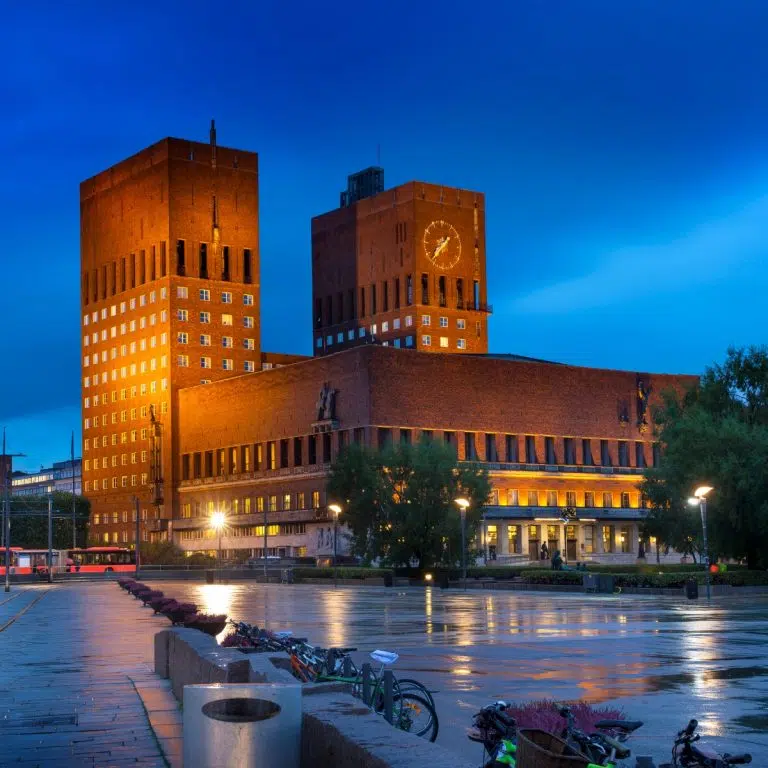
Oslo City Hall, designed by Arnstein Arneberg and Magnus Poulsson, was built between 1931 and 1950 and opened for the city's 900th anniversary. Its two brick towers rise 63 and 66 metres, and every year on 10 December the Nobel Peace Prize is presented in its main hall. Look for Dagfin Werenskiold's colourful reliefs of Norse myths in the courtyard.
6Nobel Peace Center
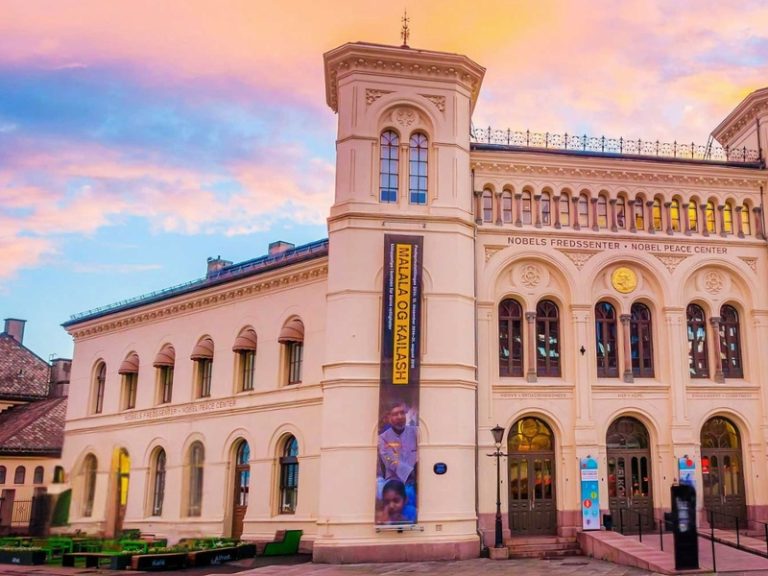
The Nobel Peace Center occupies the former Oslo West railway station, built in 1872 to designs by Georg Andreas Bull and used by trains until 1989. King Harald V opened the centre in 2005 as a showcase for the Nobel Peace Prize, its laureates and the ideals the prize stands for.
7National Theatre
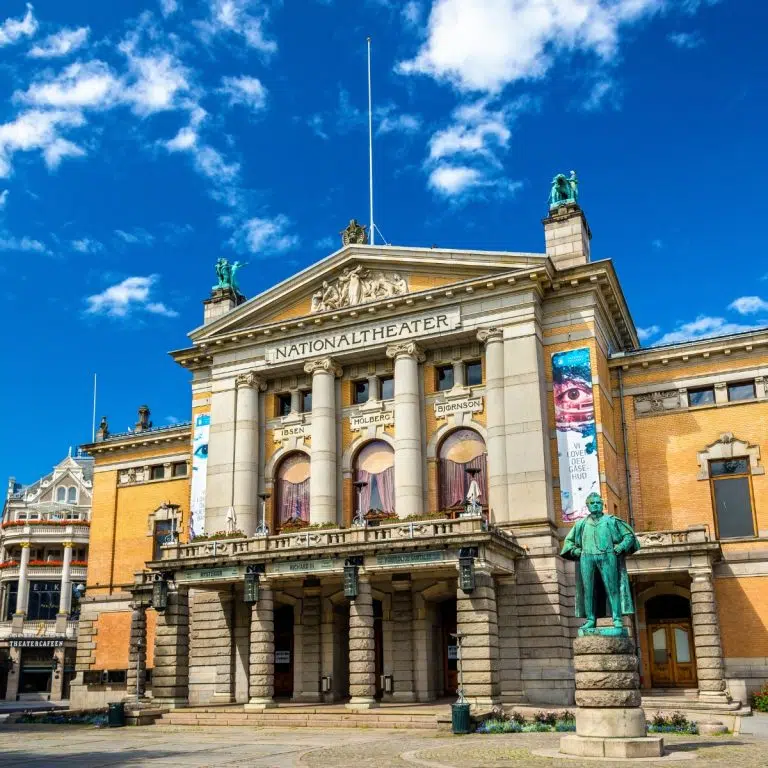
Norway's National Theatre, designed by Henrik Bull, gave its first performance on 1 September 1899. Most of Henrik Ibsen's plays have been staged here, and Stephan Sinding's statues of Ibsen and Bjørnstjerne Bjørnson have stood in front of the building since the year it opened.
8Royal Palace
The Royal Palace was commissioned by King Charles III John, who ruled Norway and Sweden, and designed by Hans Linstow; the foundation stone was laid in 1825 and the palace was completed in 1849. It has 173 rooms and stands in the public Palace Park, with Brynjulf Bergslien's equestrian statue of the king, finished in 1875, in front.
Read the full story →
9Uranienborg Church
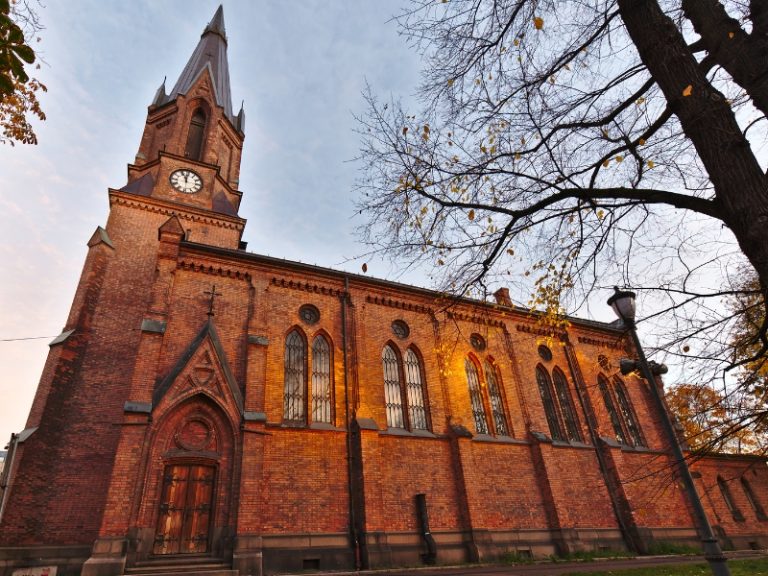
Uranienborg Church was designed in neo-Gothic style by Balthazar Lange, later Kristiania's city architect, and consecrated on 22 December 1886. The brick church stands beside Uranienborg Park behind the Royal Palace, and its stained-glass windows are the work of Emanuel Vigeland.
10Frogner Park (Vigeland Park)Finish
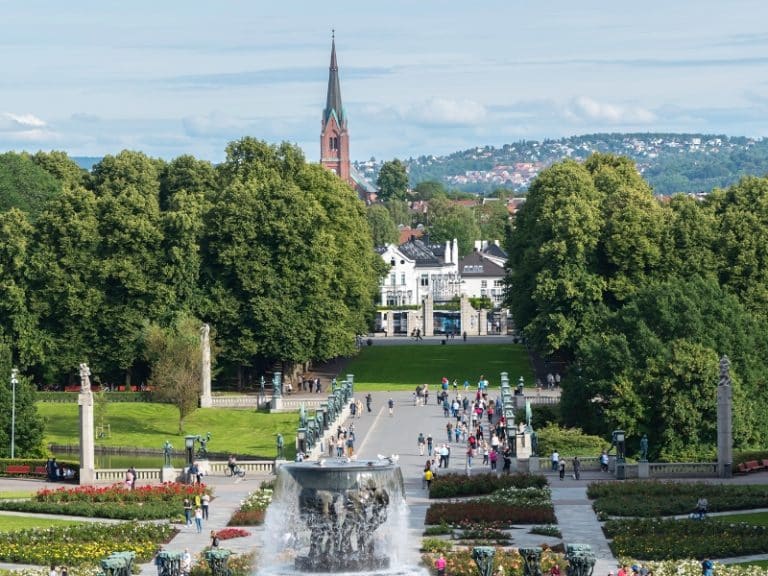
Frogner Park is home to the Vigeland installation, 212 bronze and granite sculptures all designed by Gustav Vigeland, who worked on it for about two decades. It culminates in the Monolith, a column about 14 metres high carved from a single block of granite, with 121 human figures climbing towards the top.
Only logged in customers who have purchased this product may leave a review.







Karolina– Australia –
Collected on GetYourGuide
Great guide for the highlights of Oslo. Enjoyed it a lot, and learned a lot!
Crystal– United States –
Collected on GetYourGuide
A wonderful self-guided tour we could do at our own leisure. It was as helpful to be able to pause and take in the views or grab a quick bite to eat or drink. It made it a more personal experience for my husband and I on our honeymoon. Thank you.
France –
Collected on GetYourGuide
C’est une excellente manière de découvrir la ville à son rythme et avec la langue qui nous intéresse car il y a très peu de personnes qui parlent français en Norvège…
Suzanne– Netherlands –
Collected on GetYourGuide
Lekker rondwandelen door de stad. Leuke bezienswaardigheden en wat info van de stad en plekken die je bezoekt.
Switzerland –
Collected on GetYourGuide
Spain –
Collected on GetYourGuide
Como no encontramos tours, hemos podido hacer una ruta bastante buena con la gu?a. Adem?s si tienes alg?n inconveniente te contestan s?per r?pido y son muy amables y est?n pendientes. En gral muy contenta.
United Kingdom –
Collected on GetYourGuide
Excellent, good value guide around Oslo with just enough information on the places of interest visited. It was useful that all the history and extra information could be viewed once the walk was finished. This helps if planning to return to any sites. Not for the faint hearted though: we walked 20000 steps! If it is the first time using these, be aware that you have to download the World Trail App to log in, not just the Get Your Guide. Will definitely look out for these in other cities we visit.