
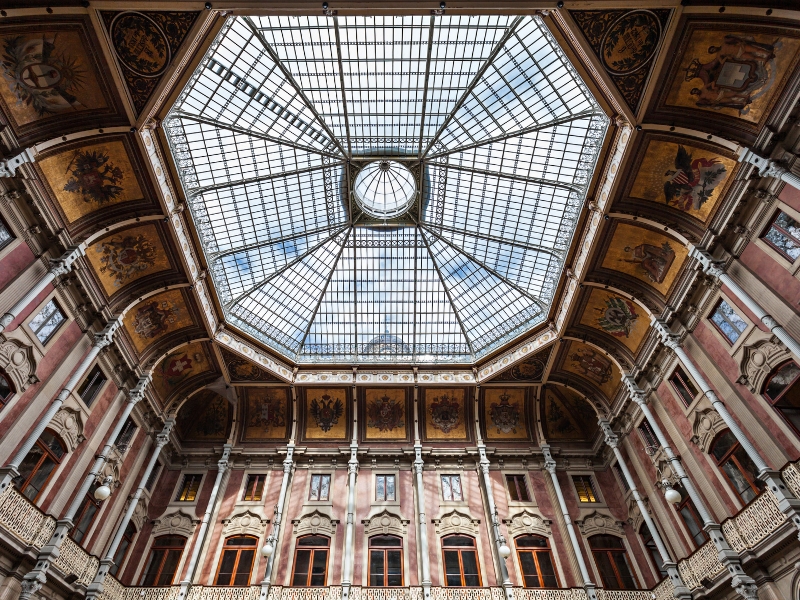
The Palácio da Bolsa, Porto's Stock Exchange Palace, is the 19th-century headquarters of the city's Commercial Association, standing on Praça do Infante D. Henrique just above the Ribeira waterfront. Its plain Neoclassical front hides some of the most lavish interiors in Portugal, above all the Arab Room, a hall of gilded Moorish-style plaster where the city receives heads of state.
Palácio da Bolsa at a glance
- Where: Praça do Infante D. Henrique in the Ribeira district, next to the church of São Francisco.
- Built: from 1842; the main structure was finished by 1850, the interior decoration only in 1910.
- By: architect Joaquim da Costa Lima Júnior, with later work by Gonçalves e Sousa, Tomás Soler and others.
- What it is today: the seat of Porto's Commercial Association, a National Monument since 1982, open for guided visits and used for events.
- Time needed: the guided tour takes about 30 minutes; allow a little extra to look at the square and the façade.
Built on the ruins of a convent
The palace stands on the site of the cloisters of the Franciscan convent next door. In 1832, during the civil war between liberals and absolutists, a fire destroyed the cloisters but spared the church. At the time Porto's merchants had no proper exchange and were meeting in the open air on Rua dos Ingleses, so in 1841 Queen Maria II gave them the ruins to build a home for their Commercial Association. Work began in October 1842 to plans by the Porto architect Joaquim da Costa Lima Júnior, who chose a sober Neoclassical style influenced by Palladio and by earlier English-inspired buildings in the city.
The shell of the building was standing by 1850, but decorating the interior took another sixty years and a whole generation of Portuguese artists. Gonçalves e Sousa designed the grand staircase and the Arab Room, Tomás Soler the iron and glass dome over the central courtyard, and painters and sculptors such as Veloso Salgado, Marques de Oliveira, Soares dos Reis and Teixeira Lopes filled the rooms with allegories and busts. The last rooms were completed in 1910. Merchants no longer trade shares here, but the Commercial Association still has its seat in the palace.
What to look for
- The Courtyard of Nations, under an octagonal dome of iron and glass, with the painted coats of arms of the countries that traded with Portugal in the 19th century.
- The noble staircase of 1868, in granite and marble, with busts by Soares dos Reis and Teixeira Lopes and a painted ceiling by António Ramalho.
- The Arab Room, built between 1862 and 1880, where every surface is covered in gilded stucco and Arabic-style inscriptions.
- The Tribunal Room, once used to settle commercial disputes, and the Portrait Room with a richly carved table that took its maker, Zeferino José Pinto, about three years.
- Outside, the restrained granite façade facing the square and the statue of Prince Henry the Navigator in the garden in front.
The Arab Room
The palace's showpiece took almost two decades to finish. Inspired by the Alhambra in Granada and by the fashion for Moorish Revival styles in 19th-century Europe, the oval hall is wrapped in gold and colour, with stucco inscriptions running around the walls and ceiling. It was designed to impress, and it still does: the city uses it as the reception room when heads of state and other important guests visit Porto, and concerts are sometimes held here.
Tips for your visit
- The interior can only be seen on a guided tour, offered in Portuguese, English, Spanish and French; buy your ticket at the palace, where you also choose the time and language.
- Arrive early in the day in summer: tours fill up, and same-day slots can run out.
- Photograph the façade from the garden of Praça do Infante, ideally in the soft morning light.
- Combine the visit with the church of São Francisco next door and a walk down to the Ribeira riverfront.
Nearby
- Church of São Francisco: a Gothic church with an astonishing gilded Baroque interior, right next door.
- Casa do Infante: the medieval building where, by tradition, Prince Henry the Navigator was born, now a museum, a few minutes' walk.
- Ribeira waterfront: the colourful riverside quarter with views of the Dom Luís I bridge, a few minutes downhill.
- Mercado Ferreira Borges: the red iron market hall from the 19th century on the edge of the square, now used for events.
See Porto with World City Trail
Our Porto scavenger hunt turns the old town into a game you play on your phone. The route links 10 stops and takes around 2 hours, with about 34 minutes of walking. It includes São Bento station and the Clérigos Tower, and at each stop you solve a puzzle and hear a story about the city. You can play in English, German, French, Italian, Spanish, Dutch or Portuguese.
If you prefer a different format, there is also a self-guided walking tour of Porto and an outdoor escape game.
Play the Porto scavenger hunt →
Take the self-guided walking tour of Porto →
Play the outdoor escape game in Porto →
Facts checked in October 2026.