
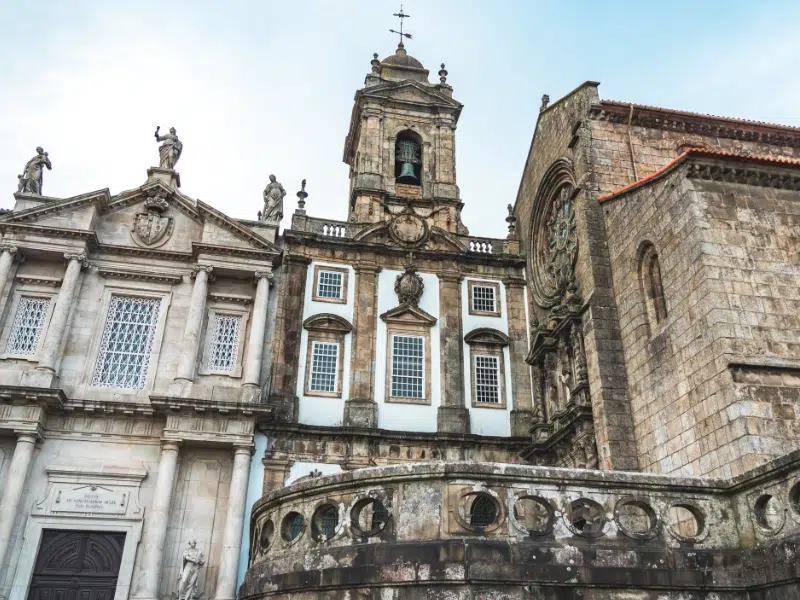
The Church of São Francisco is the Gothic church above Porto's Ribeira district, right beside the Palácio da Bolsa. From outside it looks plain and grey. Inside, almost every surface, from the columns and arches to the altars, is covered in Baroque gilded woodcarving, the Portuguese talha dourada, which is why it is often called Porto's golden church.
The Church of São Francisco at a glance
- Where: Rua do Infante Dom Henrique, at the top of the Ribeira district next to the Palácio da Bolsa, in Porto's UNESCO-listed historic centre.
- Built: begun in 1383 and finished around 1425; the gilded interior dates mostly from the first half of the 18th century.
- What it is today: the most prominent Gothic monument in Porto, visited together with the neighbouring Church of the Third Order of St Francis, its Casa do Despacho and the catacombs as the Igrejas e Museu de São Francisco.
- Time needed: about an hour for the church, the Casa do Despacho and the catacombs.
A plain Gothic church dressed in gold
The Franciscans settled in Porto in the early 13th century and began a first, small church here around 1244. In 1383, under the patronage of King Ferdinand I, work started on a larger church, finished around 1425 in the plain style typical of the mendicant orders in Portugal. Around 1534 the Carneiro family added a chapel of St John the Baptist in the Manueline style, designed by Diogo de Castilho.
The big change came in the first half of the 18th century, when several Portuguese carvers covered most of the interior in gilded woodwork. Next door, the lay Third Order of St Francis built its own church and, from 1747, its Casa do Despacho, a Baroque meeting house with catacombs below. During the siege of Porto in 1832–33, in the civil war between Liberals and Absolutists, fire destroyed the friars' old cloister. The city's Commercial Association later built the Palácio da Bolsa, its stock exchange, on the site.
What to look for
- The rose window: the large Gothic rose window on the main facade, the only original decoration on the outside.
- The west portal: a Baroque doorway with twisted Solomonic columns and a statue of St Francis.
- The Tree of Jesse on the north aisle: a carved and painted family tree of Christ, made between 1718 and 1721 by Filipe da Silva and António Gomes, with twelve kings of Judah on its branches.
- The oldest statue: a painted 13th-century granite figure of St Francis near the entrance, a survivor from the first church, now set in a Baroque altarpiece.
- The Session Room of the Casa do Despacho: an octagonal coffered ceiling with gilded carving and portraits of the Order's benefactors.
The catacombs
Below the Casa do Despacho lie the catacombs where the Third Order buried its members and benefactors from 1749 to 1866. The white-walled galleries are lined with numbered stone tombs and have their own Baroque altar. In one room, a glass panel in the floor shows the ossuary underneath, which holds the bones of thousands of people moved there from the vaults. It is a short visit, but a striking contrast to the gold upstairs.
Tips for your visit
- Visit the church, the Casa do Despacho and the catacombs together: they share one entrance and are meant to be seen as a set.
- The church is dim inside; give your eyes a minute to adjust before you start looking at the details.
- Photography rules inside the church can be strict, so check the signs at the entrance before you take your phone out.
- Combine the visit with the Palácio da Bolsa next door, then walk down to the river at Ribeira.
Nearby
- Palácio da Bolsa: the 19th-century stock exchange built on the site of the old cloister, known for its ornate Arab Room; visits are by guided tour.
- Ribeira: the riverside square and quay at the foot of the hill, a few minutes' walk downhill.
- Luís I Bridge: the double-deck iron bridge from 1886 that links Porto with Vila Nova de Gaia and its port wine cellars.
- Mercado Ferreira Borges: the red iron market hall from the 1880s close by, now used for events.
See Porto with World City Trail
Our Porto scavenger hunt turns the old town into a game you play on your phone. The route links 10 stops and takes around 2 hours, with about 34 minutes of walking. It includes São Bento station and the Clérigos Tower. You can play in English, German, French, Italian, Spanish, Dutch or Portuguese.
If you prefer a different format, there is also a self-guided walking tour and an outdoor escape game in Porto.
Play the Porto scavenger hunt →
Take the self-guided walking tour of Porto →
Play the outdoor escape game in Porto →
Facts checked in October 2026.