
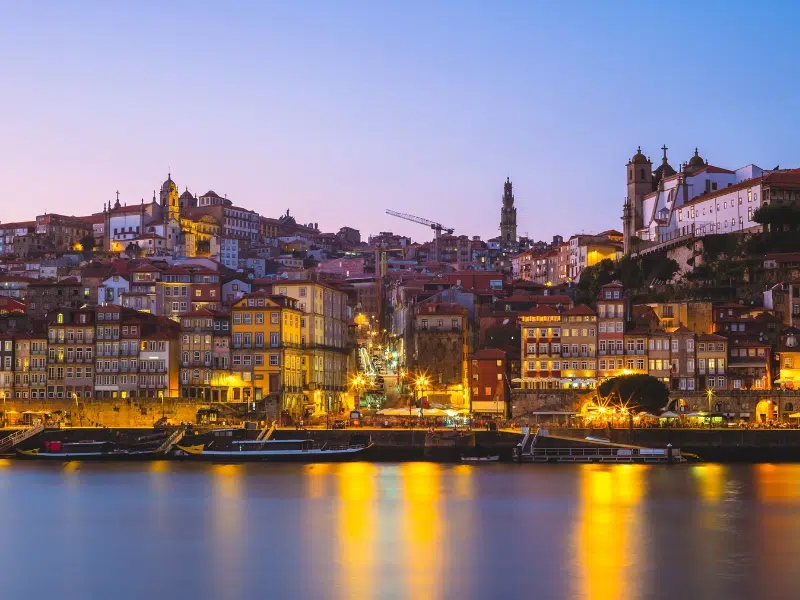
Praça da Ribeira is the old riverside square of Porto, opening straight onto the Douro below the steep streets of the historic centre. For centuries it was closed off from the water by the medieval city wall, and only when the wall came down in 1821 did the square get its famous view of the river and the Luís I Bridge. In the middle, a modern bronze cube sits on top of a 17th-century fountain.
Ribeira Square at a glance
- Where: on the north bank of the Douro, at the bottom of Rua de São João, in Porto's UNESCO-listed historic centre.
- Built: a medieval square already mentioned in royal letters of 1389; reshaped in 1776–1782 and opened to the river in 1821.
- By: the 18th-century redesign is credited to John Whitehead, the British consul in Porto, under the city's governor João de Almada e Melo.
- What it is today: a pedestrian square lined with cafés and restaurants, and the starting point for walks along the Cais da Ribeira quay.
- Time needed: 20–30 minutes, longer if you stop for a drink by the river.
From fish stalls to a river view
The Ribeira district grew up along the Douro as Porto's busiest trading quarter, and from the Middle Ages its square was full of stalls selling fish, bread and meat. When the new city wall was finished around 1370, it cut the square off from the river; boats and goods passed through the Porta da Ribeira, a gate at its south-eastern corner. A big fire in 1491 destroyed the surrounding houses, which were rebuilt with arcades on the ground floor, and the square was paved with stone slabs.
In the 18th century João de Almada e Melo wanted goods and people to move faster between the river and the upper town. He opened Rua de São João and had the square remodelled from 1776, following a plan credited to John Whitehead: arcaded buildings were to close the sides, with a monumental fountain on the north. Only the north and west fronts were completed, and on the east side medieval houses survive to this day. In 1821 the wall along the river was demolished, and the square finally faced the Douro.
What to look for
- The Cubo da Ribeira: a modern bronze cube by the sculptor José Rodrigues, set on top of a 17th-century fountain that archaeologists uncovered in the centre of the square in the 1980s.
- The St John fountain: the three-storey fountain on the north side, built in the 1780s and topped with the Portuguese royal coat of arms.
- St John the Baptist: the statue in the fountain's niche by João Cutileiro, unveiled on 24 June 2000, the feast of Porto's patron saint.
- The arcades: the ground-floor arches on the west side, part of the 18th-century plan.
- The tall, narrow houses on the east side: survivors of the medieval square, with brightly painted and tiled facades.
St John's night in the Ribeira
Every year on the night of 23 to 24 June, Porto celebrates São João, its biggest festival. The streets down to the Ribeira fill with people, grilled sardines and music, and the riverfront is one of the most crowded places in the city that night. It is fitting that the statue in the square's fountain shows St John the Baptist, unveiled on his feast day.
Tips for your visit
- Come in the late afternoon or evening, when the light falls on the coloured houses of the riverfront and on the bridge.
- For the classic view of the square and the river, cross the lower deck of the Luís I Bridge and look back from the Gaia side.
- Watch your step on the slippery cobblestones and the quay edge, especially after rain.
Nearby
- Luís I Bridge: the double-deck iron bridge of 1886, whose lower deck starts a few minutes' walk upstream along the quay.
- Casa do Infante: the medieval customs house, traditionally said to be the birthplace of Prince Henry the Navigator, a short walk west.
- Palácio da Bolsa and São Francisco Church: Porto's 19th-century stock exchange and a Gothic church with a gilded Baroque interior, side by side above the quay.
- Cais da Ribeira: the riverside quay where boats leave for cruises under Porto's bridges.
See Porto with World City Trail
Our Porto scavenger hunt turns the old town into a game you play on your phone. The route links 10 stops and takes around 2 hours, with about 34 minutes of walking. It includes São Bento station and the Clérigos Tower. You can play in English, German, French, Italian, Spanish, Dutch and Portuguese.
If you prefer a different format, there is also a self-guided walking tour and an outdoor escape game in Porto.
Play the Porto scavenger hunt →
Take the self-guided walking tour of Porto →
Play the outdoor escape game in Porto →
Facts checked in October 2026.