
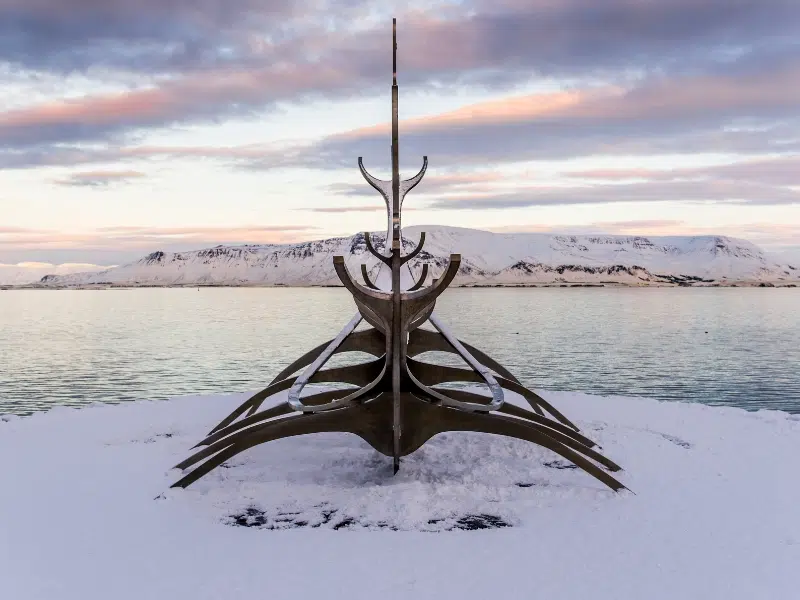
The Sun Voyager (Sólfar) is a stainless-steel sculpture of a ship's skeleton on the seafront path along Sæbraut in Reykjavík, with the bay and Mount Esja behind it. Most visitors take it for a Viking longship, but its creator, Jón Gunnar Árnason, called it a dreamboat and an ode to the sun. He died in 1989, a year before it was unveiled.
The Sun Voyager at a glance
- Where: on a small headland beside the shore path on Sæbraut, on the northern edge of central Reykjavík, between Harpa concert hall and Höfði House.
- Unveiled: 18 August 1990, Reykjavík's birthday.
- By: the Icelandic sculptor Jón Gunnar Árnason (1931–1989).
- What it is today: one of the most photographed sights in Reykjavík, a free open-air sculpture you can see at any hour.
- Time needed: 10–15 minutes, longer if you walk the shore path or wait for the light.
A competition, a model and a farewell
In 1986 Reykjavík celebrated 200 years since it was granted its town charter in 1786. For the anniversary, the residents' association of the western part of the city funded a competition for a new sculpture, and Jón Gunnar Árnason won with a small aluminium model of a ship. The model, less than a metre long, was handed to the city to be enlarged to full size in stainless steel.
Árnason, born in Reykjavík in 1931, was already ill with leukaemia, and he died in April 1989, before the full-size Sun Voyager was finished. It was unveiled on 18 August 1990 on Sæbraut. Árnason himself had pictured it elsewhere: on Landakot hill or near the harbour, facing west towards the setting sun. Its place by the sea, looking out over the bay to the mountains, has made it one of the city's best-known images.
What to look for
- The shape: a slim hull of polished steel with a pointed bow and stern and a row of long, thin oars or ribs, more like a drawing of a boat than a model of a real one.
- The base: the sculpture rests on a circle of granite slabs, which works as a small platform for viewing and photos.
- The reflections: the polished steel picks up the colour of the sky, so the sculpture looks different at sunrise, at midday and in the long summer evenings.
- The view: across the bay to Mount Esja, the long, flat-topped mountain that dominates Reykjavík's skyline and changes colour with the light and the seasons.
- The setting: Harpa's glass façade is visible along the shore in one direction, the open bay in the other.
Why it is not a Viking ship
Because Iceland was settled by Norse seafarers, many people assume the Sun Voyager is a Viking longship. Árnason saw it differently. He described it as a dreamboat and an ode to the sun, a vessel carrying the promise of undiscovered territory and a dream of hope, progress and freedom. Since he died before it was unveiled, some people also read it as a boat carrying souls on their last journey, but that is an interpretation, not something the artist said.
Tips for your visit
- Go early in the morning or late in the evening for softer light and fewer people. In summer the sun sets late and the evening light over the bay lasts for hours.
- Please do not climb on the sculpture; step back onto the shore path or the grass for a wider shot with Esja behind it.
- Sæbraut is a busy road: cross at the pedestrian crossings and then walk along the seaside path.
- Dress for wind: the headland is exposed, and it can feel much colder here than in the streets a few blocks inland.
Nearby
- Harpa: the concert hall and conference centre that opened in 2011 on the harbour, with a glass façade designed with the artist Olafur Eliasson; you can walk in and look around the foyers.
- Höfði House: the white wooden house further east along the shore where Ronald Reagan and Mikhail Gorbachev met for their 1986 summit.
- Hallgrímskirkja: the tall concrete church on the hill above the centre, with a lift to the top of its tower for a view over the city.
- Laugavegur: the main shopping street, running parallel to the shore a few blocks inland.
See Reykjavík with World City Trail
Our Reykjavík scavenger hunt turns the old town into a game you play on your phone. The route links 10 stops and takes around 2 hours, with about 41 minutes of walking. It includes Hallgrímskirkja, the church that towers over the city centre.
If you prefer a different format, there is also a self-guided walking tour and an outdoor escape game in Reykjavík.
Play the Reykjavík scavenger hunt →
Take the self-guided walking tour of Reykjavík →
Play the outdoor escape game in Reykjavík →
Facts checked in October 2026.